
BY: JAMES F. O’NEIL
Looking out from my vacation cottage porch (at 8:20 a.m.), I could see across the small lake–and could see the red lights flashing, the stopped yellow school bus, and three or four little children climbing the steps into the bus.
When I first saw what was happening, the pseudo-Latin poem popped into my head. It always seems to happen that way, as my mind drifts at the word “buses” (or the less prevalent “busses”):
O Sybilli, si ergo,
Fortibus es in ero.
O nobili, demis trux:
Sevatis enim? Causen dux!
O see Billy, See ‘er go!
Forty buses in a row.
O no, Billy, dem is trucks.
See what is in ‘em? Cows an’ Ducks!
It makes no sense in Latin. Just some silliness from high school that has been etched into my memory, and consciousness.
“O Sibili si ergo, fortibuses in ero. Nobili demis trux: sewatis enim? Cowsendux!”
School buses. In a row.
 Row of Buses…
What is there about a yellow bus, flashing red lights, children entering/exiting a school bus? And, What is “school bus yellow”?
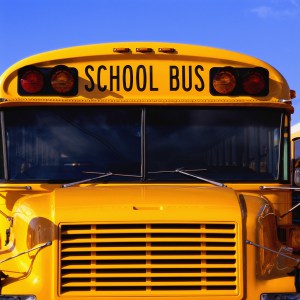 School Bus (Front View)
“Yellow was adopted as a standard color for North American school buses beginning in 1939, the adoption of a standard shade of paint. The color, which became known as “school bus yellow,” was selected because black lettering on that specific hue was easiest to see in the semi-darkness of early morning and late afternoon. Today the color is known as “National School Bus Glossy Yellow.” [Wikipedia]
When I was growing up in Chicago, I never rode a school bus. In the City, my sister, one smaller brother, and I walked to grammar school–six or eight city blocks.
My transportation to high school (a private Catholic school) was the CTA: Chicago Transit Authority.
CTA by Sullivan
I rode a city bus from 55th and Halstead to 63rd, then transferred for a long ride on the “L” (The Chicago ‘L’: sometimes written as “L” or “el,” short for “elevated.”), behind apartments’ back stairs or fire escapes–landings leading to second- and third-floor porches filled with toys and old ice boxes, or “stuff.” Past the buildings, then down, through and under downtown Chicago as the “L” went “subway.” I exited at Chicago and State streets, and walked a few blocks to school. For four years, I followed these routes, carrying a book bag. Neither snow nor rain nor heat nor gloom of early winter night prevented me from completion of my high school diploma.
 CTA EL
However, no school bus experience.
During graduate schooling in Minnesota, my taking courses in school administration, I learned about transporting students, planning bus routes, buying and selling of buses, transportation obligations of school boards, and school bus safety.
My own kids first rode school buses where I became high school principal. Here I was better educated about snow days, closing school early because of storms coming, and athletes traveling on buses to their events.
But it was in the southwest outback of the state, when I served as school superintendent from 1976-1980, that I became most knowledgeable in school bus “stuff.”
(In 1980, there were six major school bus body manufacturers producing full-size school buses in North America: Blue Bird Body Company; Carpenter Body Works; Superior Coach Company; Thomas Built Buses, Inc.; Wayne Corporation; and Ward Body Works. Today only three exist: Thomas, IC [Integrated Coach], and Blue Bird. [Wikipedia])
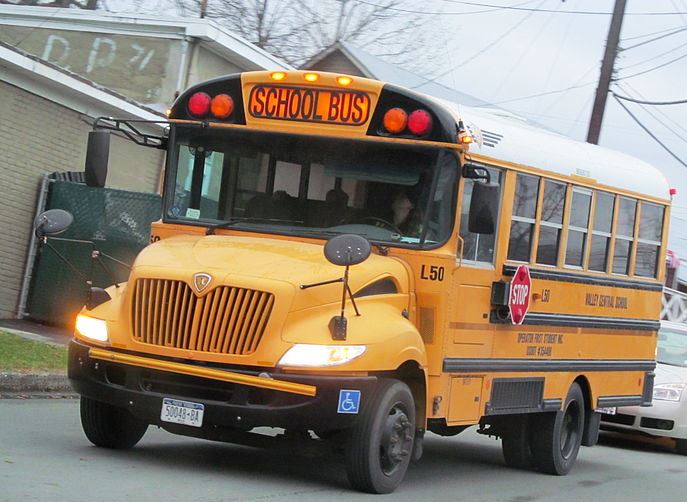 IC Integrated Coach Bus
Those four years have allowed memories to come to mind when I do see a school bus (or “busses”) on the road or street or highway. Most memories are good and pleasant.
Nervousness on my part came during bus inspection done by the Highway Patrol. The drivers and I awaited the results. I was ultimately accountable for the buses. I made sure the drivers took good care of their buses, knew their routes and their riders, and had me along sometimes as a rider so I could know as much as I could about the driving process.
Winter brought most activity with the drivers and me. I was responsible for school closings. I had to know the weather from one end of the district to another. I drove the school car in early morning “to check the roads.” I was in contact with neighboring school administrators and radio stations to help me make a decision.
And athletic events being cancelled and rescheduled? Could the buses travel safely? Sometimes there were tense times, awaiting the arrival of a bus of cheerleaders and athletes after a night game during the winter season. Even though the buses returned safely, but very late, the roads and heavy snow kept the students in town for an overnight at designated homes.
Yet I DO remember riding a bus route, with the snow plowed and moved so that it WAS over the height of the bus! High flags on every bus so they could be seen. Exciting!
![[Colorado] Snow Drift by dailycamera. com](https://memoriesofatime.blog/wp-content/uploads/2014/09/snow-drift-dailycamera-com.jpg)
[Colorado] Snow Drift by dailycamera. com
In spring, creeks rose and bridges sagged. I had to determine weights of gasoline, buses-over-bridges routes, and re-routing students to long driveways or distant farm homes.
Then the buying and bidding process, almost like expecting a baby: Who has the bid? Who will provide the chassis, and the body? Such a small district with six or seven buses, yet the bidding process was the same in all districts, whether buying one bus or three or more. (I made sure the buses were painted with high numbers so observers might consider our district larger than it was. Fun.)
I even drove a school bus! On US Highway 71, I steered the bus to another town, to have new tires installed. I was told that superintendents had emergency powers, allowing them to drive buses. (I never did check into that….) But what a time I had at the wheel of a Blue Bird Bus with a Chevrolet engine, or my favorite Thomas with an International Harvester powertrain. (IH was an early manufacturer of medium/heavy duty trucks. Although based upon truck chassis, IH also became the leading manufacturer of the chassis portion of body-on-chassis conventional [type C] school buses. Wikipedia)
Yet of all those memories of a time in Minnesota, a high point had to be the personal tour of the Blue Bird bus factory, then in Mount Pleasant, Iowa [1962-2002]. While on the way to a Florida vacation, we made a special arranged visit. We saw the assembly line, and how it worked. We watched the uniting of body with chassis. We walked inside an incomplete body, with bundles of wires and harnesses being installed. Ladies were working in the factory, sitting at large sewing machines, making covers for the bus seats.
I never knew before then how all the parts came together, to become a unified bus, to be delivered to a school district, the result of a bidding process that I had come to know and was part of.
So. One can see this story isn’t about an exciting Lamborghini,

Lamborghini by UK Telegraph
or a Lear jet, or even about the building of a John Deere tractor.

John Deere Tractor by Restoration Project
It’s simply about a school bus. Or riding a school bus. Simple.
Yet I am certain that any reader who was a rider is now filled with School Bus Yellow Memories.
© James F. O’Neil 2014

BLUE BIRD BUS by purplewave. com





 Memories of a Time