Archive

EVENTS

BY: JAMES F. O’NEIL

I never had a BB gun. But I did have a six-shooter cap gun.

cap gun broken gene autry by junkables comBroken Gene Autry by junkables

The very first time I shot it, or tried to use it, with the caps in a circle of six, I pulled the trigger. The hammer hit the cap. A loud sound I had never experienced before, never felt. A shock to my system. I dropped the gun. It hit the concreted sidewalk in front of my grandma’s house. It broke: six or more pieces, I am sure: spring, barrel, cylinder, and “pearl” handle–all lying there. Of course, what I did next was predictable: I began crying (something often done during my young age). Looking around, I did not see any king’s horses nor all the king’s men–just the ghost of Ralphie.

ralphie shot Ralphie after Christmas

I picked up the pieces myself, and then ran into my grandma’s house, hoping for the working of a piece-by-piece miracle. There was my grandpa, The Jack of All Trades. Showing him…tears…. His verdict: “Irreparable damage.”

I do not remember my next cap gun. That memory is gone, locked away somewhere. But I know I had at least one or two more cap guns.

In my Chicago neighborhood, we did not play cops-and-robbers. We did not play cowboys-and-Indians. We played for serious: We played war. In fact, a friend of my dad’s gave me authentic-looking replicas, full size, of a Tommy gun and–yes!–a .50 caliber machine gun, complete with tripod mount, all painted in a dark grey.

I was king of the mountain. Most Popular Re-Enactor, Most Popular Shooter, on the block. I should have gotten an award for my status.  I am now remembering Tom Cruise playing Ron Kovic’s childhood during a summer in Massapequa, New York. He plays war in the woods, the child war in Born on the Fourth of July.
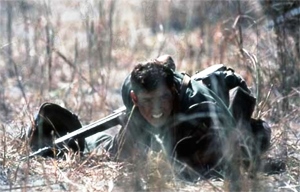
born on the fourth by wideangle-closeupTom Cruise as Ron Kovic.   Credit: wideangle-closeup

“No more guns,” Mom said.

And I put away the things of a child, and became involved in other activities, No more running, hiding behind bushes, setting up the gun with a buddy, getting killed– and no more skinned knees.

Until…1988, no longer a child, when the boy-toys grew “adult,” big-people toys. The toys were now weapons. I bought a .22 pistol.

ruger stainless 22 by icollectorRuger Government Model .22 Bull Barrel Stainless

I had learned not to drop guns, but had learned to shoot, for real, within an orange grove. I became a pretty good shooter, with a good history, with the .22, and then with a real 1911 Government Model .45, even entering shooting contests. Target practice, then local matches. Guns and Ammo was my new bible. I was hooked.

Until my eyes and vision got bad. Even new glasses did not allow me to see well a 50-yard target.

So that was the end of my “professional-amateur” shooting days.

Yet guns came and went: rifles, revolvers, automatic pistols. I still had fun at the gun range: shooting was a sport that I enjoyed. However, it all became very expensive. Ammunition became costly; range fees increased–or some ranges even closed. I was less and less on the range. Moreover, other challenges had presented themselves to me, not whole-man targets at 25 yards, but rather stained glass craft, and collecting diecast airplanes. There was no longer any time for guns.

The End.

Until recently, when I attended a large gun show. Once inside the large civic center, among hundreds of buyers and sellers of merchandise and shooting supplies, I had those good-old feelings coming back to me. It had been a long time since I had handled guns (handling glass cutters and soldering tools had taken over all my free time). I wanted to feel it all over. My friend Burt and I made our way from table to table, touchy-feely, triggers and barrels and handles. “Ah, this fits my hand perfectly,” I said, gripping a .45 with a price tag of $4,300! So smooth. “Smooth.”

45 auto ed brown kobra carry by gunsinternational $2400

Moving along, we came upon a dealer of air power guns, CO2, and mechanical, BB guns, and plastic-soft BB’s.

“You’ll shoot your eye out, kid!”

Really. I needed one of these. I could shoot in the house (gasp!) and in the yard.  “I choose this one.”

softy-gun .45My Softy .45

This was still my favorite model of all the many I have bought and sold.

And not to forget the plastic BB’s.gun BBs“Soft” BB’s

Imagine: “5,000 for $10,” the dealer said. “Of course,” I responded.

“I’m baaack!” I told my friend.

At his home, I said we had to try it out, in his yard. What fun it was.

“You’ll shoot your eye out, kid!”

Most assuredly possible: I read from the warning label: “DO NOT SHOOT AT HUMANS OR ANIMALS.” But I had to learn how much it might hurt.

My bruise was much better after three weeks…. On my right calf, where I told my son to shoot me. The plastic BB hit, and instant sting. Then instant–really instant–blood mark where the BB broke the skin, with some small bleeding. By night, the bruise was the size of a quarter, with puffiness and swelling.

“You’ll shoot your eye out, kid!”

Once again, I have a child-guy-toy. This time I will not drop it. No tears. Though maybe, after I made myself a guinea pig. From a yard away. “Pop!” Then,

“OUCH!”

© James F. O’Neil 2015

Here is what I remember learning about words (with the help of S. I. Hayakawa):

THE WORD IS NOT THE THING.

PEOPLE HAVE MEANINGS FOR WORDS.

CONTEXT DETERMINES MEANING.


Pastrami_grinder_(2012)heroes wear dog tagsdewalt angle grinder

hush puppies chukka boots800px-Pierre-Auguste_Renoir,_Le_Moulin_de_la_GaletteLGBT colorshush puppies by pillsbury


BY: JAMES F. O’NEIL

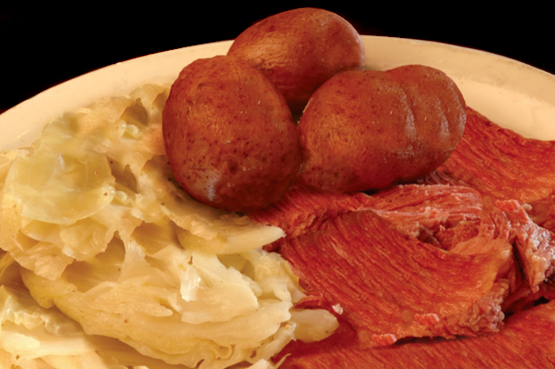
Corned Beef? “In the United States and Canada, consumption of corned beef is often associated with Saint Patrick’s Day. Corned beef is not considered an Irish national dish; the connection with Saint Patrick’s Day specifically originates as part of Irish-American culture, and is often part of their celebrations in North America.

“Corned beef was used as a substitute for bacon by Irish-American immigrants in the late 19th century. Corned beef and cabbage is the Irish-American variant of the Irish dish of bacon and cabbage. A similar dish is the New England boiled dinner, consisting of corned beef, cabbage, and root vegetables such as carrots, turnips, and potatoes, which is popular in New England and parts of Atlantic Canada.” [Wikipedia]

Cornedbeef WIKIPEDIAYummy Corned Beef and Cabbage Dinner

Since I could ever remember, we had corned beef and cabbage for St. Patrick’s Day. The Irish Catholic Feast Day of St. Patrick was almost a Holy Day of Obligation: Attend church under pain of mortal sin. Well, it wasn’t really such a day; but it was a day off from school, it meant a Chicago parade, and it meant the Italians in my neighborhood had to wait two more days to get even with us by brandishing St. Joseph’s Day–and by having local processions and festivities.

[Saint Joseph’s Day, March 19, the Feast of St. Joseph is in Western Christianity the principal feast day of Saint Joseph, husband of the Blessed Virgin Mary. But the Feast of St. Joseph the Worker on 1 May was created in order to coincide with the celebration of International Labor Day (May Day) in many countries.]

St Joseph IN GLASS  st aphonsus church wexford, PASaint Joseph in Glass

Saint Alphonsus Church

Wexford, PA

He was the stepfather to Jesus; St. Patrick only drove out snakes from Ireland….

However, more people in America ate turkey at Thanksgiving time than they ate ham. And more people in American ate corned beef at St. Patrick’s Day-time than they ate Italian sausage and peppers (though I cannot “prove” this allegation by me)!

Well, corned beef, cabbage, potatoes, and carrots had been the steady diet of my O’Neil family since I became part of the O’Neil/O’Neill Clan. So my wife and I have continued to carry on our clannish traditions with our own family on that Special Day of 17 March.

170px-Irish_cloverLuck of the Irish Shamrock

Note: In October 1884, a convention held by the Federation of Organized Trades and Labor Unions unanimously set May 1, 1886, as the date by which the eight-hour workday would become standard. As the chosen date approached, U.S. labor unions prepared for a general strike in support of the eight-hour day. On Saturday, May 1, thousands of workers went on strike and rallies were held throughout the United States, with the cry, “Eight-hour day with no cut in pay.” In Chicago, the movement’s center, an estimated 30,000-to-40,000 workers had gone on strike. What then occurred is the Chicago Haymarket Affair. “No single event has influenced the history of labor in Illinois, the United States, and even the world, more than the Haymarket Affair,” with its rally and riot and trial and executions. “What began as a rally on May 4, 1886, the consequences are still being felt today. Very few American history textbooks present the event accurately or point out its significance,” according to labor studies professor William J. Adelman. [Wikipedia]

So, the Haymarket Affair is generally considered significant as the origin of international May Day observances for workers, Catholics and Communists alike.

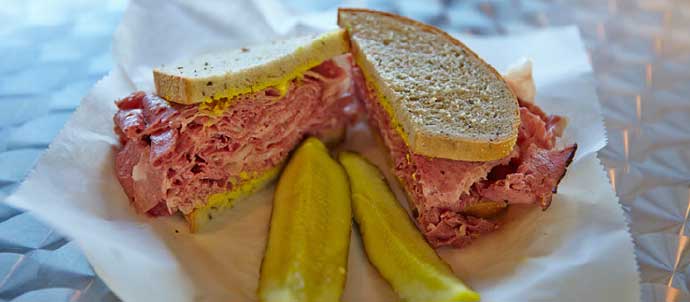
Thus ends the history lesson relating Saint Patrick, Saint Joseph, The Haymarket Riot, May Day celebrations, the eight-hour work day, and corned beef and cabbage. Now about those Reuben sandwiches….

sandwich-corned-beef by kaufmans deli skokie ILCorned Beef on Rye by Kaufman’s Deli

Skokie, IL

© James F. O’Neil 2015


BY: JAMES F. O’NEIL

“Glorious, Joyful, Sorrowful; Glorious, Joyful, Sorrowful; Glorious.” Sunday, Monday, Tuesday; Wednesday, Thursday, Friday; Saturday. The week of the rosary, as I remember it (and before some changes made in 2002): My liturgical week began on Sunday and ended on Saturday. Within each of the “mysteries” of the rosary is the subdivision of five, and…, and…, and . . . :

Glorious Mysteries: Resurrection, Ascension, Assumption…. Joyful Mysteries: Annunciation, Visitation, Nativity…. Sorrowful Mysteries: Agony, Scourging, Crowning, Carrying, Crucifixion–as some readers will remember them.

The complexity of the religion of the rosary I had to learn early on, as an up-and-coming Roman Catholic boy. And so it goes–or went.

All of this complexity came to mind recently as I tried to organize the top drawer of my dresser: My Sock Drawer.

The drawer was a mess: things everywhere, in addition to matched and unmatched pairs of socks (a pair of socks; pairs of socks) and those lost in the jumble and tumble, without a “mate.”

As I began to try to bring order to the chaos, I noted my small pile of keys and key rings in the left-front corner. Unknown keys for unknown locks. The keys are just “there.” Receipts. And more receipts, where I neatly stack them in the right-front corner: gasoline, Walgreen’s drugs, Target, Wal-Mart, miscellaneous.

Whistles, some non-USA-In-God-We-Trust coins thrown in the back left corner; an assortment of various business cards: clinic physicians, library; Kermit Weeks, “Fantasy of Flight: An Attraction of a Higher Plane” (closed for now); “Honorary Consul of the Slovak Republic–Florida” (!); lawyers’ cards. That’s the place where I keep them.

I found under the socks–after I emptied out the drawer–a package of postcards: 37 1-cent and 15 2-cent (a total of 67 cents. Easy math). I probably bought these at a garage sale. 

Handkerchiefs, in the left corner, were overlaying the keys. Monogramed, old-white, linen, camouflage. Those extras, ready for a right-rear pocket of slacks or jeans or wash pants. (“A gentleman always carries a handkerchief,” I was taught. [Somewhere, stapled or pasted in one of my old journals, is one such handkerchief, neatly folded, pressed between the pages, with stains of mascara. A handkerchief used by the first co-ed ever who was brought to tears, in my college office, “way-back-when-in-the-day.” I cannot remember what made her cry. I cannot remember the reason for her tears. I am sure it had nothing to do with me.])

And, finally, the rosary I found, in the left-back corner.

rosary in crystalRosary Found, with Crystal Beads

Crystal beads, sterling cross and medal. My mom’s rosary that I’ve had for some five years since her passing on. Now I have cleaned it and polished it. And there it rests.

Still, not the rosary itself but the “links” which came out of this rosary-discovery brought more memories: recalling catechism classes, using the rosary with all its intricacies of prayer methods, and having sore knees in chapel during rosary-recitation time.

However, one anecdote figures prominently above all others I associate with the rosary. No, not prayer-beaded mantras, like “pray for us sinners” or “blessed be the fruit of thy womb.” (Explain that one to a first-grade boy!) But, rather, it is hearing Sister Mary Philip, RSM, telling me one morning to see her after lunch. “I need you to see my sister.”

I was to become a mule, a runner (“Slang: a person paid to carry or transport contraband, especially drugs, for a smuggler.”).

Somehow, for some reason unknown to me, Sister Mary (always add the “Mary” out of respect) Philip, RSM, singled me out from my other 8th grade classmates to do “The Deed.” I was a purveyor of goods, the middleman. My reward (now, not in some afterlife) was delight and jubilation. I would miss an afternoon of classwork. Did nothing of note happen after lunch? History? Art? Music? Reading? Ah, that’s it: Silent reading. I could run errands during Silent Reading, for I was a good reader. I could miss school.

Approaching her desk, I was told to get my coat. She gave me a piece of paper with some directions, a small change purse, and, as she adjusted her Religious-Sister-of-Mercy habit, told me to be on my way. “Godspeed,” or something like that.

sisters-of-mercySister of Mercy, RSM

I had a duty; I was on a mission: to conduct an errand, leaving and returning by the end of the school day. Off I went . . . with no food or snack, no backpack, just directions and a change purse with money for the Chicago transit system, the CTA.

There I was, making my way then to the “L,” exiting at the 47th Street stop (a few stops before Sox Park-Comiskey Park).

47thSign47th Street “L” Sign

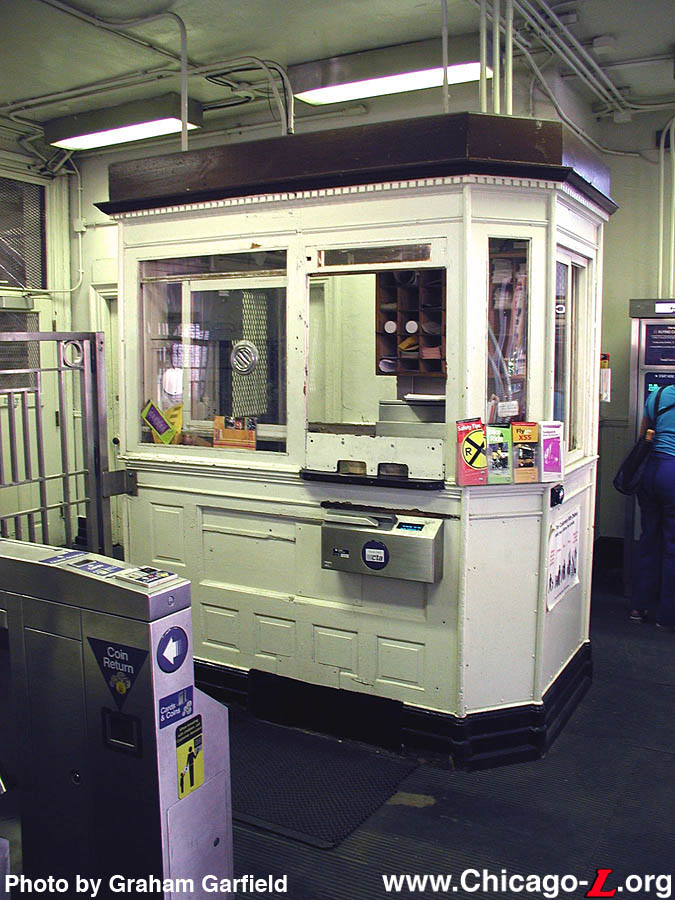
From the “L” platform, I went down the stairs to the ticket booth/fare collector’s station.

OLYMPUS DIGITAL CAMERAFare Collector Booth from Chicago “L”.org

There sat Sister Mary Philip’s sister. Only for the first time, I told her I was there for the package. She gave me a little paper bag, and a candy bar. With the package and CTA transfer in hand, I was on my way back to my school.

Often I made the trip, sometimes twice a month, receiving the goods: hand-assembled homemade rosaries. Colored beads, black beads, crystal beads; large and small silver crucifixes–all carefully wrapped, such beautiful work, as my 8th grade teacher would show me at my return.

I walked back to my desk, my classmates wondering where I had been.

“My Life with the Rosary” is certainly interesting for me, with so many memories of a time when…. I doubt any others can relate such a story (except, perhaps, those who followed after me in Sister Mary Philip’s classes chosen to do “The Deed”).

What I learned from all this is what a teacher’s pet I really was. How responsible I must have been considered–or, at least, appeared to be. I will not even mention here “child labor,” liability insurance, accountability, and other such topics. What did I know then? What if something happened on my trips? Nevertheless, I do know it was all a pretty good deal for me.

I was able to engage in one of my favorite pastimes: riding the Chicago “L.” So, in a way, I was getting paid to have fun.

oh-the-places-youll-go novelreaction.comOh, The Places I Have Been

Never did I realize how true for me. All because of the Holy Rosary.

How Glorious and Joyful it all was!

© James F. O’Neil 2015