Archive

EVENTS

By: James F. O’Neil

“Reading maketh a full man; conference a ready man; and writing an exact man.”  —Francis Bacon

Instead of math genes, I received an inordinate number of right-handed-ness-es: dexterities.  I received the keen sense of making precise o’s and p’s and q’s in 3rd grade cursive handwriting.  (I have no memory of writing skills in 1st and 2nd grades.)

In the upper right-hand corner of our wooden desktops was a hole that held a small glass bottle filled with ink.  (The small bottle was called an “inkwell.”  I don’t know what the small hole was called, other than “the small hole to put the inkwell in.”)

school desks billchance.org

SCHOOL DESKS. PHOTO CREDIT: billchance.org

A handwriting teacher would appear once or twice a week.  She would stand before us, giving directions for a lesson.  As we began, she would walk down the aisle.  A ruler would hit a desk, then another, then closer.  I would sit properly, having my paper ready at the correct angle to my body, with my left hand across the top of the paper.  I was learning The Ruler Method.

wooden rulers etsy.com

THE RULER. PHOTO CREDIT: etsy.com

So I would pick up my ink pen, with pen point.  I proceeded to dip into the well of learning, then to scratch out my name.  Cursive.  Practice and practice upon the vanilla-colored paper with its graduated red and blue lines.  Dip, scratch.  Dip, scratch.

lined paper squidoo.com

LINED PAPER. PHOTO: squidoo.com

[Note the paper facing LEFT]

Making motions with the pen, I copied from the board the letters the teacher had chalked on the lines painted onto the black slate.  Cursive letters, upper case and lower case.

Week after week, month after month after month, I perfected the letters of my name, scripting the J and O and N.  (I also fell in love with the Z, how it dropped down below the base line, taking up three lines, unlike the lowly e and others who got merely a half space.)
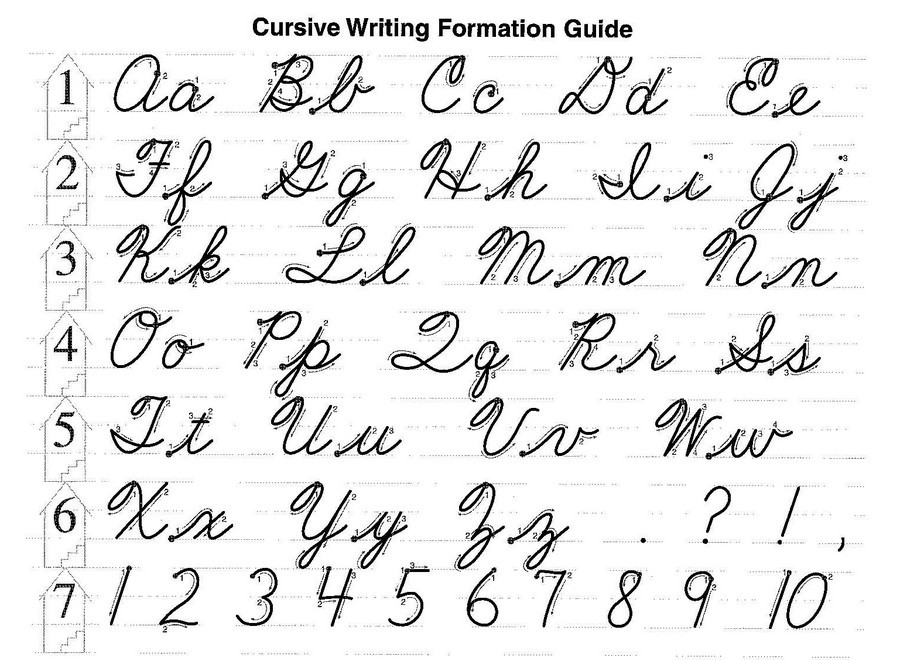
Cursive-writing-formation-guide typefacefont.com

CURSIVE I LEARNED. Source: typefacefont.com

We children-students all wrote alike by the end of 3rd grade–except for the “lefties” who were dragging ink across their pages, ending up with ink on their left-writing hands, but still using ink from the right-side inkwell.  No discrimination then: all sat up the same way, the paper at the same angle on the desktop, facing to the left.  Otherwise…The Ruler.

By 8th grade, after six brutal Ruler-Years, I had been made in the image and likeness of one of Mr. Palmer’s Chosen Disciples.  I was tested, weighed, and found not wanting.  I was a Palmer-ist.  (“There is no value in any penmanship drill ever invented unless it is practiced with correct positions of body, arms, fingers, penholders, paper, and with exactly the right movement, and at exactly the right rate of speed.”  — http://palmermethod.com)

Then whatever happened to Palmer cursive? 

I learned of Zaner-Bloser as my own kids were learning cursive.  No more Palmer Method.  Then arrived a simplified handwriting, manuscript to cursive, with a mere tilt of the letter-making pen: D’Nealian, controversial, but well taught.  Taught early and easily by…no handwriting specialists anymore.  Not needed.  Gone, like the dodo bird.  Ancient.  Mysteriously vanished.  And today few care.   

“You write like a girl!” is not often heard anymore, as I sign my name.  More likely, “What nice handwriting you have.” 

I do all right now when I have a good gel pen or a fiber point. 

I had some good fountain pens, with “bladders,” and the cartridge types: Parker, Waterman, and, of course, Sheaffer. Then I experienced the quiet that came with the invention of the gliding roller-ball (with its bloppy ink), yet still have good Cross pens, which are too slow now, and require too much motor effort for arthritic fingers.  

Yet nothing has been able to match the grace and speed and style of my Palmerism as a gel-ink pen is able to do.  No refilling,  no “perfect” gold nib needed.

The gel pens scratch beautifully, making noise as I press out the thoughts-onto-paper, carefully or sloppily.  I even enjoy hearing cross outs and corrections.    

As I write, sometimes I am back in the 3rd grade (still aware of The Ruler).  I write and write, sitting as I was taught: left hand holding down my paper, right index finger near the tip of the pen, small/little finger resting on the desk supporting my hand–with the reddened indentation on the middle finger, holding the weight of my words.  This is pleasurable writing, personal writing. 

I am a happy writer.

Looking back, I am so glad I was taught by those demanding much.

And The Ruler Method?  An un-truth….  However, it makes good stories.  The ruler-in-the-hand was nothing more than a symbolic mace, held and carried (and threatening) as a sign of order and authority.  I never had my knuckles rapped in writing class.  The Protectors of the Ruler [Method] knew better: They did not want damaged disciples who might have been too swollen to copy notes or write spelling exercises.

“Blessed are those….”  I am blessed with good penmanship.  I was a good Disciple–and one who had a great Fear of the Ruler.  I learned well.  I can print, write, copy, and sign (especially my name, which I am so proud of and so want to be legible.)  The sound of my pen scratching out letters across a blue line pleasurably reminds me of the days of “hard” that turned into “easy”–and to handwriting success.

Cursive rules!

© James F. O’Neil  2013

Note:  As I write this, some states do not require public schools to teach cursive reading or writing.

Most adults–and college students–abandon cursive writing for a hybrid of mostly print letters joined occasionally in a cursive style.  (In 2012, handwriting teachers were surveyed at a conference hosted by Zaner-Bloser, the publisher of cursive textbooks.  Only 37 percent wrote in cursive; another 8 percent printed.  The majority, 55 percent, wrote a hybrid: some elements resembling print writing, others resembling cursive.) 

By: James F. O’Neil

Many years ago, I had written a piece about the uses of food in the movies: “What Is Dirty Harry’s Favorite Food?”  [Florida English Journal 24.2 (1988)]

What fun I had doing that piece.  It was “popular writing,” not too academic.  Going through my published writings recently, looking for something, I re-read my food-in-the-movies essay.  I was curious about what recent critics might be making of the food theme.  So I did an Internet search for more examples than I had in the past.  Lists now abound with favorite movie-scenes-with-food, or best food films.  YouTube is also with us, allowing us to see eatings and food fights, feasts and gatherings.

I have seen many more food movies in the past twenty years.  I cannot even give an accounting.  Yet my short list always includes Chocolat and Tortilla Soup.  I am pleased, for sure, that Tampopo and Like Water for Chocolate still remain among some “Best Ten Food Movies”–of all time.

I will always be able to watch Splash, with that Tom Hanks guy and Darryl Hannah–and the lobster-eating scene.  Contrast that with lobster eating in Flashdance.  Film classics both.  Can we ever forget that annual turkey in Christmas Vacation?

And others?  The Big Chill, with food used as a device, over a period of days of mourning, to gather people, friends brought together, allowing them to talk.  Fried Green Tomatoes: I have always liked Bar-B-Q….  Poor Popeye, the detective, in The French Connection, freezing, stakes out the French restaurant while the “bad guys,” warm inside, enjoy a sumptuous repast.

And what about all that cooking by Meryl Streep as Julia Child in Julie & Julia?

I have my favorites: Mrs. Doubtfire, Pretty Woman, the Last M*A*S*H Supper, The Hours,The Hunger (1983), and Ratatouille.  Many others deserve a mention of my past likes; but Kramer vs. Kramer is still #1.  Food is essential to the action of the film: food “works” in this movie, having the main characters and food interact, father-son interaction.  The eating scenes represent movement from chaos to harmony.  Yes, food can do that.

And remember what Dirty Harry eats and what he thinks of ketchup?  No?

“Nobody, I mean nobody puts ketchup on a hot dog.”  (Sudden Impact, 1983)

© James F. O’Neil  2013

Lady and the Tramp SERIOUSEATS.COM

Coming Together. Photo: seriouseats.com

By: James F. O’Neil

When my boys were in high school, deciding on college life and careers, both chose to apply to military service academies.  The application process was rigorous and tiring.  One item on the initial application had to do with hobbies.  This small item on the long application fascinated me.  What importance was a hobby to a service academy appointment? 

West Point USMA

(West Point Photo: Wikipedia)

Admission to West Point is very competitive; candidates need to do their best in everything they do, including items counted in the “subscores,” or part of the whole score.

How far back in time is a candidate to “do best”?  Some hobbyists are “late collectors,” or come into a coin collection from a relative’s donation.  Others are Scouts from the very first, working on merit badges long before any thoughts of West Point or the Naval Academy [in Annapolis, Maryland].  Or what about having American Girl or Barbie collections, or miniature china tea sets, or even Cabbage Patch dolls piled neatly around a bedroom? 

And what about the young boy-child who collects paper bus and streetcar transfers?  Would he later be entitled to a “whole-man score”?

Recently, watching a city bus, I found myself wondering for a moment about all the bus transfers I collected from my days of boy-child.  I used to have piles of used transfers, punched and returned by a bus driver or motorman (on a trolley car or streetcar). 

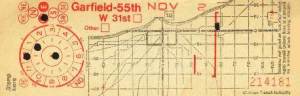
Transfers back then were pieces of paper, the size of a narrow dollar bill, white, printed with a type of clock face at one end, and the route on the rest of the transfer.  It was to show with a few punches where a passenger got on and then how much time to get to another location. 

Garfield Blvd Transfer

(Photo: Chuckman’s Photos)

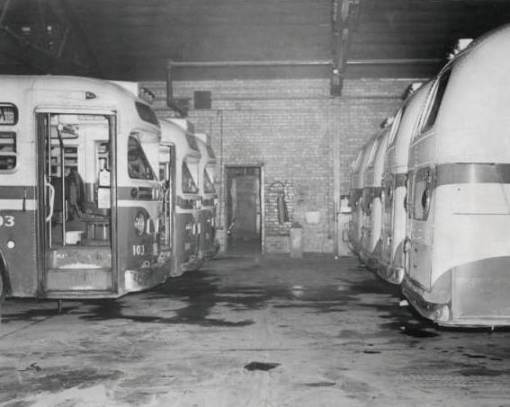
I lived but a few city blocks from a large streetcar, later bus, “barn,” as we used to call it.  This large interchange saw end-of-the-line tracks going in and coming out, streetcars lined up and put to sleep for the next day.  As buses replaced the trolley system, the buses found their spots to rest, interchange, or be repaired in “the barn.”


chicago-cta-bus-garage-5800-w-95th-street-interior-buses-parked-1953  chuckman's photos

(Photo: Chuckman’s)

 1973 Chicago Bus Barn

In late afternoons, I used to make my way through the parked trolleys or buses, sneaking along, looking inside for books of transfers, or single transfers.  Many an empty streetcar or silent open bus allowed me to rummage around, adding to my collections–and never being caught.

So this was a collection: paper transfers from all over the city, all organized into zones, dates, routes.  For what end?, I ask.  What I collected, how I collected, why I collected was for fun, and was enjoyable. 

Perhaps I gained some organizational skills, or some sense of what is “worth” something.  Perhaps this has all made me a “Whole Man.”

So, what’s my score?

 –“If something exists, somebody somewhere collects them.”

©  James F. O’Neil  2013

By: James F. O’Neil

“Find a place inside where there’s joy, and the joy will burn out the pain.”  –Joseph Campbell


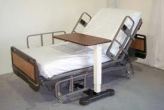
Hospital bed

Photo: Hill-Rom

Recovering from knee surgery was an ordeal that included many nights of restlessness and pain.  During those times, often under the influence of medication, I would lie in my hospital bed, trying to ease the distress by visualizing my home, mentally walking through each room, recollecting objects, colors, and decor.  Soon I was focusing more specifically, trying to picture book titles, CD labels, and the covers of my DVD collection.  I was trying to remember, to ease the pain.

After the allowed hospital stay post-surgery, I had to spend a week in a private room in a rehab center.  There I was welcomed, my aides eager to heal me, though determined to spoil me in the process.  Constant attention was paid to the person in the private room, who just wanted to moan and get some rest.  For unknown reasons, again, my mind would drift, and my memory would work to make mental lists. 

In the evening, I would fall into a light sleep.  I would dream lightly, and then awaken after an hour or so, in my darkened room.  Forced to lie on my back because of the surgical staples, I could turn a bit on my side, enough to reach the bedside stand and the light–but also my gel pen.

On the back of the small slip of paper (my evening meal menu), I added item after item from my mental lists–items that I deemed important.  

During the day, I would study my list.  Between sessions of the staff trying to help me move, to do some exercises, and my pleasant occupation of trying to regain my strength by eating, I would edit and refine my lists. 

At home, after my release from my sick bed, I found some time to copy out those remembered “favorites”–those, “What-if-you-were-stranded-on-a-desert-island-with-only-one…?” whatever-item.

By many standards, my hospital list might seem amateurish.  Nevertheless, as I later began to study the items, I was surprised that such awareness and detail could come during periods of intense pain.  Even though I felt at times as though I were dying, I knew I was not.

I just wanted out of that hospital bed, out of that place–and wanted a Jack and Coke….

 * * *

Here is some of what I scribbled:

The Written Word:  Othello; A Tree Grows in Brooklyn; The Guns of August; The Power and the Glory; Childhood’s End; The Handmaid’s Tale.

My Visuals:  Vermeer; Tiffany; Bernini; Crayolas; Chicago Architecture.

Music:  Vivaldi; La Boheme; Gregorian Chant; Streisand Duets; Fleetwood Mac.

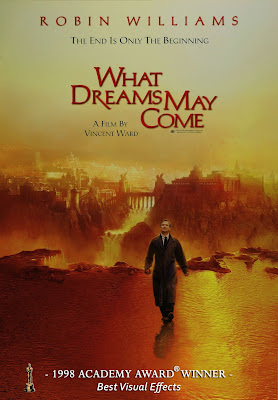
Movies:  English Patient; Casablanca; Jerry McGuire; Shakespeare in Love; Carousel; What Dreams May Come; Moonstruck.

My Beverages (Yes, I even thirsted after other types of pleasures):  Jack Daniel’s; Scotch whisky; Gewürztraminer; Diet Vanilla Coke; Arizona Sweet Tea; Cherry Dr. Pepper. 

What Dreams May Come

Photo Credit: aesteticum.com

 ©  James F. O’Neil  2013