Archive

EVENTS

By: James F. O’Neil

Some watches I’ve admired–even desired–have been very expensive pieces of jewelry.  On a trip once from Minnesota, the man next to me on the plane was a commercial pilot.  Instead of talking with him about flying in bad weather, long flights to Europe, or cockpit boredom, I asked him what kind of watch he wore.  This was important to me.  Breitling.  Navitimer.  “Instruments for Professionals.”  Of course. 
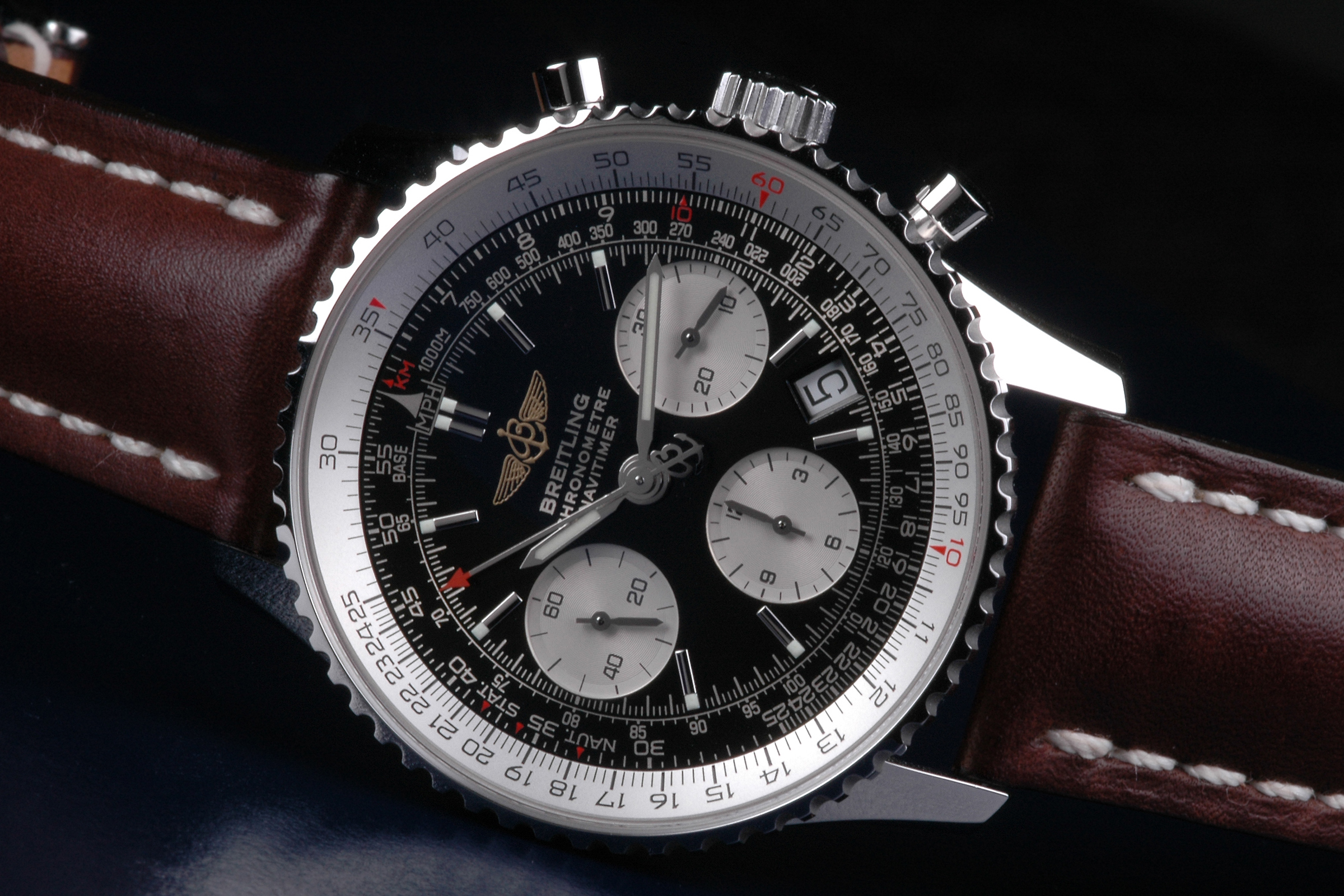
Breitling-Navitimer  credit wikipedia

Photo credit: Wikipedia

Breitling Navitimer

My stainless steel Seiko is supposed to run for 77 years, as long I move.  I figured it would be my last watch, since it would stop when I reached 120 years old, or so.  It has stopped twice; it needed a new power storage unit. 

So do I need a new watch?

What is the real purpose of a watch?  To tell the time: Am I late?  Am I finished working?  What time do I need to get there–and how long yet do I have?  Really, that’s all I need it for. 

Something else I need: Every watch I’ve owned that was not stainless has corroded.  My biology reacts with the metal or plating; corrosion results.  Only stainless–or gold–for me.

I used to have a gold pocket watch, with fob and chain.  It’s gone…

c d peacock gold watch liveauctioneers.com

Photo credit: liveauctioneers.com

C.D. Peacock Gold Pocket Watch

Hardly anyone wears a pocket watch anymore.  Perhaps there is something too fancy about the vest that must accompany the pocket watch, something too pretentious or ostentatious about the fob.  However, not wearing a pocket watch can be exciting, just the same: having it, seeing it, or touching it can be as exciting as wearing one‑‑perhaps even more so‑‑especially an old watch that belonged to someone special. 

An old pocket watch is something special, like having an occasional fine meal. 

A person who possesses such a watch‑‑man or woman, for such watches come in styles for both sexes‑‑is uniquely joined to a piece of history, the past, a period of time.  On the other hand, the remembrance of a watch might belong to a memory of a particular person.

My Grandpa Schuma had a pocket watch.  He wore a vest most of the time around the house, after he came home from work (the 1940 Census states “Lamp Cleaner, Park District”), or after he spent an afternoon in the garden or in the home workshop.  He always wore a vest on Sundays.  I remember the puffed sleeves of his long‑sleeved shirt–and then the fob, the gold light in the sun.
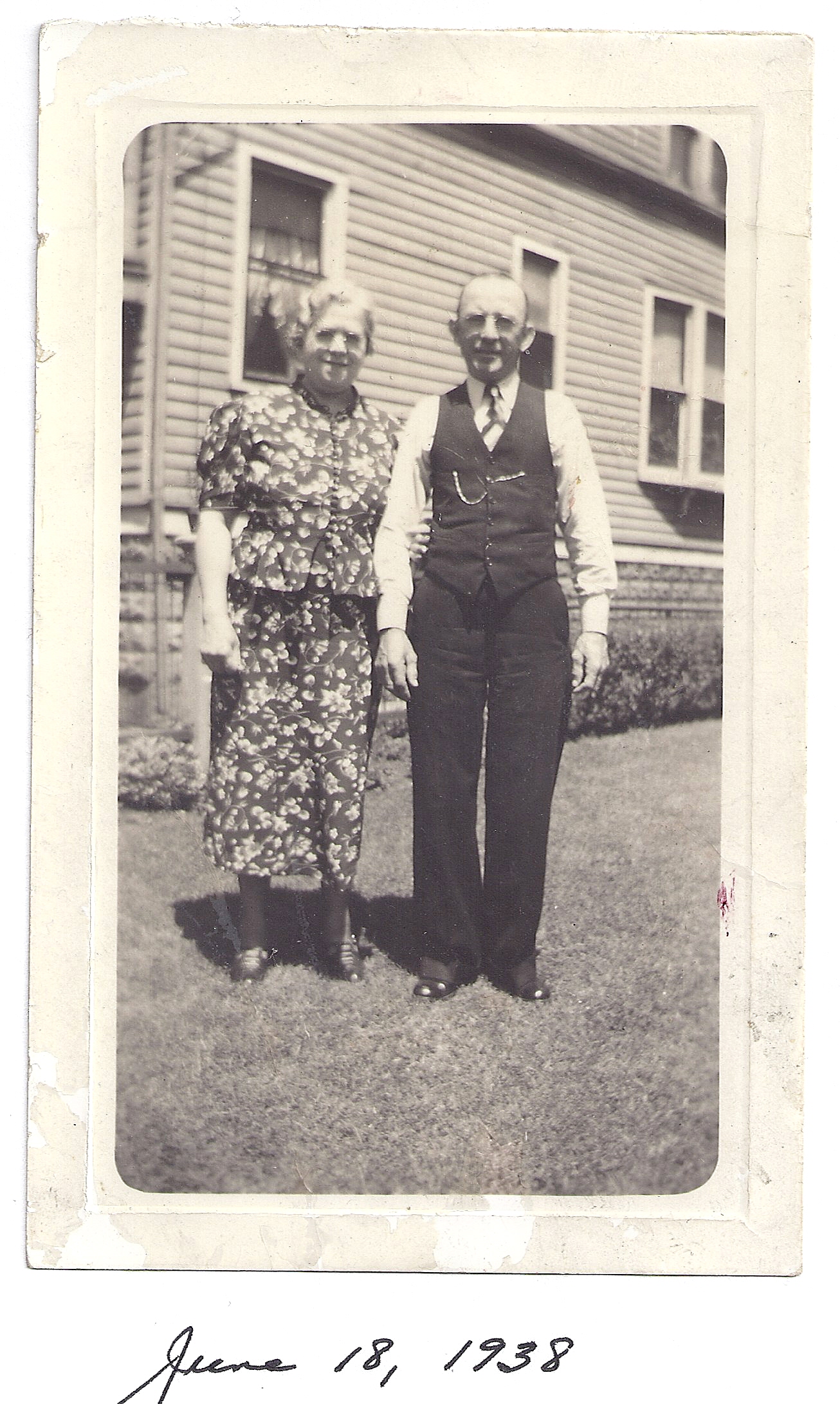
G'Ma & G'Pa Schuma 1938

Grandma and Grandpa Schuma

He learned the time of day on the watch after making a smooth, swift, artfully accustomed movement of the right hand and arm, into the smallish watch pocket, taking out the watch pressing the stem with thumb to flip open the gold cover that now rests against his first two fingers looking at the time while he purses his lips closing the lid‑‑”Snap!”  ‑‑with the same two fingers and thumb and returning the bulky piece of gold‑filled and jeweled mechanical perfection to the safety and silky softness of the pocket…  “Quarter‑past four.”  “Half‑past eight.”

I remember that, those moments of flourish. 

My memory of the movements Grandpa made makes me feel good.  I enjoy these memories of that time and that person, with memories of the comfortable times, the good times: the warmth of the past, the affections of the past, and even the bit of elegance that goes with the past–especially the elegance of a common, yet dignified, working man, who always wore a vest on Sundays.  With that special watch.                               

© James O’Neil  2013                  

By: James F. O’Neil

The older we get, we seem aware that we are often powerless or our actions are futile: We control so little in our lives.  (A psychology teacher told me he believed that 98 percent of what happens to us we have had no control over.)

Do we not have control?  Is there such a thing as “luck”?  How do we come upon “opportunities”?  Do we really get to “choose”?

A closed door could be a fitting metaphor or symbol for those looking for an occasion to open The Door to Opportunity when She knocks.

 A CLOSED DOOR [janeheller.com]

A CLOSED DOOR [janeheller.com]

As I look back upon my life experiences, one such closed door did not open for me.

In my last semester of college, I was working as an orderly in a hospital near Chicago.  I had been allowed to work with the hospital pathologist, assisting him with autopsies, on call any time of the day or night.  The doctor taught me the uses of the instruments.  He showed me life’s wonders and sometimes the powerlessness of medicine.  There I was, a twenty-one-year-old English major, fascinated, exploring the human body.  I was assisting a medical genius who taught me so much in those hours we spent together in the hospital morgue.

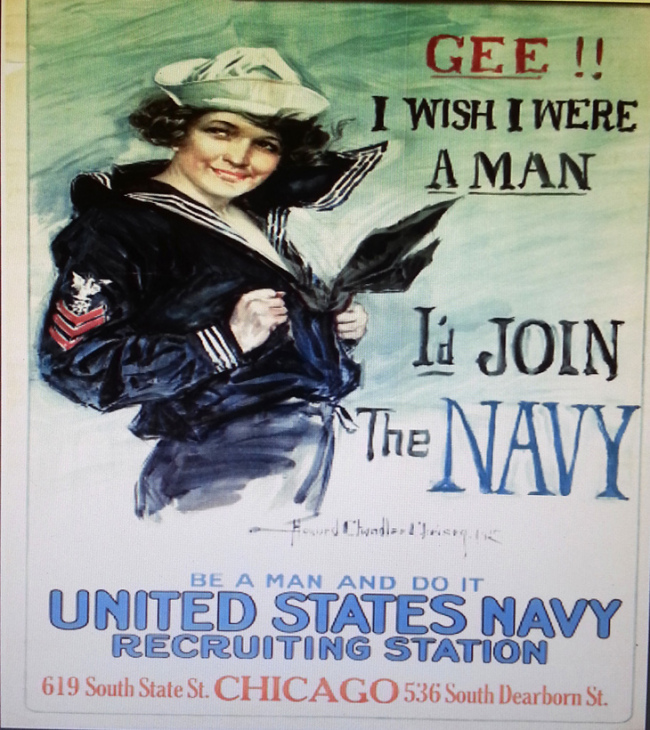
His genius made me so aware of how shallow I was.  At times, we had discussed my going to medical school.  I lamely made excuses to him.  I had thought about it, for sure.  It was part of reality as I went to work; it gnawed at me often.  “Do you want to try medicine?  You can, you know.  Join the Navy,” he prompted me.  That was a possibility I could seriously consider.

OLD NAVY RECRUITING POSTER

OLD NAVY RECRUITING POSTER

I went about my duties at the hospital.  I was interested, and even eager, about what he had said.

February: My resolve was carefully fashioned.  I would enlist.  I went to the post office and the recruiter’s office to obtain information and brochures.  That’s all I did.  I would enlist, I thought.  I read keenly, more intent.

At the end of a certain week, I would go back to the recruiter and enter the Corpsman Program. 

Credit: military.com stuff

Credit: military.com stuff

 My college training would help me; I could choose my field, probably be commissioned sooner.  The Friday could not come soon enough.  My determination was solid; nothing could sway me.

On that Friday morning I left for work, I knew the day was scheduled to be different from any other in my life. 

I would be finished at three-thirty in the afternoon.  By three-forty-five, I was walking down the steps and along the lower hallway of the post office.  I approached the Navy Recruiter’s door.  I turned the handle.  Locked.

I waited.  I knocked.  Nothing.  No sounds from within.  I was locked out.  My courage faltered. 

What now?  I asked myself.  It would be a long, trying weekend, not at all as I had planned.  I left the hallway dejected.  Monday would have to come!  I had to have another chance.  Who locked that door to my future? 

That door to the navy recruiter would never open to me–never.

On the following Monday, I would work as planned, though I did hope to contact the recruiter to make a sure-thing appointment.  At mid-morning, however, I was called to the phone.

The conversation was with a teacher at a local high school, trying to find a long-term English substitute for the remainder of the term.  “Are you interested?”  The man and the principal were desperate.  (A college classmate had told this teacher about me and my major.)

“I am planning to join the Navy.  Sorry.” 

“Would you wait a day or two to think it over?  Could you talk to the principal?  An interview?  Please?”

What was happening with this phone call?  What about my great plans for a medical career?

“Please.  You can always see the recruiter.”

I never saw the recruiter–never.

Two days later I was being interviewed. 

The temporary position did not materialize.  But I was guaranteed a full-time position in the fall, teaching ninth-grade English. 

“Will you say Yes?”

“Yes.”  I accepted.

I never saw the recruiter–never.  I never joined the Navy.  I never became a corpsman. 

I think so very often of that locked door, what it did and did not open for me. 

And medical school?   

Chance, fate, Providence–or “luck”–saw fit to it that the recruiter was not present for me, then changed my life in ways that I cannot count or recount.

What I do know, though, is that one instance, so trivial and insignificant as it may seem, was outside my control.  However, I could have said No to the caller.  I could have stopped it all right there.  I had no control over the circumstances that ultimately brought me to that point of saying “I accept.” 

“Choose wisely,” I recall from Indiana Jones and the Last Crusade (1989).  The Grail Knight tells us we MUST choose. 

 Faced with the options presented to me, I did choose.

I chose wisely….

* * * * *

 **An interesting book to look at on the subject of chance in our lives, see There Are No Accidents: Synchronicity and the Stories of Our Lives by Robert Hopcke (1998).

 no accidents goodreads.com

CREDIT: goodreads.com


© James F. O’Neil  2013


By: James F. O’Neil

Do you have a favorite song–or a song you call your “own”?

Couples usually have an answer to this question.  Unfortunately, some couples born into the psychedelic and Dr. Timothy Leary eras have “The Wall” or “Baby, Light My Fire” or “Judy Blue Eyes”–or maybe even a alcohol-induced wail by Janis Joplin, or something stronger by The Doors.

Usually a favorite song evokes feelings of sentiment, or a memory of a place special to a couple for some milestone, or it might even be the timeliness of the song that makes it so special–so nostalgic…

One song that was popular in the spring of 1963 was one sung by Andy Williams: “Can’t Get Used to Losing You”:

Can’t get used to losin’ you no matter what I try to do.
Gonna live my whole life through…loving you.

…no one else could take your place.

The nice rhythm of the music, and the lyrics, makes for easy listening.  However, for a young person with a broken heart, the words evoke feelings of hurt and sadness, maybe disgust, even anger.  Most of the time, however, reason prevails, and time heals all wounds.                         

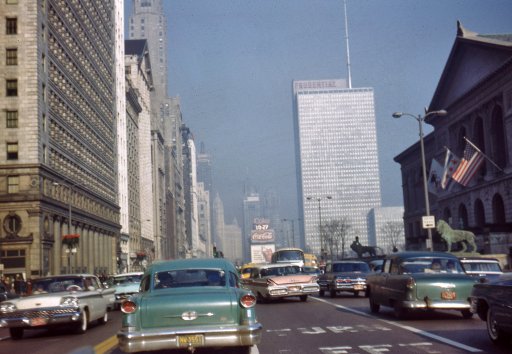
After my first serious relationship ended, my broken heart healed.  Yet every so often I found myself drifting along on Michigan Avenue, in Chicago, hearing “Can’t get used to losing you…” seeming to come from everywhere.

Michigan Avenue 1962

Photo Credit: Shorpy.com

Time passed.  My life took a turn.  I was with a new friend.  My heart was truly mended, healed!

Some would have said the song for the new relationship was “Rubber Ball”: bounce, bounce, bounce.  Some would have thought we were two star-crossed lovers on the rebound. 

The Universe employs the Principle of Correlation: the longer a couple talks together, stays together, they understand one another. 

And what song for this correlation?  Barbra Streisand was singing about “People: people who need people….” 

But was another song playing?  Was that now Andy Williams singing “. . . off to see the world”?

[Music plays]: Yes, Andy Williams–again.  Something about a river?  The 1961 song was from the movie Breakfast at Tiffany’s“Two drifters, off to see the world.”

But for the new couple, a favorite song? 

Was there a favorite musical composition that could pull together the special times, the good times?

Is there a song that goes something like “Hand-in-hand, we walked along Oak Street Beach, with the Moon…”?  Highly doubtful. 

Perhaps something more like “Moon River”:

Moon River, wider than a mile,…

Yet, what of “Two drifters, off to see the world”?

And what of “My huckleberry friend, Moon River, and me”?

There was no river.  Yet, we were off to see the world, my new friend and I–and there was such a lot of world to see.  There we were: 20 and 22, with a recently found three-room apartment, my new job, and a ’62 Corvair.  In addition, we were friends, huckleberry friends (whatever that meant, though I happened to be reading Huckleberry Finn).

And that’s our song.  But, more importantly, I’m so glad it was not “Singing ‘Do wah diddy diddy dum diddy do’”!  [Manfred Mann – 1964]

©  James F. O’Neil  2013

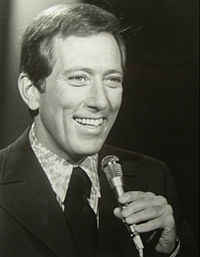
A precious memory: On the occasion of the passing of Andy Williams, 25 September 2012. 

Andy_williams_1969 Wikipedia

Photo Credit: Wikipedia

By: James F. O’Neil

“Nostalgia is the product of personal memory; it is an expression of fond regret for time lost” (Jeffrey Simpson, Chautauqua: An American Utopia, Abrams, 1999: 10).  “Missing” something–or someone–can cause a kind of pain.  And “nostalgia” is a pain, bittersweet: bitter for reminiscence of the reality, yet sweet, for it was good or fun.

Sights, tastes, and smells evoke the past, sometimes just a quick sentimental journey for a brief moment.  I remember my psychology prof telling us that the SMELL of Crayolas brought about most memories of happy times and places. 

Do I have some regrets now, missing some things of the past that provided pleasure?   

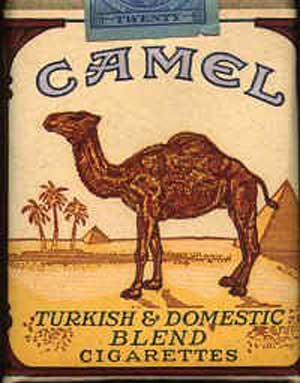
At times, after a good meal, or in a moment of relaxation, I MISS MY CAMELS.

Camel-Cigarettes

(Picture Credit: biggone.com)

That missing, but not needing, is my “perfect” example of nost + algia: the “return home” and the “algia,” the pain (like fibromyalgia or neuralgia).   I MISS MY CAMELS. 

“Severe bronchitis”: in 1972, my doctor told me.  There I was, a pack-a-day smoker.  Since 1959-1960, I had begun to smoke. Lucky Strikes, then Camels, and other brands I cannot remember.  (I do recall those days of pilfering: removing a Chesterfield from a pack lying around on a table at home.)  My bout with bronchitis, however, brought me to awareness: not of lung cancer or other smoking-related illnesses, but to just good breathing.  The doctor told me to stop smoking.  I do not know how I did it.  But I did, cold turkey, as they say, yet with the help of my wife’s chicken soup.

Nevertheless, my Camel senses linger: feel, taste, and sight: nostalgia.

No matter where I am, drug store, grocery store, airport–any place where I see Camels sold (no longer 25 cents a pack)–I can taste the tobacco flavor, smell the smoke, see the wisps of smoke I exhale (or try to make into little smoke rings).  However, probably the most particular memory-impression is my sense of feel, the smooth paper–and that white cigarette between my fingers.

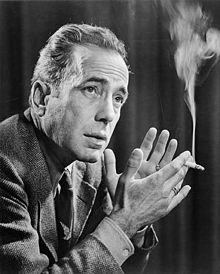
Nostalgia, when I hear “Don’t Bogart that…  [cigarette].”  Or hear lyrics “…Bogart and Bacall…” or see them: Oh, how he and she blew smoke at one another, and held those smokes.  

220px-Humphrey_Bogart_by_Karsh_(Library_and_Archives_Canada)

(Photo: Karsh: Library and Archives, Canada)

I am certain I was and still am addicted to cigarettes.  When I was teaching in a classroom with a chalkboard, I was careful not to hold my chalk like holding a cigarette.  If I did, if the chalk happened to roll out of my hand between my fingers, if I began playing with the chalk, I wanted to let the chalk rest there, then slowly I could put that piece of chalk (no matter white or yellow) between my lips, inhale, and blow.  Nothing.

Oh, the “algia”: the good feeling, the feel-good memory, but with the pain of loss.

I recognize this is an anecdote of such triviality.  Certainly, it is not equal to the nostalgic feelings and memories of the feel, smell, or sights of a former lover or beloved, to the feelings at the loss of a pet, or the loss of a child.  Certainly overwhelming nostalgia.

But then again, remembering the prom, the graduation, the wedding: pain, and happiness, as in the great movie Always.  There a song brings memory, and then the pain accompanies the awareness of loss.  Yet wonderful and fulfilling memories.  (I love that movie.)

Always poster

(Photo Poster Credit: impawards.com)

That movie contains the essence of nostalgia for me.

So, here I am, the non-smoker.  I miss my Camels, but I understand I cannot go back, cannot “go home again.” 

Besides, “The Surgeon General Has Determined That Cigarette Smoking Is Dangerous To Your Health.”  That works for me.

© James F. O’Neil 2013