Archive

EVENTS

By: James F. O’Neilcolored file folders

While going through my notebooks and files, I came across two interesting folders: one red, one the usual “manila folder.”  I knew what they were; I just had not seen them for a while.  The red tab, “Placement Programs,” in manuscript-print (all CAPS).  The other had a somewhat beat-up, dog-eared tab: “Certification Materials,” handwritten by me in my best cursive.

If you have ever sat down in front of your dresser that has a bottom drawer filled with junk, stuff, dead-desiccated prom flowers, old love letters, maybe a vibrator or two, greeting-cards-saved-forever, warranty papers for radios and bicycles and CD players long gone, and so much else, it might be difficult to slide the drawer back in.  Memories flood out from the items as you look to find something. 

Why did you go in there in the first place?  Isn’t this A Sacred Place of Collection?  Does not every item belong?  Have you tried to delete or discard something from within–or something you took out to look at, for no reason, then put back into the right place?  How about those empty watch boxes?  Stones and rocks, collected when you were in the Mojave Desert?  (I still have wrapped in the most-delicate “Saran Wrap” the two newly-marrieds from the top of my/our wedding cake.  Also, a pair of baby shoes, not mine.  A signed baseball, not mine.  An assortment of padlocks, combination locks, keys to nowhere, day-minders/day-timers back to 1973.  A handgun lock.  And more.)
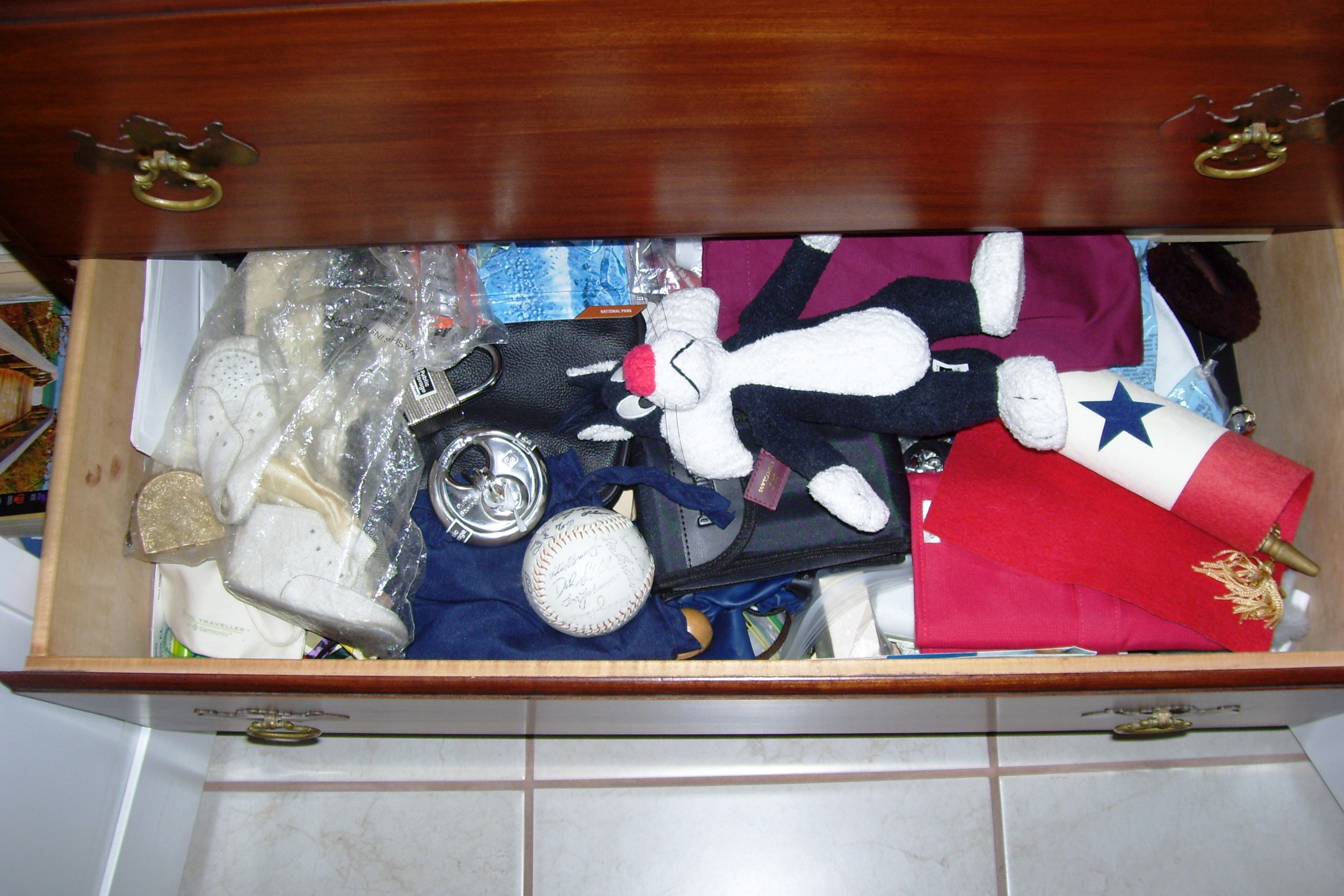
My Bottom Drawer

Those two folders I found are like my bottom drawer: A Sacred Place of Collection: papers, letters, and copies of important information about me.  Letters of application I once sent.  Transcripts from high school and college (even a sealed envelope “Issued to Student” stamped on the seal of one envelope), proof that I completed the necessaries.

My certificates and licenses, proof, to teach, to administer, to sell insurance.  Some certificates for outstanding service, for being a committee chair, or for appreciation. 

Oh, my!  What have I done?  I have opened a “bottom drawer.”  I spent hours going through the two folders: the items contained defined what I was, or prove what I still am capable of (degree to teach).  Each item tells/told where I was at a time in my life, a date and a place of my existence, in addition to what I have accomplished.

These folders, with the classes I took in the grades and in college, open up my life: “Look what he did?”  The transcripts show Latin, Greek, German, science, mathematics, philosophy, history, letters and literature, religion, physical education, geography, music, biology, Bible studies, economics, and even some art.  Proof of my education.

Something more than what is on the papers I liken to the spirits that linger, hang around those items in the bottom drawer.  Something sacred there.  Something special, or it wouldn’t still be there, right?

So, I put the papers back into their rightful folders, knowing that some had to be shredded.  They were old, outdated, non-useful, and unusable.  Someday, I told myself; not now.  Then I sigh, look at my folders, and carefully replace them in the file cabinet drawer–deleting nothing.

“Ah, me.”  Latin and Greek–and philosophy?  Really?  Omne agens agit propter finem.  Nemo dat quod non habet.  But really, Qui nimis probat nihil probat.

 Gallia est omnis divisa in partes tres,…
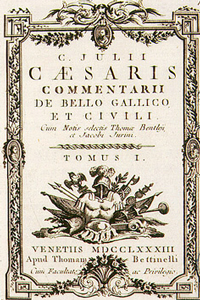
caesar

[Here are a few words of explanation:  “Everyone does something for a reason.”  “No one”–not “Nemo,” the clown fish–“gives what one hasn’t got.”  And this last one I love–really: “She/he who proves too much, proves nothing.”]

© James F. O’Neil 2013


By: James F. O’Neil

             “So, where ya’ from?”

            “The South Side of Chicago.  You know Chicago?”

            “I sure could tell by your accent you’re not from around here.”

That’s what I hear when I’m in Newark, Ohio, talking to a grocery-store clerk; or in Saint Louis; or in Cairo, Illinois; or, even more, in Darien, Georgia, not too far from the Florida border, the state in which I have lived for more than thirty years.

They can still tell I’m not from around “here”–or “there.”  What gives me away?

Is Newark, Ohio, like Newark, New Jersey [“JOYsea”–or “GERsee,” as “gerbil” or “German”]?

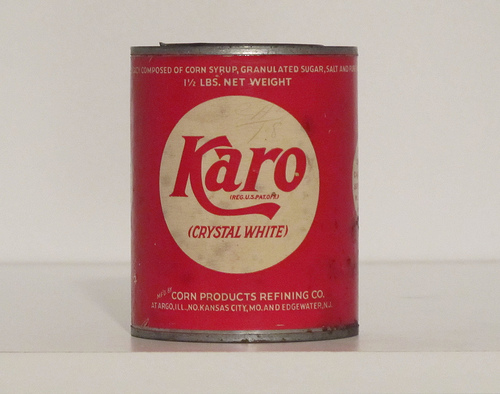
And about Cairo, Illinois: Is that like “kai” as in “KAYak” or “CAIro,” Egypt?  Or more like “cay” or KARO syrup“Kaye,” like Karo syrup, that thick sweetener, used in baking, cooking, and on pancakes?

The folks in Darien, Georgia, catch shrimp–some of the best.  They don’t care how I talk or where I am from: They care that I like the shrimp and like the hush puppies.

I lived in Saint Louis for two years of college.  Saint Louis is but 300 miles from Chicago–the “-ca-” in “Chicago” pronounced by me as in “caught” or as the sound of a crow “cawing” while sitting on a telephone or electrical wire. 

StLouisArchThree-768691My college friends, however, had a tendency to say “shi- [“shin”]-KAH-[a Boston “kah”]-goe” [“toe”], much like the way President Obama pronounces the name of his home city.  (My green car [“kar,” “CARpet,” and “cargo”] was a “core” in Saint Louis; its roof sounded like a dog’s “woof, woof.”)

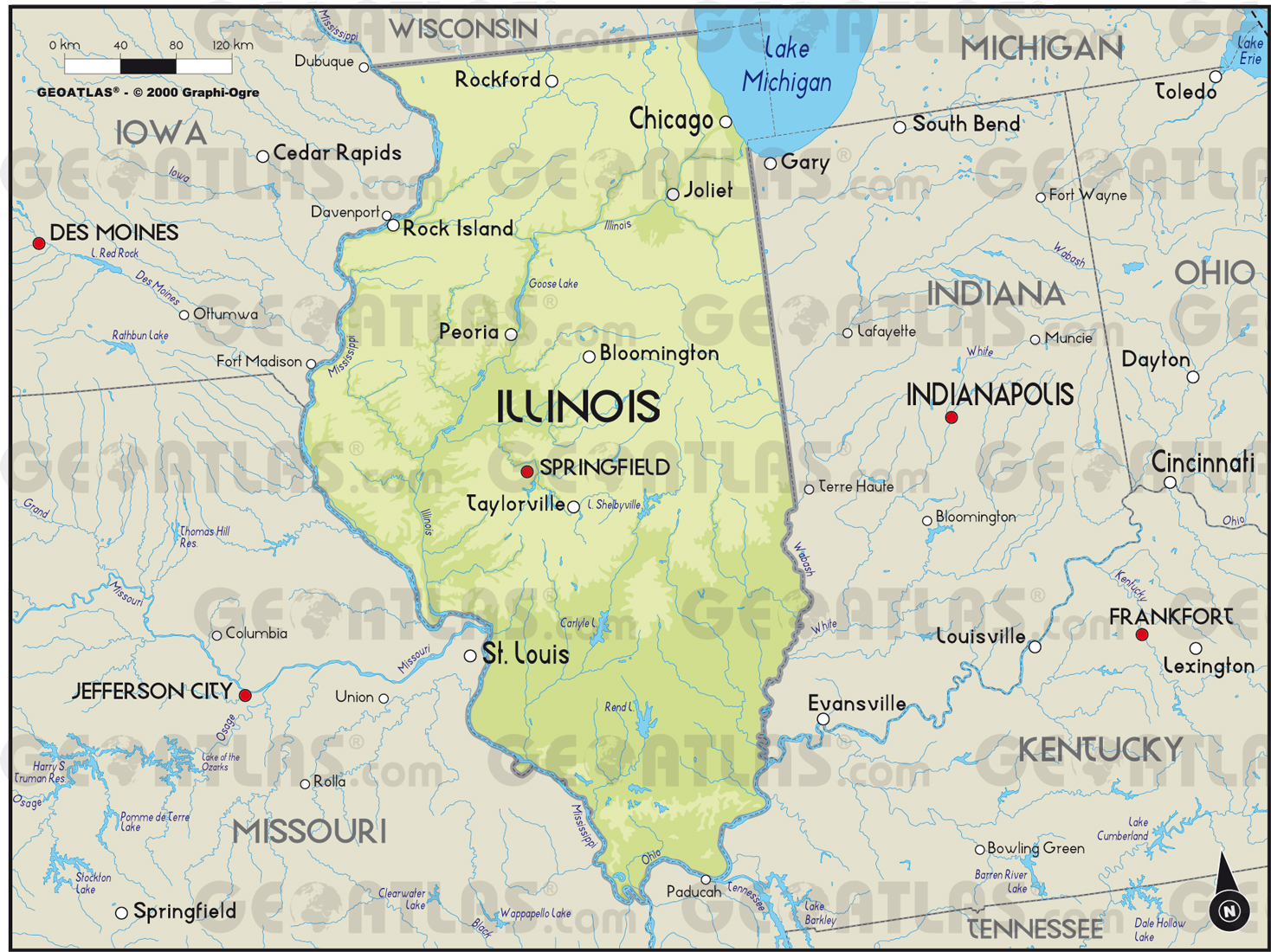
These various listeners hear my stories told in my Upper-Midwest dialect.  And that’s the long and the short of it, the length of Illinois,Illinois Map from Chicago to those good folks in “downstate” Illinois, south of Springfield and East Saint Louis, down near the southernmost border, around “KAY-roe.”

             “So, where you from?”

            “Iowa.”

            “Oh, Dess Moynes (Dah Moine)?”

 * * *

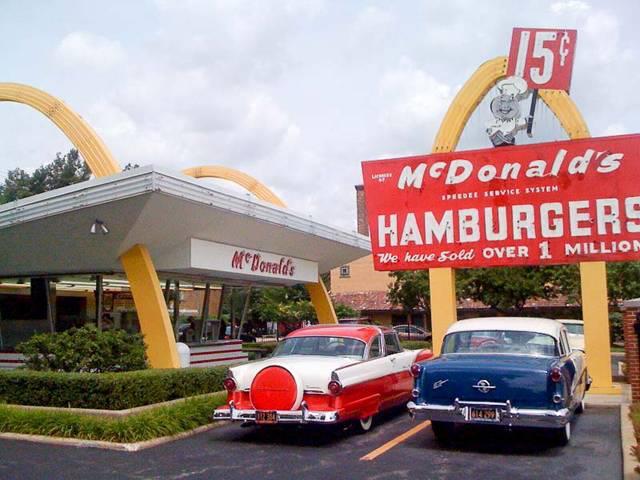
[Author’s note: I once lived in Des Plaines (Dess Planes), Illinois, the home of the first franchise McDonald’s. Oh, and there is “no noise” in Illinois: It’s like “ill-in-NOY.”]

Des Plaines History

Wikipedia photo

 © James F. O’Neil  2013

By: James F. O’Neil

It has happened again: One of those moments of memory revival when I do something that really conjures up picture-visions, feelings, tastes, and a sense of time gone by.           

Something simple I do, like mixing a pitcher of Kool-Aid or some other popular non-sugared drink, brings me into the memory world–here, the world of my childhood.       

Pour Kool-Aid There I was, pouring the colored powder into the two-quart pitcher.  As the green crystals and powder took their time getting to the bottom of the plastic container, I saw in my mind’s eye my mother, walking toward me, wearing her light-green smock with large pockets.            

I was waiting for her as she came from the Kool-Aid factory in Chicago, on the Southwest Side.  My vivid image of her now makes me remember a warm summer afternoon (she must have worked an early shift), the car my dad and I sat in waiting for her, and her gait, with her hands in her pockets.           

When I saw her, among the other women wearing hairnets, coming out the employees’ door, like those women workers in World War II, finishing their shift in some defense factory–in full-body coveralls–I left the car and ran towards her.  (This now occurs in filmed-slow-motion.)  A big hug, maybe a kiss (probably not in front of all those women), and a question:  “Watcha got in your pockets.”  We kept walking, her telling me about which line she worked that day: Cherry, Grape, Lemon-Lime, Orange, Raspberry, or Strawberry.  (I never liked orange.  Don’t know why, since I always enjoyed Creamsicles in orange flavor.)  She had colored powder on her smock, and her hair sparkled colored-crystal.           

I liked her job.           

That factory provided work for her, money for us to live on, and free Kool-Aid.  I cannot recall the exact dates of her work at this factory (in the 1950’s), but I know I was not a baby, as my title might imply.  Yet I remember one younger brother who also partook of the flavored powder.  We were children, with tastes.           

There is an expression “working for peanuts.”  My mom worked many jobs: making gaskets for bombsights, working at the Federal Reserve Bank (no free samples ever there), working in a cardboard factory making boxes, and the Kool-Aid Factory.  Of all, my remembrance of colored powders brings good feelings and positive memories.  She never suffered cuts, bruises, slivers, or smashed fingers or toes.  She brought home the money–and brought home color and flavor into our lives.  Much better than peanuts…

Postscript.  In 2004, the former Kool-Aid factory on the city’s Southwest Side was scheduled to be razed and replaced with a housing development.  Now known as Marquette Village, near Marquette Park, I know the soil must contain memories and crystals, with Kraft Foods Inc. manufacturing Kool-Aid, with a dose of Good Seasons salad dressing mixes–and maybe some drops and bits of Open Pit barbecue sauce.  My remembrance of things past?  “Kool-Aid, Kool-Aid, Tastes Great!  Wish We Had Some, Can’t Wait”–and, “A five-cent package makes two full quarts.”  How great was that!?

*I remember Tom Wolfe’s great book, The Electric Kool-Aid Acid Test, published in 1968.  When writing this memoir, I could not get that title out of my mind–yet I always referred to it with the “Baby” added to the title.  Don’t know why.  Perhaps I have just been a “Kool-Aid Baby.”

© James F. O’Neil  26 May 2013

By: James F. O’Neil

I have a small wooden sign in my man-cave with the words “home,” “story,” and “begins.”

What a neat sign with a neat saying.

Many craft stores, country gift shops, and little antique storefronts have made these kinds of signs popular, signs of warm, fuzzy slogans or aphorisms or “down-home” good feelings.

We like to buy these, put them on walls expressing that “Family Is Everything” or over a bed “Always Kiss Me Goodnight” or in a study “Home Is Where Your Story Begins.”

Perhaps “This Is As Good As It Gets” might be found over a door in a summer cottage. 

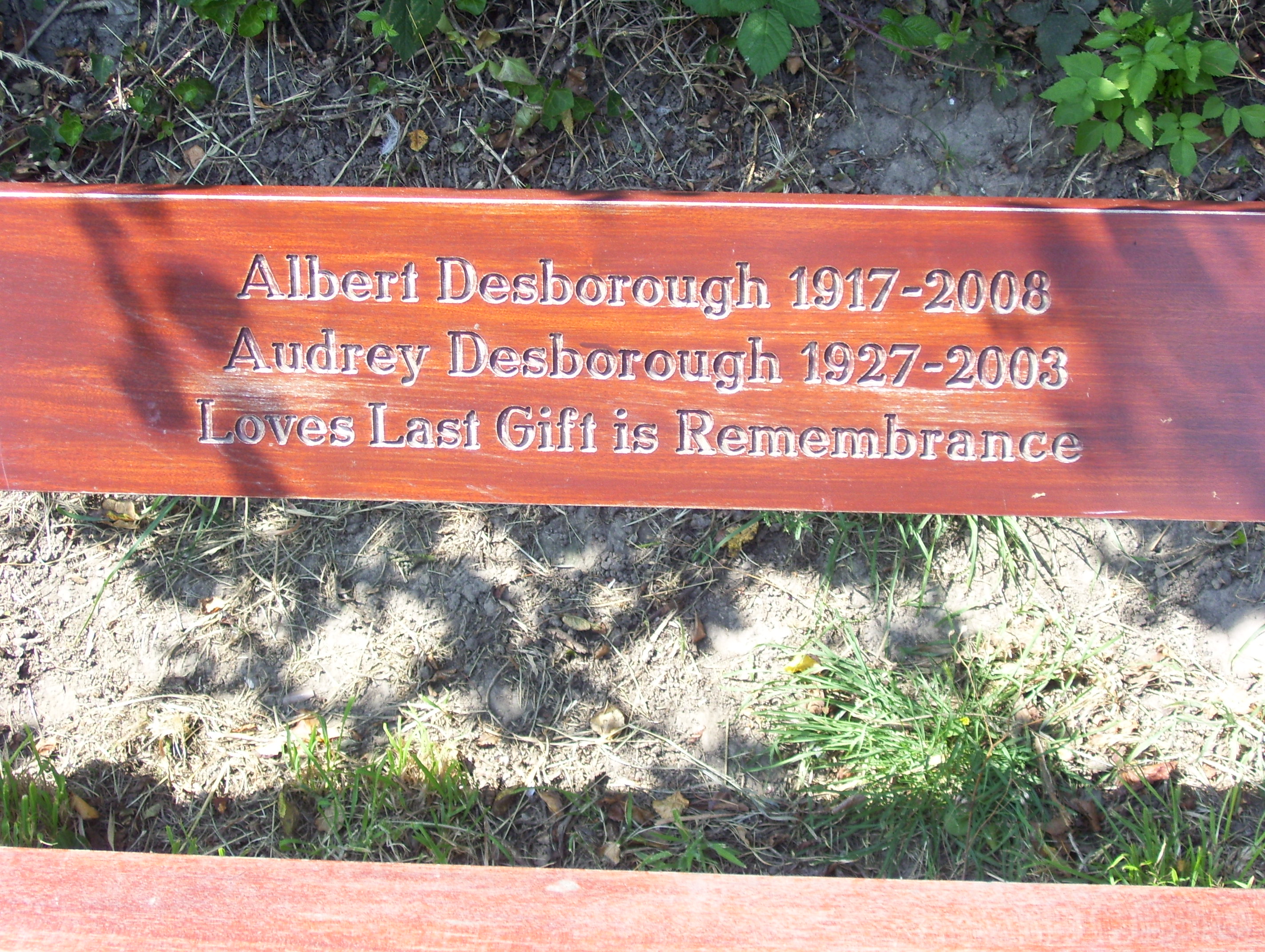
Cottage #16, of the original 100 cottagesThus it begins: a vacation, a story (“What I Did Last Summer”), a life, a death, a beginning or an ending, a love (“Love Is Blind”), stress (“Keep Calm And Carry On”), or friendship (“BFF”)–or one I really do like: “Love’s Last Gift Is Remembrance.” 

Saying from Hastings BenchStories are everywhere, where we look to see or find them.  And if “Home Is Where The Heart Is,” then that is where a story can begin. 

We must tell our story: “Once upon a time, when I was six and living with my grandmother, …”    Our listeners depend on it.

© James F. O’Neil  2013