Archive

GROWING UP

BY: JAMES F. O’NEIL

PART I: TRAINS

“One of the things the government can’t do is run anything.  The only things our government runs are the post office and the railroads, and both of them are bankrupt.”  — Lee Iacocca

***

Once upon a time, a long time ago, after my Grandpa Cummings had retired from many years with the Pennsylvania Railroad, pennsylvania railroad symbolhe took me to visit a friend of his at a switching yard on the South Side of Chicago.  The three of us walked through the roundhouse, walked among the rails, and even watched to see the railroad turntable in operation.

In rail terminology, a railway turntable or wheelhouse is a device for turning railroad rolling stock, usually locomotives, so that they can be moved back in the direction from which they came.  Railroads needed a way to turn steam locomotives around for return trips as their controls were often not railway turntableconfigured for extended periods of running in reverse, and in many locomotives the top speed was lower in reverse motion.  In the case of diesel locomotives, though most can be operated in either direction, they are treated as having “front ends” and “rear ends” (often determined by reference to the location of the crew cab).  When operated as a single unit, the railway company often prefers, or requires, that a diesel locomotive be run “front end” first.  All this is visually and masterfully shown in the movie with Denzel Washington, Unstoppable.unstoppable train of denzel

So, the three of us, walking up to a diesel whose engine was running, climbed aboard.  I sat on my Grandpa’s lap for a bit, then stood at the controls.  And he moved the control my hand was on.  We moved.  Forward, ever so slowly, down a length of track.  Surely, I did not wet my pants, but surely, my rheumatic-fever heart was racing in excitement.  Yes, I sat at the engineer’s controls, with my grandfather standing next to me, and we powered the engine forward.  Slowly, I pushed the control lever forward (or sideways).  I was eleven or twelve, maybe 1951 or 1952.  Those ages and dates are not part of the details.  I was there.  The smell of fuel, the motors’ noises, the motion of the train engine I cannot forget.  How many young boys have had such an experience to talk about?  (Don’t tell Homeland Security that I actually “drove” a diesel engine in a switching yard on the South Side of Chicago.)

Pennsylvania RR diesel by RRPictureArchives Net Kim Piersol Pennsylvania RR diesel

I have had an on-again, off-again love affair for trains.  I did have a Christmas-present American Flyer electric train set that never seemed to work properly: maybe parts, maybe the rugs or the floor or the connections.  Lionel-boys always had more success with theirs; we Flyer-types were not as lucky with our two-track system american flyer track from ebay (though that was not always the problem).  Lionel had the heavier three-track, more expensive gauge sets, parts, transformers–all the right “stuff.” lionel on ebay.jpg So my frustration abounded, as trains were taken out and put away; I never had a basement with a large open space for a board for a train layout.  [An interesting bit of Wiki-history: During the 1950s, Lionel outsold its closest competitor, American Flyer, by nearly 2:1, peaking in 1953.  Some Lionel company histories say Lionel (more than just trains) was the largest toy company in the world by the early 1950s.  The 1946–1956 decade was Lionel’s Golden Age.  The Lionel 2333 Diesel locomotive, an EMD F3 in the colorful Santa Fe “Warbonnet” paint scheme that was introduced in 1948, atsf-347c-emd-f7a-santa-fe-diesel-electric-locomotive-wernher-krutein became the Lionel company icon and the icon of the era, yet Lionel declined rapidly after 1956.  Hobbyists preferred the smaller but more realistic HO scale trains, and children’s interest shifted from toy trains to toy cars.  Efforts to increase train set profitability and/or sales by cheaper manufacture (largely by replacing castings and folded sheet metal with unpainted injected-molded colored plastic) were largely unsuccessful; 1957 was Lionel’s last profitable post-war year.  In 1959, the business direction of the Lionel company changed: it added subsidiary companies unrelated to toy train sets.  The company lost more money. See more in Wikipedia.]

Trains have continued to be part of my transporting life.

Back in the ‘50s, our family vacationed for many years for a week or two at the Shubat’s Resort.  That was cabin livin’ summer cottage sisters lakes

though with indoor plumbing and beautiful water and great fishin’,

at Sisters Lakes, Michigan.  sisterlakesmichigan.jpgNot well known, but better recognized if I say “near Dowagiac,” or Benton Harbor.  Those were great growing-up summers with my cousins and siblings, and “friend-girls” from different neighborhoods in Chicago. 

One memorable summer of my hormonal youth, a sophomore in college, I was on a train, going to that Michigan Paradise with Laverne, meeting our families who were already there.  She and I had grown-up conversations; she was the grown up, the neighbor lady to my aunt, the Eloise to me-Abelard-sans letters, the Isolde to me-Tristan, my Guinevere, my courtly-loved.  She was married with kids.  I was young, naive, infatuated.  So much to think about on that train ride.  That so special train ride…from Chicago to Michigan.

During the summer of 1968, I spent time in Delta House!  On the campus of the University of Minnesota, taking a few post-grad grad courses.  Three courses, small room with bed and dresser, shared bath and shower and fridge and cereal cabinet.  Delicious library, smoking in the classrooms, considering how my light (time) was spent with John Milton and a totally delightful professor, but unfortunately also with a totally boring Shakespeare scholar.  The other peak experiences were the bus rides to the train station to board and train-ride south to Winona to visit wife and kids for a weekender, with them and no books.  And then back again on Sunday night or early Monday morning.  Those train rides that held the memories of the weekend activities, loving and familial.

Though my train-love has given way to airplanes, I still am fascinated by the sounds, and sights, and history, and large-sized picture books of trains.  And have still used the rails in my life of travel. 

I did have a horribly uncomfortable coach- ride to Richmond, Virginia, not many years past, S-L-O-W, CREAKY, AND UNSLEEPABLE.  “It will be some time before I board a train again!” you might have heard me say.  Those trains in Europe?  We’ve seen Jason Bourne speed across European countryside on the TGV.  TGV-Duplex-21.jpg Yes, I have done that too.  And the “Chunnel” Eurostar, London to Paris?  Yup, that too.  London to Carlisle, to Cambridge, to Oxford.  Never yet to Cornwall or Land’s End, or to see Doc Martin’s place.  Mostly–mostly–friendly, delightful, memorable. 

I’ve waited for a train on Platform 9 ¾ in London, at King’s Cross Station…and waitied…and waited…9 3-4 KINGS CROSS STATION

And in 2013, Paris to Chartres…  That’s  how I want to travel by train.  Maybe someday on the Orient Express?  Probably, not. 

However, I’ve heard the Canadian Pacific has a beautiful train route…  Canadian-Rockies.jpg

Perhaps…

©  JAMES F. O’NEIL  2017


[MOTHER’S DAY GIFT: REVISION OF MAY 2014 POSTING]

BY: JAMES F. O’NEIL

MOTHERS’ DAY: The current holiday was created in 1908 as a day to honor one’s mother.  President Woodrow Wilson made the day an official national holiday in 1914.

Have you ever been asked, “Who is the person you most admired from your childhood?”  I believed from once upon a time that everything “must be true.  My mother said so.”

Yes, that worked for me, with my religion of motherolatry.  I thought it was true: My mother was all-powerful, all knowing, all loving, and all wise–seeing all.

M-O-M = G-O-D.

Then it happened: 9th grade for sure.  World History.  Discussion question about . . . and my answer: “My mother said so.”  And the teacher’s response: “Your mother is not God!” shouted back by my man-teacher wearing his black cassock.  “NO?”

How could I have been so naive?  How did I ever make it into high school believing that my mother had the VERUM VERBUM, the true word?  When did I stop believing?  When did I come to that realization the Game of Life was changing?  That I had to learn for myself?

verbum-dei

Somewhere, sometime, I said, “NO!” to Mom-God.  There I was, probably shaking while or after the words came from my mouth.  My Act of Rebellion.

And so it goes in the Game of Life, as we grow through adolescence into adulthood (which my pop-psychology taught me.  Or was that Gail Sheehy: Tryout Twenties, Turbulent Thirties, Flourishing Forties, Flaming Fifties, and Serene Sixties?).

* * *

I cannot imagine not having a mother, losing her to disease [Steel Magnolias], in a car accident [Raising Helen], in childbirth [The Sign], to a hunter’s bullet [Bambi], or to the many other awful things that happen to mothers before their children know them. 

“I lost my mother when I was five.”  “I don’t remember my mother.”  “My mother died of cancer, when I was seventeen.”  “My mom never came home from the party.”

And on it went, as I read college essay after college essay, year after year, for over twenty years.  This question was my choice.  I wanted my students to do personal narratives by which they could express themselves–and do their best writing–I hoped.

As the semesters ended, I turned to my readings.  Often tired, I usually would become pensive while reading.  I tried to be an objective reader, weighing the writing against the grading standards.  Yet so often I was pulled into the story being told.  I think I was, at times, like Miss Lonelyhearts [by Nathaniel West], encountering sad story after sad story, truth stranger than fiction.  I could not help it.

Essays ranged from the “My mother took care of me when I was sick” to “My mom had it rough raising the nine of us with no father…or with a druggie father…or with an alcoholic father…or with a___ father.”  [How did she manage?]

While I was drifting off, and away from the papers, my own questions, my own answers snuck in: How did my mother manage to sleep, work nights (mostly), raise the four of us, and keep up with the household duties–and be a wife, too?

Doing the dishes was the job that fell to my sister, Janice, and me.  We learned–and were outstanding dish-doers.  “Glasses, knives, and forks.  Dishes, pots, and pans.”  That was The Sacred Order.  I learned that way, from Mom.  [Trait One: MANAGER]

Years before (maybe when in 9th grade?) as I was washing coffee cups after supper, I reached into the soapy water, reaching after a cup that slipped from my soapy left hand.  My hand went automatically to retrieve the cup, but the broken cup sliced into the fingers of my left hand.  Blood in the water.  Panic from the immediate intense pain, soap-in-cut.  My sister screaming for, of course, “M-O-M!”  [Trait Two: NURSE]

“Mom, can you read my story before you go to work?”  [Trait Three: GRAMMARIAN]  ‘Nuff said.

grammarian amazon

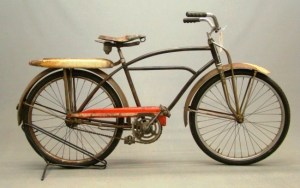
Mothers cheer us on: “You can do it.  Go ahead!  Go ahead!”  I remember vividly, her feeling good on a warm Saturday evening in Chicago.  She had just ridden the (used) small bicycle bought for me.  I ran alongside her with glee.  At the corner, she turned around, giving me the bike.  My turn.  My first two-wheeler.

“You can do it.  Try again,” I heard as I tried to gain balance, but fell into the bushes.  Getting up, scratched arms be damned!, I tried again.  Her laughing encouragement behind me grew as I cycled away from her.  At the end of the sidewalk, near the alley, I stopped (applying the brakes expertly), then fell over–and off.  I turned back to see my mom waiting at the end of the street.  I rode to her.  “Expertly,” of course.  Yeah, wobbling from side to side, houses’ steps and bushes on the right, grass-curb-city street on the left.  I pedaled the gauntlet.  To Mom.  [Trait Four: CYCLIST TRAINER]

50s bicycle

50s BICYCLE (CREDIT: LIVEAUCTIONEERS)

“What do you think I should do?”

If there is one question I ask, probably more than any other, it is “What do you think I should do?”  My kids do it.  My wife does it.  We all do it.

Looking over my Early Asking Age to now, I realize this has to be The Ultimate Question: Each of us is a Grand Inquisitor.  We seek answers.  I seek (and sought) answers.  However, the answers that come from “What do you think I should do?”, though not unique to kids asking moms, make us Deciders.  For the answer usually is, “You’ll have to decide.”  It means, “You’ll have to make up your own mind–and live with it.”  This is not cold, harsh, cruel, but is concerning, caring, and–when I think more about it–allowing the Inquisitor to grow and live.  Therefore, we talk and discuss and ask: “What should we do?”

Yes, just like a mom, she said, “Yes, you’ll have to decide.”  Just as I expected, not unexpected.  [Trait Five: NON-DECIDER/DECIDER]

Good move, for, as we all know so well, not just Mother Nature, but “Mother knows best” (often).

So I would search those student essays for goodness and admiration, stories that demonstrated “goodness” and “admiration.”  “All the good” moms do . . . “is oft interred with their bones.”

NO!  The good DOES live after them.  I CAN recall the good times, the admired times; memories of the hard times, the rough times; illnesses, job layoffs, or . . . .”

Too, from Trait Five, I learned: to be able to reach decisions, come to conclusions, after rational thought, not impulse thoughts, but rather, like a good Indiana Jones Crusader, to choose wisely.

 So, “The person I most admire from childhood . . . .”

 © James F. O’Neil   2014;  Rev. 2017

* * *

 ~Irish Proverb: “A man loves his sweetheart the most, his wife the best, but his mother the longest.”

happy-mothers-day shlomoandvitos.com

(CREDIT: shlomoandvitos.com)


BY: JAMES F. O’NEIL

“Just lather, that’s all.  You are an executioner and I am only a barber.  Each person has his own place in the scheme of things.  That’s right.  His own place.”  — from the short story  “Just Lather, That’s All” by Hernando Téllez (1908 – 1966)

Possibly the most famous work by Hernando Téllez was his short story Espuma y nada más (“Just Lather, That’s All”), a story widely read amongst American high school Spanish students.  It depicts the inner conflict of a barber who is shaving the captain of a military unit who has tracked, imprisoned, and killed some of the barber’s comrades.  The barber vacillates between thoughts of slitting the captain’s throat with his razor or giving him the expert shave for which he is known.  In the end, the barber decides he does not want to be stained in blood, but only in soap lather or “espuma y nada más.”  As the captain leaves, he reveals that he heard the barber would kill him; his visit was to see if this was true.  [Summary by Wikipedia]

I first heard about this story when I was teaching 10th grade English in Florida.  I knew nothing of it except it was a film available through the A-V Department.  “Anything I could use to keep them entertained,” I said to myself one day while I was shaving.  The 10th graders and I were having some difficulties with literature “appreciation.”  So I ordered the film.  They and I were mesmerized.  What a great film–and I had to find and read the story.  I did–again and again.

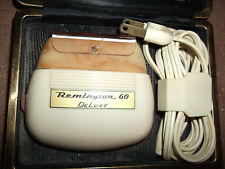
Yet aside from the literary effects of the story or the history of my classroom use of the film, the memories that audio-visual production (real film with projector!) conjured up took me back to my beginning experiences with face hair and shaving, images of laughter and love affairs with razors and shaving; remembrances of questionable pedagogical actions.  Gillette, single edge, blue blades, double edge, Mach 3 Turbo; Merkur, Wilkinson.  Words, words, words.  And Remington, not shotgun, but a 1959 Electric Roll-a Matic electric razor.

As men get older, they don’t shave as often.  If they do, it’s out of habit, not of necessity.  “Don’t hafta go ta work.”  Or when they look shaggy, or out of self-esteem–or, perhaps, guilt.  Or, possibly, old military-like discipline.  I’m one of those who don’t shave much anymore, certainly not every day, as before.  “In the day,” I used to look forward to Saturdays, for a day off–especially from shaving.  Yet how excited and eager we were “once upon a time” to be able to shave like our dads, brothers, or uncles.  Then.

Today, shaving and all it entails is such big-money business, in stores and in advertising.  Reggie Perrin was the consummate Razor Man, from reggie-perrin-bbc-martin-clunesBBC-UK: from the company always trying to out-blade the multi-blade blade.  Reggie was British comedy.  More important, who would ever have thought of a sit-com about a razor blade engineer-salesman, and his company’s Quest for the Perfect Razor Blade.  The elusive “Perfect Razor Blade”–or even The Perfect Shave, like the search for The Holy Grail or the secret of alchemy.  We men (mostly) continue our Quest, as the mythics tell us “from the beginning” (ab initio) until… 

Which brings me up to my story.  (My “beginning” early memories of collecting “stuff” includes digging through garbage in the neighborhood alleys of Chicago to find used razor blades.  Whatever possessed me to do such a thing?  [I had quite a collection of Gillette Blue Blades.  I related some of this story of collection/addiction previously: https://memoriesofatime.com/2013/10/25/confessions-of-an-addict-reflections-on-collecting/].)

During my puberty and adolescence, peach fuzz came, sprouted in the pores on my face where zits did not thrive.  As I aged, I found razor blades not kind to my bumpy face.  My Uncle Bill gave me the Remington electric in 1959 that I used through my senior year of high school, then took to college. 

remington-electric-razor-my-first

JIMMY O’NEIL’S FIRST RAZOR

(Any memory images of college shaving are non-existent, more than a blur.)  My Electric Days have included Norelco products and mini-portables–and Braun Mobile units, battery-powered, for quick touch up works, at home or office.  These have been delightful.  Thomas Edison notwithstanding, I always have come back to the lather and the razor.  I have been on the receiving end of the lather and the blade: in college, a classmate who did haircutting offered to give me a shave.  My first and last with a straight edge, though older barbers still do neck trims with straight razors, and around the ears. 

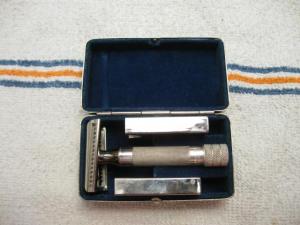
For our first Christmas after our wedding, my new bride learned–perhaps from hints I had made, or from her reading–that The Perfect Shave Tool was a Merkur (German) razor wedded to a Wilkinson Sword Blade blade (made in England).  These, with a genuine badger bristle brush and a bar of Williams Shaving Soap were my gifts under the tree in 1963. 

merkur-razor-by-toecutter1967-photobucket

MERKUR RAZOR (by photobucket)

Brushes later, shaving mugs later, then Burma Shave canned lather, or Barbasol Thick and Rich (with aloe, of course)–to say nothing of a cup of Old Spice in a mug–have been used, tried, sampled (gels never were a success), and discarded.  I am a fickle shaver with lather, even trying shaving using messy (non-foaming) greasy-like cream or Noxzema.  Messy application, messy shaving, messy clean up.  (But, incidentally, a clean shave.  In spite of that, not worth the mess.)

In the past years, I have tried different razors and a combination of blades.  No Reggie Perrin blades (six or seven?), but single, twin, triple, with Atra razors, various Gillette models, the Merkur, and the Mach3 Turbo (current).  Harry’s in New York sent me a trial sample kit.  Harry’s is becoming popular, with good products and mailing.  But I just could not maneuver the blade under my nose…and around my nostril…  So No to their beautiful razor and handle and shaving cream and Blade-of-the-Month Club.  And I also do not need any Gillette Fusion!

So this story ends.  Not quite.  That film for the 10th graders.  Whatever possessed me (another possession) to bring brush and soap and razor to class and ask for a volunteer.  Was I sure of what I was doing?  (Did I care?)  I was certain that many of the peach-fuzzed boys had not yet shaved; many of the girls (I assumed then) had never seen any boy shave, or watched anyone shave, for real or in the movies (and certainly not as done in the Lather film).  Up stands Jerry Cohee, and comes to the front of the room.  “Gather round, kids,” I might have said, putting a towel around him.  I had the water and the soap ready.  In the cup, I “began to stir with the brush…and whipped up the soap” and just lathered.  I took my razor, and off they came, the hairs on his chinny, chin, chin.  Voila!  Done!  “Next?”  No Next.  Time for the bell. 

That was the end.  The last time I showed that film.  The last time I demonstrated expert shaving in the classroom.  The last time I taught 10th grade, and high school classes (moving on into a community college setting).  After all, though, it was one of those memoriesofatime never to be dismissed as trivial or insignificant.  So much surrounds it making it a great story.  And that’s it.

Telling stories about shaving isn’t as glamorous as writing about food in the movies, diets, exercise plans, building muscles in a gym, or travels to Paris, or babies’ first walkings–perhaps.  But I enjoy telling my stories about shaving.  At the same time, I have been thankful, at times, that I did not have to worry about cutting or nicking an ankle or taking a chunk out of my knee or calf, or messing with a razor in a bathtub.  I just need some hot water, a sink, a good razor and blade, and Just Lather, that’s all.


© James F. O’Neil  2016

shaving-bowl-and-colonel-shaving-brush

SHAVING BOWL AND BRUSH


BY: JAMES F. O’NEIL

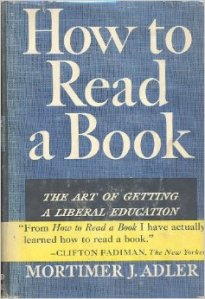
How to Read a Book by Mortimer J. Adler

how to read a book by mortimer adler old

What a great book for me!  While a senior in high school, I belonged to the Book Club.  A group of us would meet once a month to discuss a book chosen by a faculty advisor.  He prepared questions for our comments.  Our first reading was Adler’s book.

This now-favorite and well-used book (first published in 1940) is still available in both “real” print and “electronic” print.  I have gone through two or three copies–and have given copies as gifts.  Were I to point out a most influential book in my life, Adler’s would be one of the three (followed by The Power and the Glory [1940] and A Tree Grows in Brooklyn [1943]).

Often I see Adler’s book staring at me from its place on my bookshelf.

Looking through this book not long ago, I was searching for an answer to some question about my teaching career and about students: “…although the teacher may help his student in many ways, it is the student himself who must do the learning.  Knowledge must grow in his mind if learning is to take place.”

At that point, in a special mental instant, memory-filled, I became so aware of how far I had come in my learning and discovering, by reading.  Then there occurred a light-bulb “Ah-ha!” kind of connective moment,

light of reason

not about reading but about my own discovering, by do-ing.  I stood before my bookshelf, holding Adler, musing: What have I done? 

When I was being presented with my retirement gifts and honor plaque, “For his twenty years of full-time service…,” I stood there–really–thinking about my grandfather teaching me how to do “hands-on”: the practical, not the theoretical.  Nailing and sawing and shoveling and painting and gluing.

So much of my teaching career was not “hands on”–except, of course, when I would finger paint with my Head Start students; except, of course, my writing class notes on black, green, and white boards; except, of course, for correcting-annotating-commenting upon hundreds and piles of student papers; except, of course, for typing lesson plans, calculating and entering grades and achievements.  (Late in my career, though, I was doing “hands-on” computer instruction.)

Adler’s how-to book came long after some of my how-to experiences.

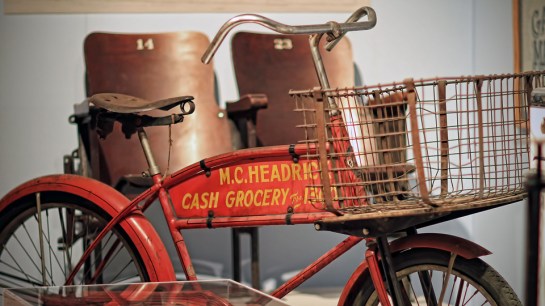
While in grammar school (elementary school), I did babysitting duties: bathing, feeding, and bedding (and changing diapers).  Yet I also was able to get a “real” job at a local grocery story.  I put up stock, helped clean up, but most importantly (since I was an experienced newspaper delivery boy), I was able to be trusted to deliver groceries.  Not as easy as it sounds, considering the delivery vehicle:

grocery bicycle

DELIVERY BICYCLE [RUSTED]

Careful and skillful, I did not let the bicycle tip or turn, spilling the contents of the basket–well, not often.  I learned then about center of gravity.  (The turning bike wanted to pull me over.)

Sometimes “all thumbs” at changing faucet washers, and driving nails, I still managed to be “hand-y”: knowing how to paint, scrub floors in the local school with a temperamental scrubbing machine, do dishes (glasses, knives and forks first; dishes, pots and pans last); mow lawns, shovel snow, change tires (automobile and bicycle).  (Later in life, in my automotive-mechanic stage of life, I actually installed water pumps, changed brakes, and even added a Holley 4-barrel carburetor to my 1954 Ford!  What achievements!)

1954 ford

I could tie a tie, long after learning how to tie shoelaces; shave my face, handwrite, and sign my name.  I hate to dust, but I can organize dirty clothes and do laundry.  And from observing and reading, I could/can make a “signature” meatloaf!

While working in a foundry, handling a swing grinder and hand tools, I made, fashioned, and finished dies for plastic companies, or was grinding off mold-edges on fire hydrants or small engines, still hot from the casting.  This work was dirty, sweaty, and hands-on. 

Yes, I have been a doer, with hands and fingers.  And I am pleased. 

I did, though, have my creative artistic attempts, like drawing flowers that looked like lollipops; then had twenty good years using my hands with glass, colored and contoured, fabricating flowers and shapes and geometrics that let the light shine through: my stained-glass years.

The Maltese Blue--One of the Best

THE MALTESE BLUE

All this and more.

My story of learning and discovery, however, cannot end without mention of one of my other greatest accomplishments of manipulative making.  I was privileged, honored, to be able to use my hands in a bookbindery.  Now how is that for a Mortimer Adler segue?

As a college junior, I found a place in the college bindery, an opportunity for me to come in contact with paper, cloth, glue, drill presses–to love books even more and realize the sacredness of pages put together.  There I folded and bound papers and pages into sets, the fascicles; sewed and pulled and tightened using needles and “thread” to sew units, not unlike Shakespeare’s quartos and octavos.  I grouped, squeezed, and pressed together the clusters of papers, then glued and waited.  The ends of the pages were trimmed with large-bladed cutters; I lost no parts of any fingers or thumbs. 

I learned how to make covers of cardboard and cloth, uniting the covers to the sewed and glued pages.  I pressed all parts together, and waited for drying.  I even learned to print titles, imprinted, impressed, using fonts of type and gold leaf foil.  I bound magazines, students’ notes, paperback texts, library journals, old books.

book edge of grant memoirs

I was proud of my work; I did my job.  I was good at my work and all the work I have done “with these hands.”

From all of this–from my reading, from my doing, from my remembering–it is that when I consider this “do-ing,” I am well pleased, something akin to sticking in my scarred thumb and pulling out a plumb–and saying, “What a good boy am I!” 

I did well, with my fingers and my thumbs. 

©  James F. O’Neil  2016

Little-Jack-Horner the color com