Archive

MEMOIRS

By: James F. O’Neil

“Hi!  I’m Jim.  I am a collecting addict.”   “Hi, Jim.”

My memories of collecting “stuff” include digging through garbage in the neighborhood alleys of Chicago to find used razor blades.  I had quite a collection of Gillette Blue Blades.  Of course, I had to wash off dried shaving cream and dead whiskers, usually doing this in my bathroom sink.  The hazards of washing used razor blades are obvious: cuts and blood.  I stored the blades in metal Band-Aid containers.  (My mother knew little of my secret stashes–though she later found out.) 

  razor blades

I was 7 or 8 years old, as I recall now.

I collected used medicine bottles of all sizes, shapes, and colors.  I had my own little pharmacy with my little brother, Tom.  What a bottle collection we had!  We played with pills, mixed colored water, and made prescriptions for hours and hours on end. 

medicine bottles

Picture credit: sks-bottle.com


(I used my A. C. Gilbert chemistry set for more sophisticated medications–even buying test tubes from the real local pharmacist.)


1940s_Gilbert_chemistry_set_04

Photo: wikipedia


I was 9 or 10 years old then.

Then I had some electric trains, made model airplanes–plastic and even a few balsawood.

10th mountain

10th Mtn Div.

During high school I added to my Army and Air Force sleeve insignia (SSI) collection.  Earlier my grandfather had helped me with the original collection which I used for merit-badge-winning Boy Scout project.

stack of textbooks

Photo: ucf.edu


In college, I collected textbooks…

When my sons were growing, one collected stamps (with me) and one collected coins (with me).  Who was really collecting?  Perhaps re-living my own childhood collecting days, still “addicted” after all those years?  (Baseball cards one son collected; I helped feed his addiction at Christmas time.)

And now, after so many years?  I am collecting again. 

Collecting, to me, is healthy.  I guarantee, it keeps me sane, makes me “whole.”  One hour’s visit to a psychiatrist used to cost me $160.  Now I have something physical to show for my “mental health” expenses. 

So I am back at it, since 2004.  Slowly I began to walk the path of addiction. 

Down that road I went.  What I have found is rewarding: reading and doing research while collecting  WWII model airplanes. 

Some LVR s Models

Diecast Model Airplanes


I enjoy reading: about pilots, planes, places; stories, anecdotes, interviews, memories, recollections. 

Thus, here is what I have learned: The more I learn about one little bit of this or that, the more I realize how impossible it is to really “know it all”–like trying to collect it all.

When it comes down to it, as all know, it’s “whatever turns your crank,” isn’t it?  What I collect, how I collect, why I collect makes me, me.  It is fun and enjoyable.  That works for me–and guides me.

 However, forget the old razor blades!

 “Collecting is the sort of thing that creeps up on you.”  –Paul Mellon

©  James F. O’Neil  2013
By:  James F. O’Neil

“Life grants nothing to us mortals without hard work.”  –Horace

October.  Summer is a memory.  Schools are back in session for a new year, a new term.  “What I Did Last Summer” is long finished.  But wait!

What did teachers do “all” summer?

In my entire college education, I had only one course in economics.  I did not understand much of it; the plain grey-covered textbook weighed at least 15 pounds.  My transcript shows that I received a C in Econ 152 Intro to Economics.

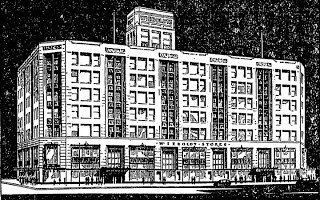
My work-life began with a Social Security card, and a job in the produce department of Wieboldt’s in Chicago, on 63rd Street and Green.

 Wieboldt's 63rd and Green departmentstoremuseum.blogspot.com

Photo: departmentstoremuseum.blogspot.com

This job brought me my first real paycheck and my first taxed Social Security earnings ($21) in 1957.  At sixteen, I was on my way to retirement (and the not-yet-known-Medicare), but certainly did not know it nor understand what was ahead for me in the work force.

In 1957, I was a junior in high school.  I had no earnings to speak of until 1963, the year I began teaching, the year I was married.

The Intro to Economics course taught me nothing about budgets, doing income taxes, withholding, rent, income, health insurance.  The GNP and Adam Smith did not help me with my first checking account.  (We did money orders for the first two years together.)  

We newlyweds had rented a nice one-bedroom apartment, 2nd floor, in a three-story building with long balconies, and dumpsters in the parking lot in the rear.  Wonder bread was 25¢ a loaf.

 wonder-bread-sign-garry-gay images.fineartamerica.com

PHOTO CREDIT: garry-gay images.fineartamerica.com

We could fill the tank of the ’62 Corvair for $3.00; and my Camel cigarettes were 25¢ a pack.

However, we soon realized near the end of the first year together that my teacher salary of $4300 a year was not going to be adequate for our lifestyles of fast cars and nightlife at the drive-in. 

During the summers after a school year, most young teachers, having reported final grades, and having cleaned their classroom and done other bureaucratic duties in order to receive the final paycheck, had to find work for the summer. 

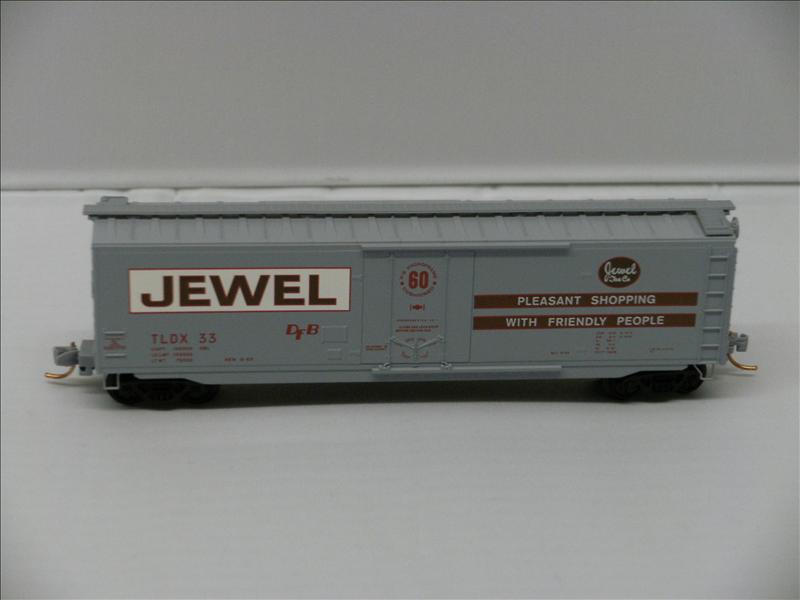
In the summer of 1964, I unloaded boxcars for Jewel Tea Company. 

jewel tea box car americanrailroadcentre.com

Photo of Model Boxcar: americanrailroadcentre.com

Unloading boxcars was, without a doubt, the hardest work I have ever done in my life. 

I was a lean, mean machine who could unload fifty-pound packages of bags of sugar, emptying a “sugar car” in an hour.  Green beans and SPAM took longer.  Ketchup cars were often scenes of massacre as the cars were “humped,” sending cartons of ketchup smashing against walls and ceilings.  After the broken glass, crushed cartons, and sprayed blood-red ketchup were disposed of, the remnants were able to be stacked in proper form on the pallets, awaiting the two-pronged forks of the lifts.

Summer could not end soon enough, with sandwiches made with ground baloney and mixed relish for lunch.

After the next school year?  No more bloody boxcars. 

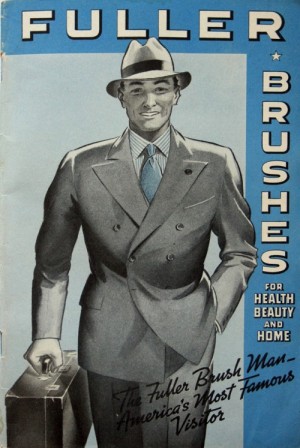
“Fuller Brush!  Good afternoon!  I have a few specials to show you today.”

fuller brush man www.emissourian.com

Photo: Fuller Brush Man http://www.emissourian.com

The work was fun and the products were good (like the DCW–Dust, Clean, Wax–cleaner).  And the brooms never wore out.  My territory was mostly in the Palatine area near Chicago.  Selling, carrying that Fuller Brush case, then sorting orders and packaging and then making deliveries, was the routine.  The best part?  Meeting people–and no baloney sandwiches.

My territory got too big; my manager wanted me to do more.  I quit. 

After the snows melted and the spring rains came, I knew summer would come after another school year finished.

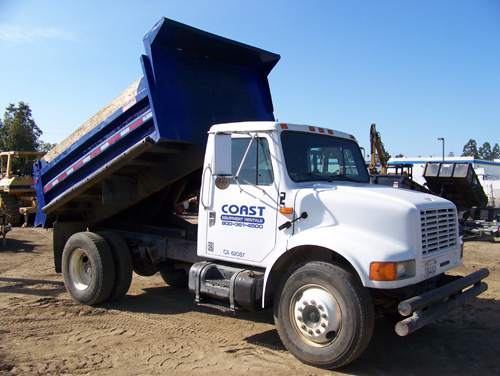
I drove a dump truck.

dump-truckDump Truck

I worked for a landscaper.  I was a real “sod-buster,” taking the truck to the sod farm, getting sod or loads of dirt, and delivering–safely, through the streets and on the roads of northwest Cook County–to the job sites. 

My sod-busting and sod-laying and plant-planting work brought me home every night looking like a Welshman from the mines. 

At the end of the summer of 1966, that chapter of my life, which really began long before at Wieboldt’s, concluded.  We left Chicago and headed up to the Land of 10,000 Lakes.  It was to be our first big Adventure in Moving.  But more summers would lie ahead.

I was only 25….

oh-the-places-youll-go novelreaction.com

Image: novelreaction.com

© James F. O’Neil  2013


By: James F. O’Neil

“Who is John Galt?”  —Ayn Rand, Atlas Shrugged (1957)

In this Ayn Rand book, characters are searching for a mysterious man but also searching for answers as to why things happen the way they are happening.

atlas-shrugged-coverAtlas Shrugged Book Cover

Things happen.  Not often explainable.

“If you don’t know where you are going, any road will get you there” is often attributed to a Cheshire cat and Lost Alice in Wonderland.  Lewis Carroll did not really write it exactly that way, but the famous quote now grows up with us–and the “story” is more “real” than the fact.

Alice and the Cat imgfave.com

Pic courtesy: imgfave.com

Alice and the Cheshire Cat

Now that is the essence of my search: “Where are we?” and “Who is Phil McCool?”

Here is my “real” story….

Automobiles have always played a part in my growing up: our ’37 Plymouth, the ’49 black and beautiful Ford, the green ’50 Chevrolet, and then the 1956 Chevrolet (which I learned to drive).  In these cars, we made trips and traveled to parts of Chicago to visit relatives, to attend dances, to laugh and dance in beer gardens, to see movies at the drive-ins, to have picnics, to take someone to school or to work. 

Our travels together, our games in the car together, were usually orderly and educational: songs, stories, reading, quizzes, and geography lessons.  Our family travels allowed all four of us kids to learn geography, the layout of Chicago and its suburbs–and farther. 

My mother possessed an in-born compass that came with her from birth: She always knew how to get where we were going–or were supposed to go.  My truck-driver dad knew the city and his bakery-truck delivery routes.  Sometimes, though, on more occasions than I can count, we’d all be sitting in someone’s driveway or on a strange street, looking to find our way. 

My mom and dad had to work it out before we began moving again.

The “conversation” went mostly like “I know where I am.  I’m turning here.”  Then into some strange driveway, pulling in, stopping, then backing out and turning around from whence we came.

We found our way.  And when young, we kids never questioned anything.

One time, though, that all changed.  I can hear my sister now, as the ’50 Chevy made its way slowly into an unfamiliar driveway, or maybe an alleyway.  There was a pause.  Brake.  Stop.  Clutch.  Reverse.  Motion.  “Where are we?” she dared ask.  Or maybe it was, “Who lives here?”  Without a breath of hesitation, my dad answered, “Phil McCool.  It doesn’t look like he’s home.”  And we backed out and away, to somewhere.

Thus began the question that got the answer–always: “Where are we?”  “Phil McCool’s.”  And we knew no different for losing our way.  We were never lost: we were making our way to Phil’s Place–geographically located in disparate parts of the city and in Cook County, in assorted neighborhoods, or in parts of downtown.

I never, ever, remember pulling into a gas station, hearing my dad ask for directions.  With Mom’s internal, innate GPS, my dad’s driving skills (Mom never learned to drive–ever), and Phil McCool in so many destination places, there was never a need for directions (or maps) to anywhere.

As we aged, Phil became a relative of ours, a member of the family, our personal “I-don’t-know-where-we-are.”  When our boys were little, sitting in the back of our ’66 VW Square back as we made our travels from Chicago to Wisconsin to Minnesota–and around other parts of the country–they heard often their mom and dad discuss (quietly, of course) direction or location, or whether the strange house we were in front of was Phil’s.  “Who’s Phil?”  They were told, “A friend.  He’s not home,” as I backed out of a driveway, or pulled away from a curb in front of a strange house….

Phil McCool lives….

He is that Irish friend of mine with me from childhood, who now helps me find my way when I am in need of direction.  He might be that friend of Dad’s who helped him so often find the right street or address for a delivery.  But mostly he remains for me a treasured memory of a sister boldly asking for the first time, “Are we lost?” 

And never having to ask that again.  We were never lost.  We always arrived somewhere–at Phil’s, maybe first–and then we found our way.  Somehow.  (And that might have involved even later, my asking an attendant at a gas station.  The Giver-of-Aid might have been Phil.  Never know….)

*    *    *

ADDENDUM

From The Story of the Irish Race by Seumas MacManus (1921; 1982):

p. 731: MacCool, Finn (Fionn MacCumail), 64ffp. 730: Fionn MacCumail (Finn MacCool), 64ff: (p.64) Chapter XIII: Fionn and the Fiann         “Fionn MacCumail (Finn MacCool), leader of the Fian (Feninans), …lived and died in the third century of the Christian era.”  [A.D. 283]

(p.65)  The Fian: “…a great standing army of…daring warriors, whose duty was to carry out the mandates of the high-king–‘To uphold justice and put down injustice,…’”

Finn McCool's Pub finnmccools.com

Courtesy: finnmccools.com

 FINN MCCOOL’S

 (“…a Pub named after Finn McCool, the legendary giant of Irish folklore,…”)


©  James F. O’Neil  2013

By: James F. O’Neil

“Home is where one starts from.”  –T. S. Eliot

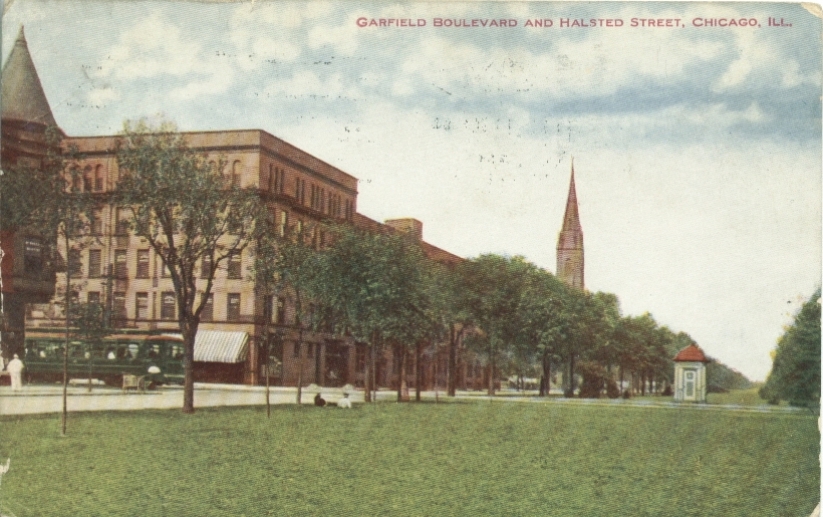
I used to fly in my dreams.  Drs. Freud and Jung were not worried that I crashed, got up, ran up four flights of stairs, and flew again.  My favorite crash-site was the dirt and dirty non-grassy courtyard behind the Byrne’s Building.  This magnificent brownstone of four floors and some seventy-five apartments faced the beautiful grass-center of a divided Garfield Boulevard on the South Side of Chicago. 

garfield blvd & halsted chicagopc.info garfield blvd 50 chucksViews of Garfield and Halsted 

The apartment had its beauty and elegant layout, well planned by architects to house the growing middle-class of Germans and Irish whose ancestors slaved in The Back of the Yards (the stockyards), but who could not yet afford their own houses.

This structure was part of the South Side I knew best, bordered by Garfield-55th, Halsted, and Green streets. 

The building has disappeared from Google maps, having been demolished some time in the late 1970s.  Yet it remains an important place where my memories reside and continue to live–and a place to which I return often.

We moved from South Marshfield to Green Street.  Our new home in the Byrne’s Building gave us…four flights of stairs, little privacy (with its eight apartments to an entrance), noisy back porches seen by all other back porches, and less room. 

And the Byrne’s Building had bed bugs.  Soon after we moved in, I can remember my dad with his bar of soap, trying to catch the buggers, in the front bedroom off the living room, which my baby brother shared with my parents.  Whomp!  Whomp!  Whomp!  went the bar of soap against the mattress–and the tearing sound as my mom pulled down the wallpaper.   

The Wonder Years for me began there, the early adolescent years, the new high school years, my growing years–years that provided me with countless memories.  The wonders that were part of my life there included illnesses and happinesses, graduations and birthdays, family celebrations and holidays, freezing Chicago winters and street-softening summers.  And a place where dreaming, I fell to the ground, or flew to the dirt center, crash-landed–then being resurrected, then awakened.

I was comfortable, I recall, in the larger bedroom with one brother and the bunk beds.  Its window opened into the void between the walls of the building, that emptiness adjacent to eight sets of bathroom windows, the stale air–and sky–and the laughter and crying and more.  Closed, the window provided some relief from neighbors in summer. 

My desk for high school subjects faced the window my mom tried to decorate.  The beds for us were next to the wall and the ornate sliding door, once dividing the living room (the parlor) from the sitting room in the brownstone elegance of a time gone past.  Now the door was squeezed open for air–and for eavesdropping.

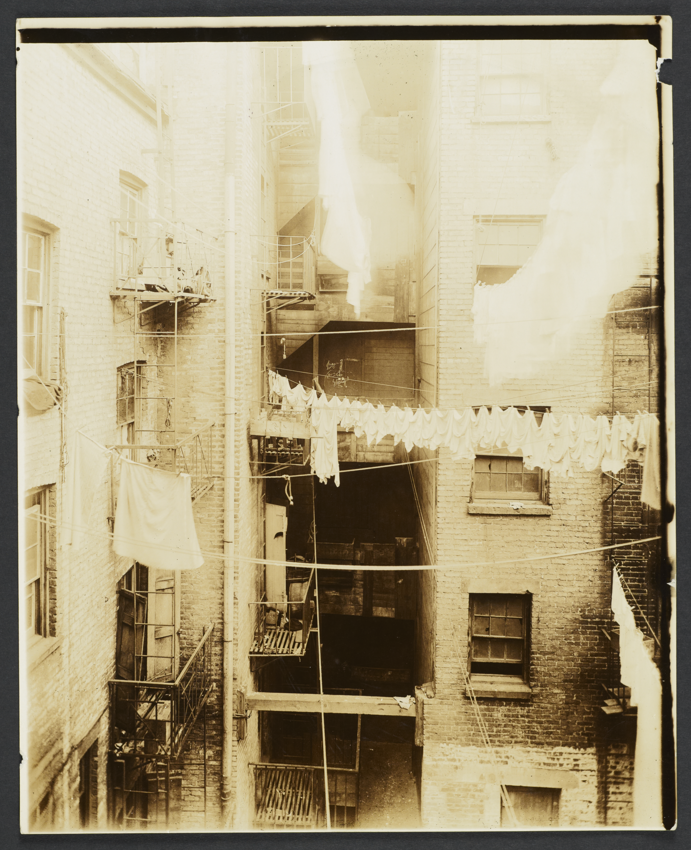
And then another summer on the fourth floor, staring down into our back yard: at clothes lines on pulleys, like a maze of crossed telephone wires, attached to the Power House; at children playing marbles in the dirt, or pushing baby buggies through the moonscape called a playground, without any grass, and maybe some few weeds; at the dirt devils, twisting their way around and through neatly-hung clothes, and clothes lines, those clouds of dust from Windy Nowhere; at the center of the yard, my crash site of dreams, with no fear of flying….

clotheslines  css.cul.columbia.educatalogrbml_css_0224

Laundry and Clothes Lines Pic: Columbia U.

 © James F. O’Neil   2013