Archive

PEOPLE

BY: JAMES F. O’NEIL

“Glorious, Joyful, Sorrowful; Glorious, Joyful, Sorrowful; Glorious.” Sunday, Monday, Tuesday; Wednesday, Thursday, Friday; Saturday. The week of the rosary, as I remember it (and before some changes made in 2002): My liturgical week began on Sunday and ended on Saturday. Within each of the “mysteries” of the rosary is the subdivision of five, and…, and…, and . . . :

Glorious Mysteries: Resurrection, Ascension, Assumption…. Joyful Mysteries: Annunciation, Visitation, Nativity…. Sorrowful Mysteries: Agony, Scourging, Crowning, Carrying, Crucifixion–as some readers will remember them.

The complexity of the religion of the rosary I had to learn early on, as an up-and-coming Roman Catholic boy. And so it goes–or went.

All of this complexity came to mind recently as I tried to organize the top drawer of my dresser: My Sock Drawer.

The drawer was a mess: things everywhere, in addition to matched and unmatched pairs of socks (a pair of socks; pairs of socks) and those lost in the jumble and tumble, without a “mate.”

As I began to try to bring order to the chaos, I noted my small pile of keys and key rings in the left-front corner. Unknown keys for unknown locks. The keys are just “there.” Receipts. And more receipts, where I neatly stack them in the right-front corner: gasoline, Walgreen’s drugs, Target, Wal-Mart, miscellaneous.

Whistles, some non-USA-In-God-We-Trust coins thrown in the back left corner; an assortment of various business cards: clinic physicians, library; Kermit Weeks, “Fantasy of Flight: An Attraction of a Higher Plane” (closed for now); “Honorary Consul of the Slovak Republic–Florida” (!); lawyers’ cards. That’s the place where I keep them.

I found under the socks–after I emptied out the drawer–a package of postcards: 37 1-cent and 15 2-cent (a total of 67 cents. Easy math). I probably bought these at a garage sale. 

Handkerchiefs, in the left corner, were overlaying the keys. Monogramed, old-white, linen, camouflage. Those extras, ready for a right-rear pocket of slacks or jeans or wash pants. (“A gentleman always carries a handkerchief,” I was taught. [Somewhere, stapled or pasted in one of my old journals, is one such handkerchief, neatly folded, pressed between the pages, with stains of mascara. A handkerchief used by the first co-ed ever who was brought to tears, in my college office, “way-back-when-in-the-day.” I cannot remember what made her cry. I cannot remember the reason for her tears. I am sure it had nothing to do with me.])

And, finally, the rosary I found, in the left-back corner.
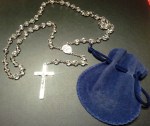
rosary in crystalRosary Found, with Crystal Beads

Crystal beads, sterling cross and medal. My mom’s rosary that I’ve had for some five years since her passing on. Now I have cleaned it and polished it. And there it rests.

Still, not the rosary itself but the “links” which came out of this rosary-discovery brought more memories: recalling catechism classes, using the rosary with all its intricacies of prayer methods, and having sore knees in chapel during rosary-recitation time.

However, one anecdote figures prominently above all others I associate with the rosary. No, not prayer-beaded mantras, like “pray for us sinners” or “blessed be the fruit of thy womb.” (Explain that one to a first-grade boy!) But, rather, it is hearing Sister Mary Philip, RSM, telling me one morning to see her after lunch. “I need you to see my sister.”

I was to become a mule, a runner (“Slang: a person paid to carry or transport contraband, especially drugs, for a smuggler.”).

Somehow, for some reason unknown to me, Sister Mary (always add the “Mary” out of respect) Philip, RSM, singled me out from my other 8th grade classmates to do “The Deed.” I was a purveyor of goods, the middleman. My reward (now, not in some afterlife) was delight and jubilation. I would miss an afternoon of classwork. Did nothing of note happen after lunch? History? Art? Music? Reading? Ah, that’s it: Silent reading. I could run errands during Silent Reading, for I was a good reader. I could miss school.

Approaching her desk, I was told to get my coat. She gave me a piece of paper with some directions, a small change purse, and, as she adjusted her Religious-Sister-of-Mercy habit, told me to be on my way. “Godspeed,” or something like that.

sisters-of-mercySister of Mercy, RSM

I had a duty; I was on a mission: to conduct an errand, leaving and returning by the end of the school day. Off I went . . . with no food or snack, no backpack, just directions and a change purse with money for the Chicago transit system, the CTA.

There I was, making my way then to the “L,” exiting at the 47th Street stop (a few stops before Sox Park-Comiskey Park).

47thSign47th Street “L” Sign

From the “L” platform, I went down the stairs to the ticket booth/fare collector’s station.
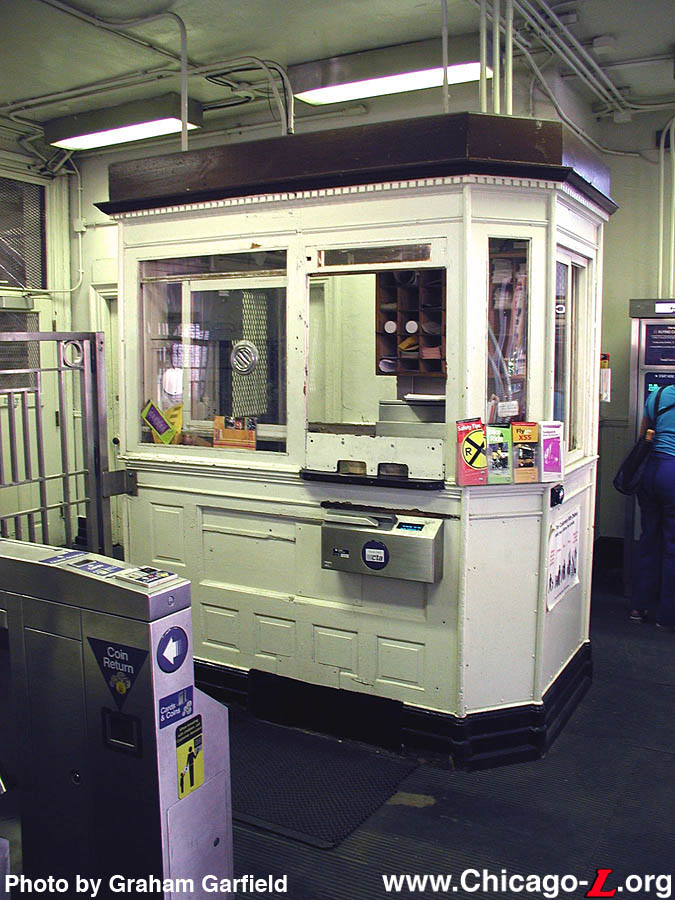
OLYMPUS DIGITAL CAMERAFare Collector Booth from Chicago “L”.org

There sat Sister Mary Philip’s sister. Only for the first time, I told her I was there for the package. She gave me a little paper bag, and a candy bar. With the package and CTA transfer in hand, I was on my way back to my school.

Often I made the trip, sometimes twice a month, receiving the goods: hand-assembled homemade rosaries. Colored beads, black beads, crystal beads; large and small silver crucifixes–all carefully wrapped, such beautiful work, as my 8th grade teacher would show me at my return.

I walked back to my desk, my classmates wondering where I had been.

“My Life with the Rosary” is certainly interesting for me, with so many memories of a time when…. I doubt any others can relate such a story (except, perhaps, those who followed after me in Sister Mary Philip’s classes chosen to do “The Deed”).

What I learned from all this is what a teacher’s pet I really was. How responsible I must have been considered–or, at least, appeared to be. I will not even mention here “child labor,” liability insurance, accountability, and other such topics. What did I know then? What if something happened on my trips? Nevertheless, I do know it was all a pretty good deal for me.

I was able to engage in one of my favorite pastimes: riding the Chicago “L.” So, in a way, I was getting paid to have fun.

oh-the-places-youll-go novelreaction.comOh, The Places I Have Been

Never did I realize how true for me. All because of the Holy Rosary.

How Glorious and Joyful it all was!

© James F. O’Neil 2015


BY: JAMES F. O’NEIL

“Friends, Good Friends–and Such Good Friends”–by Judith Viorst (1977)

I came across Judith Viorst’s essay on friendship many years ago. It was included in a writing text, as an example of one of the major (“classic”) expository writing strategies: Classification. The content is about degrees of friendships and kinds of friendships, an essay mostly about women but also does include “men who are friends.” Viorst posits some eight or nine categories. I liked/like her essay, so much more concise and example-driven than Cicero’s “classic” essay on friendship, which I once wrote about in a college paper.

I like Viorst’s varieties of friendships, which I modified for my own use, but based on her commentary: acquaintances, companions, social friends, intimates. Yet within my own classification, I even found myself making too many subdivisions, sub 1, sub 2, and on.

What more can be said, then, written about, that is not already available, from Aristotle (now that is one-long-analytical-philosophical piece–EVER) and Francis Bacon, and not to forget Emerson–and more?

For movie-lovers, the screen is filled with examples of friends and friendships, categories and kinds. (There’s that Jack Ryan character, in Clear and Present Danger, sorting out friends, and all the President’s friends.). And Stand by Me: classic. Nor can we ever forget Bogart and Bacall; Rick and Ilse?

rick and ilseCASABLANCA

Pause with me for a moment. Hold that thought-picture from Casablanca, while I come to “black books”: those small black books within which are found addresses of friends, relationships, passwords, codes, comments. Such little black “address” books become a Revelation of Life and Times and Thoughts. And mysteries. Small address books, black, leatherette, red tabs, handwritten entries, perhaps with some phone numbers. No pictures. Special books. I never had such a black book. Instead:

JIMMY'S FIRST COMMUNIONJIMMY’S FIRST COMMUNION

There I stand, on May 9, 1948, between The Twins, my first “friend-girls.” Though my hands are folded in the prayer-mode, my first little black book was My First Communion Prayer Book, not an address book. It was probably similar to this:

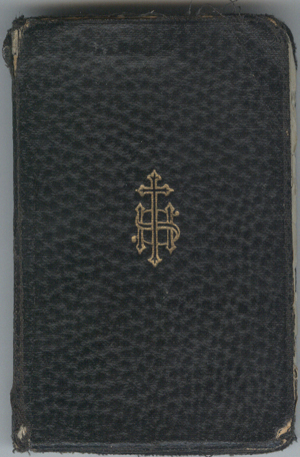
FIRST COMMUNION BOOKFIRST COMMUNION BOOK: PHOTO CREDIT: jerryhammes.com

Most likely, the book was in my little suit pocket. I used the little prayer book for a few years, until I graduated to something akin to the Saint Joseph’s Sunday Missal, then on to the Saint Joseph’s Daily Missal through high school.

Some years ago, I underwent a special period of nostalgia. I searched for a link to a past life, and another black book. I found The Book of Common Prayer, with its soft leather and gilt edges. I bought this particular book (in 2007) mostly for its beauty and its comfort-for-me content:

EPISCOPAL BOOK OF COMMON PRAYER.Photo Credit: Oxford U Press

Since the beginning, however, my little black books have morphed into larger black books, but then on to a Day-Timer, and AT-A-GLANCE (2-year format) “books.” Yet were I to have a “small black book,” it would include, among other items, the coded names and coded notes about my “something-special” friends. I once intended to write about my “friend-girls,” those women in my life who were/are special, yet certainly are not “girlfriends.”

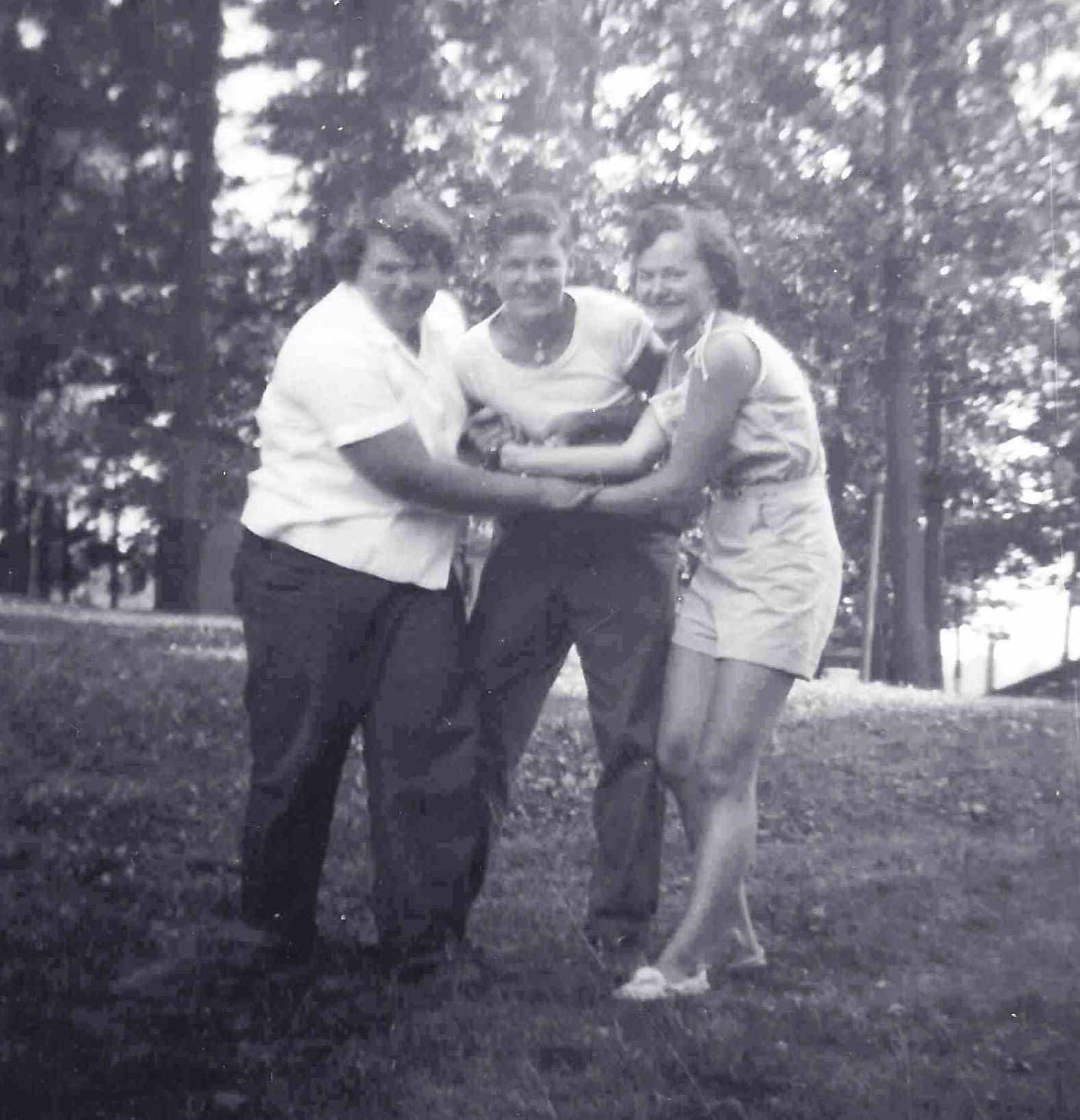
carol, jim, dianne at shubat's july 1956--10th gradeJIMMY ON VACATION 10TH GRADE

So there we were: C. Z.: At Sister Lakes, Mich., and her cousin, D. K. My first REAL Friend-Girls. Teen years in the summers, high school, and college. “Friends Forever”–until after my marriage. C. my confidante. Confessor. Mentor. Guide. Wee-hour discussions, for hours and hours, about poetry, God, friendship–and love. Then gone. A loss. One of the essential pieces of The Great Puzzle I Am…. [R.I.P. July 1998]

L. A.: Next-door neighbor: Married. I loved her. I am fourteen. I am sixteen. I am eighteen. I still love her. [R.I.P.]

T. M.: On a first date. Movies in downtown Chicago. The Longest Day.

longest dayTHE LONGEST DAY. Photo Credit: imdb.com

DUMB! Didn’t think she’d ever date me again. I was right: she didn’t. A war movie, for God’s sake?!

K. N.: Nice Czech-Bohemian girl from Chicago. I had her pictures pasted everywhere. I was a fan-atic. She was my pubescent-time fantasy. Silly infatuation with a goddess, Jeanne Eagles. I was The Man with a Golden Arm. KimKimKim. I suffered from Vertigo:

KIM.KIM.KIM.KIM.KIM.KIM.KIM.

P. S.: “My” BRIDE OF CHRIST. Most holy and beautiful. A spiritual distraction, came to be my first dark night of the soul. To the nunnery! Curse God! Conflicted. “What a friend we have in Jesus.” Not so. Or so I thought. Time healed.

AUDREY HEPBURN in THE NUN’S STORY. Photo Credit: amazon.com

D.T.: SECRET ADMIRER. I kept address and phone number in secret place. Secret letters. Mail from “D.T.” The Vixen? The Destroyer? Just a friend? Serious discussions. Two lost souls.

Oh. And:

saint pauli girl vintageadbrowserPhoto Credit: vintageadbrowser

M. V.: “You’ll never forget me.” Too young. I’ve never forgotten her. “You’ll never forget your first….”

And, finally (here), 

E. W.: Untouchable, with braces. Virgin on Pedestal. Adorable. Adored. Forever a Good Memory of a time that was good and wholesome. And how I did so well learn how to spin that bottle with her!

My friends, and such good friends at the right time.

© James F. O’Neil 2015

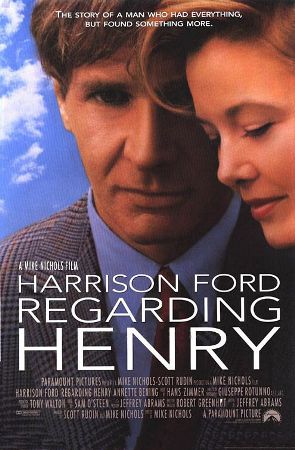
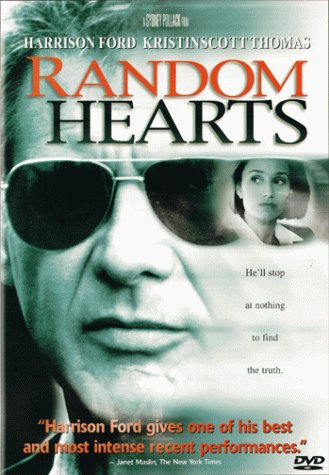
Regarding Henry wikipediarandom hearts poster

[For some interesting viewing of “friends” and “friendship,” try Random Hearts (1999) and/or Regarding Henry (1991).]

The WordPress.com stats helper monkeys prepared a 2014 annual report for this blog.

Here’s an excerpt:

A New York City subway train holds 1,200 people. This blog was viewed about 7,900 times in 2014. If it were a NYC subway train, it would take about 7 trips to carry that many people.

Click here to see the complete report.

BY: JAMES F. O’NEIL

“Wake-up call”: “a shocking event that changes the way someone thinks; an event that alerts people to a danger or difficulty; a portentous situation that brings an issue to immediate attention.” [This metaphoric term originated in the second half of the 1900’s for a telephone call arranged in advance to awaken a sleeper, especially in a hotel. Its figurative use dates from about 1990. ]

Once more–again: “What are the best Christmas holiday movies?”

I wouldn’t want to be left home alone to watch the bad Santa; however, I am a die-hard fan of being in love–actually. I do believe a miracle, which might occur in New York on 34th Street. Or even in New Jersey, in 2001, thirteen years ago, where Jack and Kate live, thirteen years after he did not board a plane to London and to a wonderful life.

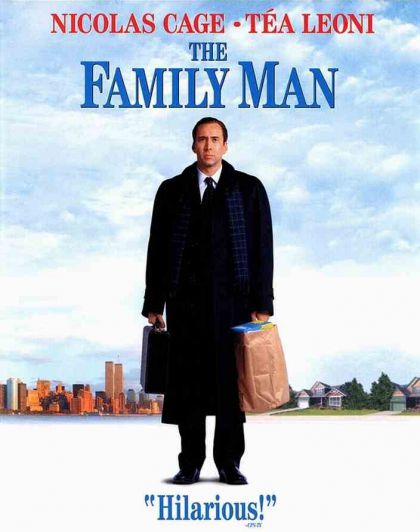
The Family Man

The Family Man is a Christmas story, somewhat about the holiday many peoples of the world will observe. Jack’s movie-story really begins when he goes to sleep, on Christmas Eve. Does he dream, or have the nightmare before Christmas? Or is the story simply a glimpse of “what if”? He says, “One morning I woke up and it was all different.”

We have been scrooged with this kind of “what-if?” story before, in literature and in film. And the endings? “Then I woke up”: that cliché line given after a person relates a dream to another. Yet sometimes, how real it all seemed. And in the telling, the listener, usually our listener friends, wants to know: THEN WHAT HAPPENED?

“Then I woke up.”

What a great line. The older we get, I believe, the wiser or more aware of our lives, if we examine them. This includes especially into the teens when a mom or dad shouts/argues/exasperates, “Do you know what could have happened? What if . . . ?”

Then, as we age, we do have second thoughts about a decision we made, and wonder whether we made a wise choice. Maybe we even want or need second chances. Often we are given a second chance, or are rehabilitated, or do have it to do over (though instant replays are not often present to overturn our lives).

Where would I be if…? Where would I begin to re-live or re-begin, or even want to change how it would all be different?

For some, ONE event/moment with awareness of the implications or consequences can or will be the “wake-up call.” Some others have to be “hit over the head” with the truth.
In the film, acted out honestly and characteristically as Nicholas Cage and Téa Leoni do in this movie about lives and family matters and friendships and jobs and careers, what would be that ONE event/moment for change? And then he woke up. And then?

What a profound, unscrooged Dickens film. This is a “big-people” movie. “Hilarious”? A comedy? As, All’s well that ends well?

As I think about what I have written, or as I write this, music keeps playing in my head: “Chances Are”:

Guess you feel you’ll always be
The one and only one for me
And if you think you could
Well, chances are your chances are awfully good.

Here is the motif, for me, which permeates the film. Taking chances, but then consequences. Maybe best not take that road less travelled by. Or maybe do.

So, the film ends for me, during this special season, despite all the sadness in the world, within people, between people/peoples, among families, concerning bitterness and rivalries, that chances are, positive. That it will work out…one way or another. And we pray for peace on earth, for that someday. Someday chances are awfully good. How? It’s a mystery, but it’s a wonderful life/world. [Music plays: “Yes, I think to myself, what a wonderful world. Oh yeah…”]

© James F. O’Neil 2014

“When I consider how my light is spent”? –John Milton
Jack says: “I don’t have it all figured out.”