“Let’s get some clarification here before we vote….”

“So all of what we have here is THE KNOWN.” Science can/does deal with the KNOWN.

“But then we have THE UNKNOWN, the not known.”   Maybe.

“So all of that could be THE KNOW-ABLE?” Science can/will/might deal with the KNOWABLE.

“But what about the other unknown, THE UN-KNOW-ABLE?” Science cannot, through/by theory, assumption, or and scientific principles, deal with the UNKNOWABLE.

“So all of that may have to do with theology, philosophy, psychology, anthropology, sociology?”  Maybe.

In our thinking, reasoning, problem solving, the KNOWN or KNOWLEDGE–by societal agreement–becomes the basis for the thinking about a subject or problem under study.

“Like global warming?” Yes, knowing what to know. “Like ‘Why are we here?’”

SO: “Somewhere, something incredible is waiting to be known.” –Carl Sagan

* * *

 “Get your facts first, and then you can distort them as much as you please.” –Mark Twain

“Hey, look. Here are the facts.”

“The fact of the matter is…”

“Let’s look at the facts.”

“Just the facts, Ma’am.”

“Well, look, I like the fact that…”–Gov. John Kasich

* * *

 “Everything we hear is an opinion, not a fact. Everything we see is a perspective, not the truth.” –Marcus Aurelius

FACT = a bit of information, verifiable; something known with certainty or asserted as certain; objectively verified; something having real, demonstrable existence. (However, “facts” can change, are not ALWAYS immutable, are necessarily incomplete, dependent upon science and uses of technology.)

OPINION = a belief or conclusion held with confidence, but not substantiated by positive KNOWLEDGE or proof.

JUDGMENT is an opinion based upon reasoning or evaluation; a feeling or sentiment; any conclusion to which one adheres without ruling out the possibility of debate.

TRUTH = conformity to KNOWLEDGE, fact, actuality, logic; or a statement proven to be accepted as true.

BELIEF = a conclusion, not necessarily derived first hand, to which a person subscribes strongly. [Sometimes is explained as “What I stand up for”; whereas a VALUE is sometimes explained as “What I stand around in.”]

CONVICTION = a belief that excludes doubt and usually proceeds from weight of evidence. [a mental construct]

PERSUASION = a strong belief, but not based necessarily on the intellectual. [an emotional construct]

CONCEPT = a general idea or understanding; a thought or notion; a representation formed by generalizing from particulars.

IDEA = that which exists in the mind, actually or potentially, as a product of mental activity (thought or KNOWLEDGE).

LAW = a generalization based upon the observation of respected events [Gravity must be caused by an Agent acting constantly according to certain laws, but whether this Agent be material or immaterial I have left to the consideration of my readers.” –Isaac Newton]; a rule established; a PRINCIPLE or rule obeyed in all cases to which it is applicable. [Gravity]

PRINCIPLE = an accepted or professed rule of action or conduct; a fundamental, primary, or general law or truth from which others are derived; a fundamental doctrine or tenet; a distinctive ruling opinion; a personal or specific basis of conduct or management; a guiding sense of the requirements and obligations of right conduct; an adopted rule or method for application in action; a rule or law exemplified in natural phenomena or the working of a system; an actuating agency in the mind or character, as an instinct, faculty, or natural tendency. [Bernoulli’s principle]

VALIDITY = being sound, supportable, correctly inferred from a premise; whereas RELIABILITY = dependable.

SCIENCE = the body of interrelated superordinated, subordinated statements, which are generalizations which deal with realities. [Generalizations are in the form of theories.] SCIENCE is observation, identification, description, experimental investigation, and theoretical explanation of natural phenomena. [A science is any methodological activity, discipline, or study.]

ASSUMPTION = a statement accepted or proposed as TRUE without proof or demonstration. It can be used as or become the basis for drawing hypotheses that can be investigated.

HYPOTHESIS = an assertion subject to verification or proof; a premise from which a conclusion can be drawn; an ASSUMPTION used as the basis for an action; a conjecture; a basis for further investigation.

AND

THEORY = systematically organized KNOWLEDGE applicable in a relatively wide variety of circumstances, especially a system of ASSUMPTIONS, accepted PRINCIPLES, and rules of procedure devised to analyze, predict, or explain the nature or behavior of a specified set of phenomena.

Question_mark_(black_on_white)

“DO I UNDERSTAND THIS?”


“A gem cannot be polished without friction, nor man perfected without trials.”–Chinese proverb

THEORY: a set of assumptions from which a set of empirical laws (or principles) may be derived.

Good theory leads to new knowledge, serves as a guide to new knowledge by suggesting testable hypotheses. (Theory does produce hypotheses.)

See: Germ theory, Atomic theory, Maslow’s Theory of need.

Theory: is a tool for inquiry; provides a general explanation for phenomena; provides a method of investigation; organizes logically by selecting facts; orders observations and experiences.

Theory DESCRIBES, ANALYZES, PREDICTS

THEORY is what I learn; PRACTICE is what I do.

Properties of theory: generalizability, longevity, reliability, dynamic, adaptability, stimulating (for further knowledge), objectivity, useful (utilitarian), predictability, not true or false but useful or not.

Theory is difficult to define; it is even often difficult to have agreement on the concepts of the definitions.

Theory is not a law, but is a set of assumptions from which a set of empirical laws or principles may be derived–derived by purely logico-mathematical procedures.

Theory is a set of assumptions or generalizations supported by related philosophical assumptions and scientific principles.

Theories serve as a basis for PROJECTING hypotheses which suggest a course of action; the hypotheses are then subjected to scientific investigation; the findings are evaluated to validate NEW scientific principles and philosophical assumptions. [Theory in Action]

Theories tell us what facts to look for, select facts, allow (help) us to ask the right questions.

“Well, that’s all fine and good. But it’s just theoretical.”

Question_mark_(black_on_white)


BY: JAMES FRANCIS CUMMINGS O’NEIL NEE ČAPEK

“I know my father and my mother, but beyond that I cannot go. My ancestry is blurred.” –V. S. Naipaul

* * *

Once upon a time, from my interviewing my mother, and thus it is written (here), I learned that the beautiful young maiden (of course!) …

KATRINA VON KOENIG, Great Grandma Katrina, a worker in the Barony of Luxembourg (it’s sounding so romantic and mysterious) met

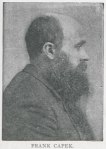
FRANK ČAPEK [b. 1834], a laborer who was (maybe) in the Prussian Army (that would be romantic, like in Elvira Madigan), later turned anarchist, and (perhaps) a bomb manufacturer, in Chicago, for the eight Accused Conspirator Workingmen in the Haymarket Affair (Riot), May 4, 1886.

HaymarketRiot-Harpers

Drawing from Harper’s Magazine and Wikipedia

I heard about this man when I was a child. I grew up believing I was related to a famous anarchist, because Grandma Schuma said so, and because my mom told me so.

I couldn’t wait to see my Great Grandpa Čapek’s picture in the newspapers.

Frank Capek (Great Grandpa)

I spent hours at the beautiful Chicago Public Library on Michigan Boulevard, using the actual newspapers and microfilms of the events of May 4, 1886. (At one time later, my Uncle Elmer told me he studied, too, about his grandfather, and claimed he recognized pictures. He lived with Great Grandpa at 5431 South Seeley Avenue [I remember that house across Garfield Boulevard] until the Prussian soldier died.)  Great Grandpa Čapek was a talented watchmaker. He died in 1930.

* * *

Frank and Katrina, whom I did not ever know, had eight children, with beautiful ethnic Bohemian names: Emilie [b. 1886], Mike, John, Frank, Joe [b. 1884], Theresa, Katherine, and Mary. I could never understand why my Bohemian relatives chose these names. But when I thought about emperors and empresses, presidents and monarchs, like Franz Josef and Maria Theresa, or King John, maybe the “common” names were more special emulations than Leopold or Vlad the Destroyer. (Not many songs about Leopold, but Emily? Maria? and Joe? or Meet John Doe?–or A Guy Named Joe–or, even better, “What a good Joe he is!,” the compliment.)

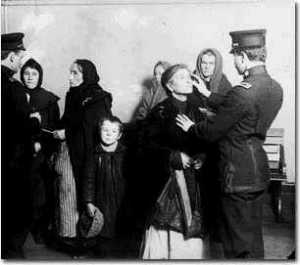
immigrants at ellis island

Bohemian immigrants on Ellis Island

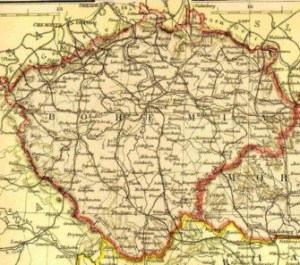
There they were, these Bohemian kids (not CZECHS!, not Slovaks, not Slovenes, but Bohacs, or Bohunks–Hunkies or Honkies!). Czechoslovakia was formed in 1918. Bohemia was a kingdom, from “way back when,” like before A.D. 600–those days of Beowulf….

bohemia in 1882

Bohemia in 1882

I learned–and was reminded often–that I was a Bohemian, because “Mom said so.” There I was, growing up in the ethnic South Side of Chicago: Damen and Seeley and Garfield Boulevard (55th Street), and Back of the Yards. Some neighbors were postal workers; others, electricians, tradesmen, homemakers. Family people. Neighborhood people. [Emilie worked in Upton Sinclair’s The Jungle. She was a meat packer for Libby Foods.]

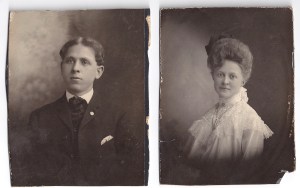
JOE ČAPEK married ANNA JARYKOVIC.

Joseph Capek and  Anna Jarykovic

JOE AND ANNA WEDDING PICTURE

Anna–of course, it had to be “AH-NAH”–died in 1924. In 1918 she had contracted the flu–the world influenza pandemic that occurred near the end of World War I. (More died from the disease than died in the war. I learned that in school.) She then contracted and succumbed to TB. Growing up, I remember many trips to the North Side, to Bohemian National Cemetery, and the graves and headstones.

Bohemian_National_Cemetery

Bohemian National Cemetery Entrance

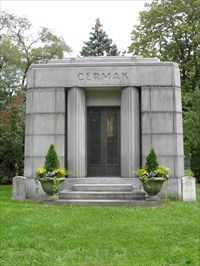
And Mayor Anton Cermak’s mausoleum

cermak tomb

Cermak Tomb

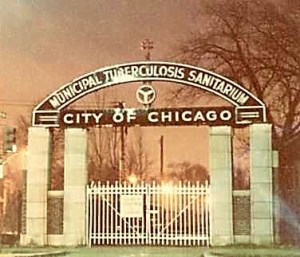
–and the nearby restaurant that had the best roasted duck, with mashed potatoes and gravy. On the way, we sometimes passed the TB Sanitarium….

tb sanitarium in chicago Jennifer A. Stix 1974 photo

Photo by Jennifer A. Stix 1974

Joe and Anna begot: Herbert (Uncle Herbie, who went with Aunt Flo); Joe (Uncle Joe, who went with Aunt Aggie); Elmer (Uncle Elmer, who went with Aunt Gladys) —I knew them all; and LILLIAN CATHERINE [b. November 16, 1918] (my mom).

Lillian C. Capek Schuma

LILLIAN C. CAPEK

Mother Katrina, while helping Anna with the children, died of a heart attack: November 1918….

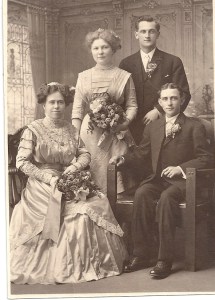
In June 1910, having fallen (madly?) in love, Emilie Čapek (Joe’s sister), while working at Libby Foods, married her handsome supervisor, Edward Albert Šuma [Schuma] [b. 1884]. I have the wedding pictures. My, what a handsome couple they were!

Edward Suma-Schuma and Emilie Capek

Edward Suma-Schuma and Emilie Capek (seated)

* * *

My Grandpa Schuma was hospitalized, was dying. In Evangelical Lutheran Hospital cafeteria, in 1956, on the South Side of Chicago, I came to know who really begot whom. I heard a beautiful story from my mother, a story of family and love. I heard of the love of a mother for a daughter, and a grandmother’s love. Then illness and death. How could all these children have comprehended it all?

Family togetherness, and the love of a generous aunt and uncle (Emilie and Ed), “begot” Lillian as “parents” and for me were my Grandma and Grandpa Schuma. They took the little girl. “Uncle Joe” kept the boys. I never knew that Joseph Capek was my real grandfather–until 1956. I knew my “grandparents” helped raise me when my father (Francis Cummings) was overseas with the Army. Their house was the first I can recall, at 5644 South Seeley Avenue.

5644 South Seeley, Chicago Grandma s Place

5644 South Seeley Chicago (current)

I grew up there with them: with their daughter, my “Aunt” Emily, and with my sister and with my (2nd) cousin Marilyn (who was begot by “Uncle” Bill Knoch).

So I learned the family “secret.” Yet it was never meant to hide or deceive. Life went on. I learned the facts, the “truth.” My mother said it was so.

Nothing changed after that. Except for my awareness. After Grandma Schuma died, I was present for the reading of her will, in 1958. Then the lawyer stated the “where-from?” that began in 1924: “My niece Lillian,…” when they took in that little girl. Nothing really changed for me.

How does one ever begin to tell a story of ancestry? The more I work with the lives and the connections, however, the more I realize the story was really the beginning of how my sister, my cousin, and I–three little kids–became part of the family story. I never looked at it this way before. Those earliest of pictures I have of me alone show a cute happy baby in my mother’s arms.

jimmy loved b

Jimmy Loved

Later pictures begin to show three little children, each a year apart, with smiling faces.


jan jim marilyn january 1944

January 1944 THREE FRIENDS [Janice, Jimmy, Marilyn]

Then, standing together, holding hands.

GRANDMA'S PORCH 1945 B

Grandma’s Porch  5644 S Seeley 1945  [Marilyn, Jimmy, Janice]

In  the beginning,… Janice [b. 1939], Marilyn [b. 1940], and Jimmy [b. 1941]….

Little did these women, sister and cousin, who begat my formation, who made me laugh, who taught me some funny-ness–little did they know they’d become the main characters in an important story:

“Where ya’ from?”

© James F. O’Neil 2016

kim novak bohemian daughter

Kim Novak famous Chicago Bohemian


UNITED STATES ARMY FIELD MANUAL

The Army defines leadership as the process of influencing people by providing purpose, direction, and motivation, while operating to accomplish the mission and improving the organization.

Leadership is the multiplying and unifying element of combat power. Confident, competent, and informed leadership intensifies the effectiveness of all other elements of combat power by formulating sound operational ideas and assuring discipline and motivation in the force.

Good leaders are the catalyst for success. Effective leadership can compensate for deficiencies in all the warfighting functions because it is the most dynamic element of combat power. The opposite is also true; poor leadership can negate advantages in warfighting capabilities.

An Army leader, by virtue of assumed role or assigned responsibility, inspires and influences people to accomplish organizational goals. Army leaders motivate people to pursue actions, focus thinking, and shape decisions for the greater good of the organization.

Army doctrine describes essential leadership attributes (character, presence, and intellect) and competencies (lead, develop, and achieve). These attributes and competencies mature through lifelong learning.

Leadership is crucial in dealing with civilians in any conflict or disaster. Face-to-face contact with people in the area of operations encourages cooperation between civilians and Soldiers.

Army leaders strive for the willing cooperation of multinational military and civilian partners.

Leadership in today’s operational environment is often the difference between success and failure.

Leaders provide purpose, direction, and motivation in all operations. Through training and by example, leaders develop cultural awareness in Soldiers. This characteristic improves Soldiers’ ability to cope with the ambiguities of complex environments.

Leadership ensures Soldiers understand the purpose of operations and use their full capabilities.

Army leaders clarify purpose and mission, direct operations, and set the example for courage and competence.

Question_mark_(black_on_white)