
BY: JAMES F. O’NEIL
“We’ve been playing games since humanity had civilization. There is something primal about our desire and our ability to play games. It’s so deep-seated that it can bypass latter-day cultural norms and biases.” — Jane McGonigal
“You have to learn the rules of the game. And then you have to play better than anyone else.” — Albert Einstein
***
I hate games!
I don’t care whether they are intellectually or physically challenging: I simply hate them.
I have been a Player in this Game of Life. It’s a game, with winners and losers. And that “crap” about “it’s not about winning but how you play the game”? It’s crap! Otherwise, why keep score? Statistics? Population numbers? Win-Loss columns? Is that what Life is all about? Scoring?
So life is The Big Game, this life of ours. From beginning to end. Parameters.
When did it all begin? (Big Bang Game Theory?) LET THE GAME BEGIN!
Who set the rules? “RULE NUMBER ONE: Don’t eat the fruit from that tree over there!” And all amid them stood the Tree of life, / High eminent, blooming Ambrosial Fruit / of Vegetable Gold; and next to Life / Our Death the Tree of Knowledge grew fast by, / Knowledge of Good bought dear by knowing ill. [Paradise Lost, IV:218-22.] Was there a rule book for the participants? Too late! “Unfair!”
Ten Commandments? The Constitution? Case Law? “Color inside the lines.”
Does everyone get a chance to play? (“Many are called, but few are chosen”?) The strong/strongest survive–those picked for the team. But “some play by different rules” (“march to a different drummer?). The mystery of it all boggles my mind.
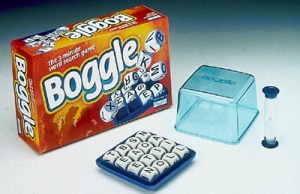
Boggle–I hate that game, especially the three-minute sand timer: “the sands of time run out.” Maybe the Whole of Life is Boggle? or maybe Monopoly? What game are we playing that is NOT physically or intellectually challenging?
From birth, I play Either/Or: Either breathe or not, crawl or not, walk or not. If I can move, I move on to the next plateau, the next level. (Flying is out of the question: I have to compete with gravity–and that is really some opponent, that Gravity Character!).
Physically, I learn the rules as I grow: “Don’t touch! You’ll burn yourself!” “Careful! You’ll fall!” Those rules of physics, natural science, natural selection, X-Y rules, and other theories, like Germ Theory. I have to compete with bugs; I have to fight, win-lose, survive: illness, wellness, strength, weakness; weather, climate, natural destruction and/or disaster.
Most of this is out of my control, usually lucky or not. (Is 98% of my life really out of my hands, not under my control? Fate? Chance? Providence? Good or Bad Luck? Predestination?)
Oh, the Lucky Theory: Where was I born? On an island? In Canada? On a tectonic plate line? (A “fault” line? whose fault?) In a village in the Sudan? Oh, that Lucky Theory. So some have been dealt one hand better than another. Another Game of Life: Poker, Hearts, Go Fish (“Teach a man to fish…”). The metaphors, the symbols, the myths all reflect–or are–Game Theory in Life: kings, queens, jacks, spades, clubs, deuces, aces. And those Tarot Cards? Have you seen the movie The Red Violin?
 I hate games. Chess? A beauty this is, with royalty, pawns, knights, and even a bishop or two. I was even in the high school chess club. I played on a miniature board with a classmate while we rode the “L” to school. I made a chess board for my boys. But I’ve had it with chess. And Battleship, Solitaire, Minesweeper, Husker Du, or HOOSKER DOO– whatever. I have outgrown Cops-n-Robbers, lost my Confederate soldier cap, never did the Cowboys-n-Indians thing, but Soldiers? Now THAT…
I was a regular in John Wayne’s squad–er, Sgt. Stryker’s squad: “You gotta learn right and you gotta learn fast. And any man that doesn’t want to cooperate, I’ll make him wish he had never been born.”
 JOHN WAYNE aka SGT Stryker
I had the pluck. I had the skinned knees to show my battle damage as I played war games on the neighborhood sidewalks of Chicago. Not in the parks: Couldn’t be too far from home. Not too far from supper. Not out too late. Homework.
Saint Paul wrote to the Corinthians (13.11), in that now-famous verse, that when he became a man, he wasn’t playing with the kids anymore. I can’t believe that: “…when I became a man, I put away childish things.” No, he didn’t stop playing. (I just bet he was a good soccer player!) He is saying that at the time he was serious about love. And life. But not that we couldn’t have fun. Nor shouldn’t have fun.
Subsequently, I accept Life. The Game of Life. I’ll play. I’m in. Deal me in. I hope I get a good hand. I’ll keep my fingers crossed. I shall play my best. Besides, it’s not about winning and losing but about how I play the game anyhow, right? (Said that. Heard that so many times. That mantra.) I’ll keep my eyes on the prize, maybe getting into the semi-finals, for I know that “strait is the gate, and narrow is the way, which leadeth unto life, and few there be that find it.”
Along the way, I might even pick up a medal or two–or a ribbon–or have a moment of fame. I’ll run the good race, fight the good fight, go for a three-pointer, believe I can win. “I think I can. I think I can. I think I can. I know I can.”
 Rodin’s THE THINKER
“HE SCORES!”
I’ll have to wait, however, in the “the kiss-and-cry area” for my results, maybe not a Perfect 10, but for sure a
-30-
© James F. O’Neil 2017
NUGAS LUDOSQUE ANTE GRAVIA.
[FUN AND GAMES BEFORE SERIOUS THINGS]
I cannot forget the motto of my college class.
Cardinal Glennon College (Saint Louis, Missouri), 1963:

 Memories of a Time