
BY: JAMES F. O’NEIL
PART III: AUTOMOBILES
“I’d ban all automobiles from the central part of the city. You see, the automobile was just a passing fad. It’s got to go. It’s got to go a long way from here.” –Lawrence Ferlinghetti
* * * *
A. Driving My Mom: My mother worked at the Federal Reserve Bank in downtown Chicago. This was one of her jobs I can remember. She worked from 11 pm–7 am. She didn’t drive to work. She didn’t drive–ever. And no one ever let her take a bus or subway at night. So, someone had to drive her to work each night, leaving at around 9:30 pm. For years my dad did this while I was in high school. When I earned my driver’s license, I became the chauffeur, even on some school nights, most of my duties coming in 1958-1960, with our 1956 Chevy. What great driving experience, learning city streets, unencumbered by daytime traffic. And, in the spring and summer, what beautiful rides home, windows down, radio-for-teen-driver blaring along the Outer Drive. Home from college on vacation, I assumed my duties once again as she continued to work. (She always took public transportation home in the mornings.) [My fiancé and I did enjoy making some off-to-work trips for my mom. On the return, we had a chance to stop at Oak Street Beach or some other beautiful place to spend some quiet time together.]
* * * *
No doubt each of us has stories–memoriesofatime–we can relate about our automobiles or driving habits and incidents or how we first committed “vehicularism”: “steering any automotive vehicle in a proper and correct manner; learning to drive a vehicle appropriately.” My enumeration of vehicles I’ve had and used, from my “First,” a 1950 Ford to my current 2016 KIA SOUL, may be longer than some, shorter than others.’ But with each car or auto, there goes at least one anecdote, or several stories, that could go on for pages of memories. A few, however, I highlight as part of my trilogy “Are We There Yet?”
* * * *
When young, growing up, I never played cops-n-robbers. I never played cowboys-n-Indians (though I did have a cap gun six-shooter). I played Soldiers at War. I crawled through bushes and along city sidewalks and through alleys, skinning my knees, carrying my Thompson “Tommy” gun–or I would set up the “50-cal” on its tripod in the front yard. In the house, I played fighter pilot or bombardier. Mostly Flip Corkin of Terry and the Pirates, or Steve Canyon–or John Wayne as a Flying Tiger.

The elevated, behind our apartment building in Chicago, ran parallel to Van Buren Street. Under that dark brown rusting structure, my sister and I played. When the family’s ’37 Plymouth was parked there, we drove for miles and miles in our imaginations, swinging around the steering wheel, working the pedals. (Did we have anything to do with the clutch going out, and the purchase of that sleek black ’49 Ford? Hmmm.)
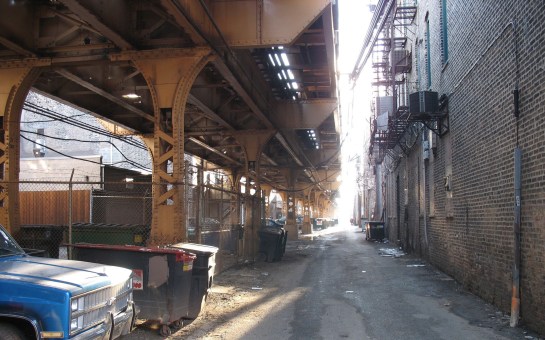 Elevated Tracks and Alley
Our first “big people” car was the two-tone Our Family Chevy, 1952. I thought I could drive that car, bold and brassy “big people” that I thought I was becoming! However, of course, I had to wait awhile…for the Chevrolet 210, new, in 1956. This was to be my real learning-taught-mobile.

1956 Chevrolet 210
In this car, my dad taught me his Rules of the Road: charity (“Give ‘em a break and let ‘em in), and his sometimes “Two-Right-Turns-Are-Better-Than-A-Left” philosophy. He taught me well, to stay in my lane (while he would have small heart attacks as I drove down the boulevard’s middle lane), and how to “play the lights” to make all the greens. He helped me pass my license test on the first solo. “Of course,” he said. Then I began the drive to the Bank, taking my mom to work (not alone, bringing along my little brother sometimes).
* * * *
B. The Korean War. A long, long time ago. Well, in my memory years, not too too many years, you could have found me on South Marshfield Street, on a warm Saturday morning. In the alley, I’m there washing and polishing a beautiful 1950 Plymouth convertible.
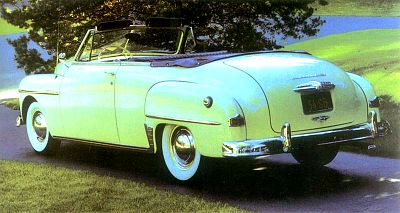
I had been taking good care of this car. I was like the Neighborhood Helper: shopper, babysitter, sidewalk-snow-shoveler, car washer, paperboy. I was eleven and twelve then. Even a good, successful Boy Scout (Senior Patrol Leader, no less).
The mother of a young man off to war in Korea had asked for some help with the car, and I had obliged. Such a beautiful machine! I worked to make him proud. We prayed for his return, his mom and I, to be healthy. And “If he doesn’t come back from Korea,” she said one day, in a moment of deep sorrow and emotion, “the car will be yours.” Amen! Oh, how I prayed. And prayed. “Please, God…” I tried to pray. “Dear God . . .” God must have heard my prayers, for he returned–and often gave me long rides for my hard work. “O God!”
* * * *
“Seventy-five dollars!” All mine. My First. The 1950 Ford. Fuzzy-brown upholstery (including the headliner), manual shift, in-line 6, 4-door Ugly.

My friend, called “Betsy” (last time I ever named a car), was good transportation, better in the cold. The engine just quit in the hot weather. I was learning something about cars and engines when I threw a rod, and had a classmate rebuild the engine. Then I grew into a ’54 Ford, my Mechanic-Me machine. A V-8 that got my hands dirty: I did brakes, new spiffy grill, and installed a Holley 4-barrel carb. Sweet! I did all that while keeping all my fingers and thumbs intact.
“Will you marry me?” I asked in my black 4-door hardtop ’57 Oldsmobile. Oh, that was My Beauty, the Loveofmylife. Like no other. My “wooing” machine.

And after that “Yes,” My Automobile History becomes a catalog of special machines, with special stories: travel, vacation, auto accidents, blizzards, camping, broken bones, emergencies, and other illnesses. The machines were athletic (Sportage); creepy-crawly (Beetle and “bug”); Arthurian (Avalon); class standing (Squire); and metaphysical-theological (SOUL).
Cars come and go. Miles and miles. Bought, sold, traded, leased. Oil changes, maintenances, contracts, extended warranties, license renewals, sales taxes, repainted, detailed, egged, hailed upon, bird-shat upon, iced and salted. And sales personnel. Those sales personnel. “What will it take to make the deal? To make you walk out of here happy?” Some buyers thrive on haggling. Some would rather have a root canal without Novocain than buy a new car.
However, when all is said and done, the papers are signed twenty times or so, that new car smell: nothing else like it. Some dream of their dream car for years; others, it’s merely a “thing” to worry about and get washed once in a while when it looks dirty. I have had my favorites, have drooled on many a steering wheel at auto shows in my “salad days.”
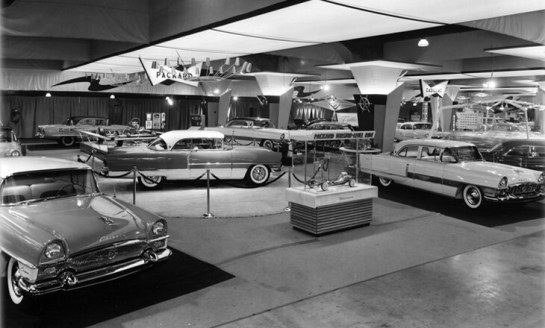 Small Demonstration at an Auto Show
It has been a fun run, and yet a stressful one, too, at times, without maps or directions (GPS and Garmin have helped). I’ve enjoyed the rides, the miles; I have been avoiding trouble, while having fond memoriesofatime, though witnessing some horrible accidents.
Yes, I’ve run out of gas, have broken down, needed towing, gotten lost (but more often than not, asked for directions), had my own accidents–and, yes, had a few traffic tickets/citations of my own, don’tcha know? My share.
I’m coming up for another license renewal in a couple of years. I’m not worried: I’ve been at this for a while. Yes, the bright night lights now do bother my surgeried-cataracts, so I won’t be on the road much after dark (when the monsters come out anyway).
So please watch out for me: I’ll have my blinkers on. I’m slow (always following the speed limit) in the left fast lane. I try not to hit squirrels and other rodents. Oh, did I mention? My driver’s license is stamped SAFE DRIVER. ORGAN DONOR. O+
© JAMES F O’NEIL 2018
 Iceland Map
 Jimmy in Birthday Present Ride B-17
 Collings Foundation B-17G
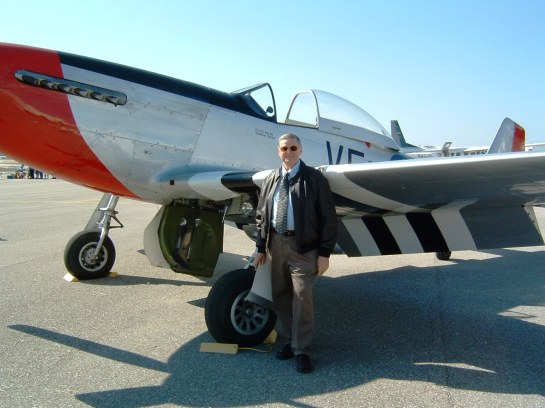 Jimmy Dreamer Next to His Favorite Plane
  Modelers’ Dream of Testor’s Paints
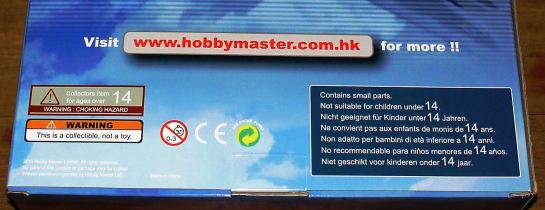 “Some Assembly Required.”
 Small Part of the Collection
 he took me to visit a friend of his at a switching yard on the South Side of Chicago. The three of us walked through the roundhouse, walked among the rails, and even watched to see the railroad turntable in operation.
 configured for extended periods of running in reverse, and in many locomotives the top speed was lower in reverse motion. In the case of diesel locomotives, though most can be operated in either direction, they are treated as having “front ends” and “rear ends” (often determined by reference to the location of the crew cab). When operated as a single unit, the railway company often prefers, or requires, that a diesel locomotive be run “front end” first. All this is visually and masterfully shown in the movie with Denzel Washington, Unstoppable.
 Pennsylvania RR diesel
 (though that was not always the problem). Lionel had the heavier three-track, more expensive gauge sets, parts, transformers–all the right “stuff.”
  So my frustration abounded, as trains were taken out and put away; I never had a basement with a large open space for a board for a train layout. [An interesting bit of Wiki-history: During the 1950s, Lionel outsold its closest competitor, American Flyer, by nearly 2:1, peaking in 1953. Some Lionel company histories say Lionel (more than just trains) was the largest toy company in the world by the early 1950s. The 1946–1956 decade was Lionel’s Golden Age. The Lionel 2333 Diesel locomotive, an EMD F3 in the colorful Santa Fe “Warbonnet” paint scheme that was introduced in 1948,
 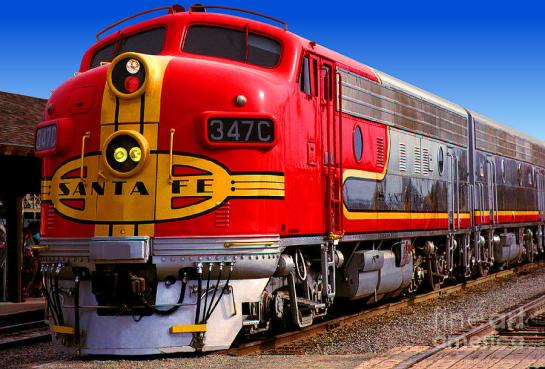 became the Lionel company icon and the icon of the era, yet Lionel declined rapidly after 1956. Hobbyists preferred the smaller but more realistic HO scale trains, and children’s interest shifted from toy trains to toy cars. Efforts to increase train set profitability and/or sales by cheaper manufacture (largely by replacing castings and folded sheet metal with unpainted injected-molded colored plastic) were largely unsuccessful; 1957 was Lionel’s last profitable post-war year. In 1959, the business direction of the Lionel company changed: it added subsidiary companies unrelated to toy train sets. The company lost more money. See more in Wikipedia.]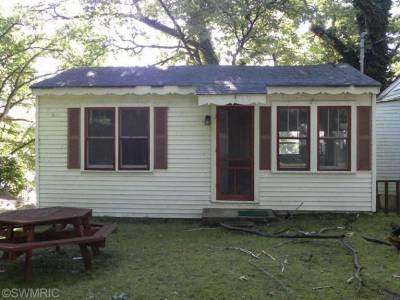
 Not well known, but better recognized if I say “near Dowagiac,” or Benton Harbor. Those were great growing-up summers with my cousins and siblings, and “friend-girls” from different neighborhoods in Chicago.
 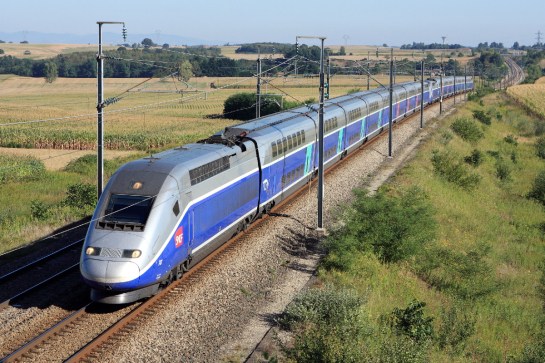 Yes, I have done that too. And the “Chunnel” Eurostar, London to Paris? Yup, that too. London to Carlisle, to Cambridge, to Oxford. Never yet to Cornwall or Land’s End, or to see Doc Martin’s place. Mostly–mostly–friendly, delightful, memorable.
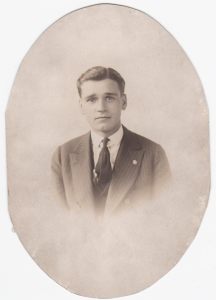 Young Mortimer J O’Neil
 Uncle Leonard’s Place
 1957
1957 1960
1960 October 12, 1963
 Memories of a Time