BY: JAMES F. O’NEIL
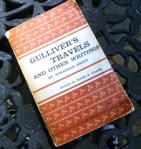 Pic of Old Text by HarperHoney.com
James F. O’Neil
2111 Ash Street
Des Plaines
11/29/62
So this is written on the first page of my “textbook” for my 18th Century Literature course in my undergraduate English major program (1962-1964, BA ’64).
I have too many books. Reaching this conclusion (again, as I have noted before), I have been giving away my books to the library. But many, like this volume, have too much writing in them, too many annotated passages in them for the library to accept them. Too much marginalia, too many underlinings and highlightings (mostly in pencil and red ballpoint ink, the latter soaking through the pages; pencil works best).
Thus I have been sorting (again, again) and culling: those books no longer usable (silverfished or book-wormed) or useful have found their lives with me cut short: into the recycle bins. That’s that.
 Credit: Arbor Day Foundation
The Swift book had a long life with me. By the first page alone, its life and use has time-dates: 11/29/62; 1-15-66 (graduate school, MA ’66); 3-21-68; 9-3-68; 11-18-70; 11-10-71 (dates I taught from the text for undergraduate courses in Minnesota); then a hiatus while I did school administration. The book was again opened 12-11-80 when I was teaching 12th grade English classes in Florida: many memories there, for sure, as my students reacted to the modest proposal, for cooking fattened Irish babies! Next, 11-94, 11-95, 12-2-97, the years I taught British Literature I at a Florida community college. The end.
That was the last time I had need for the text, for I moved on to teach other subjects until retirement in 2003.
The book has sat, has been boxed-unboxed-re-shelved, gathering dust on its pages, as do other unused books that reside in bookcases. “Some books are to be tasted; others swallowed; and some to be chewed and digested.” [Francis Bacon]
Even though downsizing, I had to keep one page, to remind me of what I learned, of what I remember. I look upon this page (now glued intomy current journal) and see written in pencil, in addition to all the dates of my book’s life, the essence of what I needed to take with me from Gulliver’s Travels:
1. Explain the main point of each voyage, the theme of each book.
2. Explain through the work how “man fails to use his reason.”
3. Discuss the Utopian society in each book. Explain “dystopia.”
Under this handwriting (in cursive, of course with me), I find some other notes of mine: science fiction; Vonnegut. H. G. Wells. Bradbury. Bellamy. Verne. Butler.
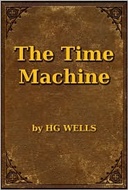
 Nice Cover for The Time Machine
How important Jonathan Swift was. How important the other authors were. Are?
The text is gone. Its residue remains with me: flying machines, time travel (like one of my favorites, The Time Traveler’s Wife?), horses and apes (like Planet of the Apes?), ice-nine, giant octopuses; Erewhon (the novel/place AND the cereal), Dandelion Wine, and Fahrenheit 451 (and now, Fahrenheit 9/11?).
Enough. Enough memories and connections for now. Enough “teaching” and reminders of what was learned or retained from school.
I understand.
So the text was carefully placed into the recycle bin, a text that brought back (brings back?) so many memories of a time. . . .
And so it goes.
But, I have Gulliver’s Travels in my Kindle…
© James F. O’Neil 2015


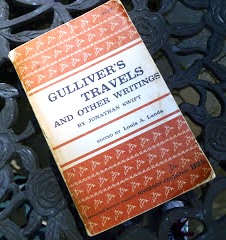

 Memories of a Time