Archive

PEOPLE

BY: JAMES F. O’NEIL

Each of us can relate somehow, some way, to a cold winter morning. Well, perhaps most of us. Yet a few of us have such a gift they can relate to others their own experiences with cold and winter mornings (poets and storytellers especially).

I have read of soldiers in Alaska, in Moscow, in the Ardennes, in Afghanistan: cold winter mornings that I have no concept of or experiences with. War is not kind. . . .

My cold life in Chicago had me in -18 degrees one winter night. My cold life in Minnesota had me at -16 degrees one Christmas: “way below zero.” The nose hairs froze. Not fun for sledding or the toboggan. Dressed for school? Watch A Christmas Story: see Ralphie’s brother waddle off to school. (And don’t forget that tongue frozen to the flag pole.)

A CHRISTMAS STORY  huffington post

Cold Walk in A Christmas Story (Huffington Post)

House cats do not have to go out for a walk on cold winter mornings. Most dogs are accustomed to morning walks, cold winter morning or not. I had to walk the dog: “Hurry up! I am freezing out here (in a Chicago alley in the early grey cold winter morning)!”

On some cold winter mornings, Jim Miller, my friend and high school classmate, and I arrived early a few times a week during our senior year at our seminary. We were chosen to sing the liturgical responses for morning Mass, at seven. Cold, stone-walled chapel, cold vocal cords, and a chapel organ that was temperamental when the bellows were cold.

 QPS

Saint James’s Chapel

On cold winter mornings, along city streets, steam could be seen coming from that small hole in manhole covers–or steamy exhaust from city buses, and from cars.
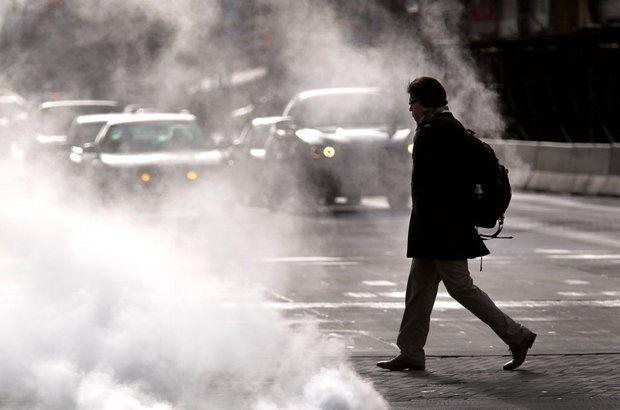
cold cleveland steam.

Winter’s Steam (www. cleveland.com)

So, those of us who live in the Northern Hemisphere will soon have those cold winter mornings–or already have had a taste of winter. As sure as the sun rises and the sun sets, winter arrives. And cold-weather records will, no doubt, be set in the U.S. and in Europe–again).

One April, with spring approaching, April 4-6, 1968, some teaching colleagues and I were attending a conference in Minneapolis, Minnesota. A guest speaker was a poet named Robert Hayden. He received a gracious introduction and a warm audience-reception. I was there; I knew little of him, about his work.

He read a poem. He began another–but could not continue. He said, “. . . ,” then began to cry. He left the stage.

April 4 Martin Luther King, Jr. is shot dead at the Lorraine Motel in Memphis, Tennessee. Riots erupt in major American cities, lasting for several days afterwards. Minneapolis was not spared.

We were dismissed. Our conference was over, cut short.

(In 1940, Hayden published poems that drew little attention. Yet by 1976 he was well respected enough to be Consultant in Poetry to the Library of Congress, the U.S. Poet Laureate. He died in 1980, age 66.)

Although I had little acquaintance with the works of that poet, I would forever always have that memory of him in Minneapolis. So that was that.

Until about ten years ago. In an introduction to literature program. There was a poem of his, about cold Sunday mornings, a poem about a son remembering his father.

My memories of a time–or times–came across to me in such a personal way, as I am certain other readers could recollect similar remembrances. Those memories of a love and actions are not always known nor understood by us when we are young-er. That is all.

“What did I know, what did I know…?” So I took out the dog. So I walked my brother to school. So I got groceries for the invalid woman down the street. So I shoveled the neighbor’s walk. So my dad made oatmeal for us on cold mornings. So my dad walked miles in the deep snow to get a bus or a train to get to work. And me?

“What did I know, what did I know // of love’s austere and lonely offices?” Robert Hayden: “Those Winter Sundays” [1962]

“Those Winter Sundays” is a not-too-simplistic poem of age-brought discovery of what others do for us. But we don’t appreciate. However, this little “masterpiece” is about doing-in and remembering-about the cold. Those cold winter mornings.

©  James F. O’Neil 2014

* * *

Collected Poems: Robert Hayden. Ed. F. Glaysher. New York: Liveright, 1985; rpt. 1996.

Words in the Mourning Time: Poems by Robert Hayden. London: October House, 1970.

Robert Hayden American Poets Stamp


 

BY: JAMES F. O’NEIL

My brother Denis recently asked me for a copy of a handout I used in my writing classes: “The 3-8 Paragraph.”

In my memories of a time many years ago, my friend and colleague, Walt, gave me a handout called “The 3-8 Paragraph Method for Writing.” I was not as overly enthusiastic about using it as he was; he explained it was something he had used in teaching for some years. And he had gotten it from someone else during a long-time-ago workshop.

This method shows a simple way for writers to get started working on a topic, especially memories of a time–bringing about “the thrill of mining one’s own experiences,” as Jeff, a former student of mine, described it.

I found it to be a gem in my writing programs, after using it for a while. Since that time ago, I had been using this handout as one of the best pass‑and‑share/show‑and‑tell items I have ever received. I have given workshops describing how to use it, taught it, and shared it with colleagues. (Some might know it now as a method to help develop the so-called “essay map.”)

And so much for that.

However, my remembering now the times I have used the method makes me want to share the most essential element in the process, the keystone: having the concept of “three” or “3” or “threesies.”

This might seem too easy. And it is. And that is all I am going to say about that. Well, not really.

How much does “three” play in a life? What should I know about “3,” other than it comes after 2 and before 4? But wasn’t that a difficult thing to do, counting as a very young child, as you think back on it?

This is not about numerology–but it could be: the study of the use and power of numbers. Though I want it not to be “occult” or “cult-ish.” But think and remember what you might know about this number and its effect upon your life–or what memories you have about something “three.”

Maybe, “Once upon a time, there were three bears….” Why three?

“And now, Earth, Wind & Fire!” (though the classical elements add the 4th, water)

1st, 2nd, and 3rd place… (blue, red, and yellow [white for 4th place])

“Three men on a match”: That is “bad luck.”

Picture this: In the wind, a soldier during World War I lights a match, at night or in the dark, cupping his hand to prevent the wind from putting out the match. Then the cigarette is lighted. He shares the flame with a 2nd soldier. Then a 3rd soldier attempts to use the fading fire. He is the dead man, shot by an enemy sniper who has been alerted by the first light, takes aim on the 2nd, and knows there will be a 3rd.  Bad luck.

That is how I learned it.

In the novel As Time Goes By (by Michael Walsh, 1998), Rick Blaine shares a light with a friend. Reading that, I at once thought of the three-men-on-a-match anecdote. It happens that way with me.

Between 1490 and 1510, Hieronymus Bosch painted Garden of Earthly Delights, the modern title given to a triptych.

The Garden of Earthly Delights by Bosch

The Bosch Garden

What is a “triptych painting”? It is a work of art divided into three sections, or three carved panels that are hinged together and can be folded shut or displayed open. A trifold, three-sectioned something. Like a trifold wallet, or greeting card.

And then, remember “Two’s company, three’s a crowd”? Not as dramatic as the match story, but it could be, for some, a serious “threesome” relationship–or a stage of growing up. Just think of how many times you were the “odd man out,” the “third wheel.” Growing up, did you have fun as a “trio”? Or was it ever a “love triangle” (in French, ménage à trois).

Triangle: “… and the hypotenuse of a right triangle is….” Let’s think about that baseball field and see, not three bases but two triangles abutting one another across the mound in the middle. And see the 127 feet from first to third. Hypotenuse. Geometry. Tenth (10th) grade for some. Oh, that throw from third to second to first? That’s known as a “triple play.” That’s a baseball rarity.

Triple, as in “triple-crown winner.” Or the “trifecta.”

What gives me pleasure? “A loaf of bread, a jug of wine, thou.” Yup, another “threesie,”

In The Little Mermaid look carefully at the “trident” that King Triton (“tri-”) carries.

King Triton wiki

King Triton (Credit: Wikipedia)

 Or remember the Times Table of Three: that “three times three equals __.”

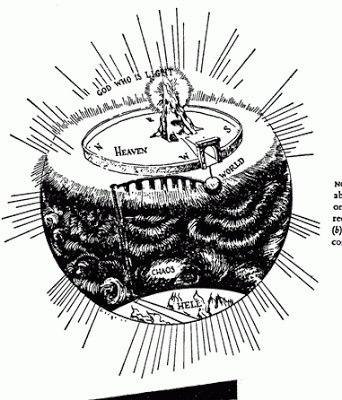
Finally (though this is by no means the last word on threesies), the poet John Milton wrote Paradise Lost, the massive poem about the massive battle about good angels, bad angels, and man. And God. The places were Milton’s poetic descriptions of mythic threesies: heaven, earth, hell.

Milton’s Universe

Though his poem was written “way back when” (1674?), even today writers ask (and answer in science fiction, fantasy, or pop literature), “What is the tripartite cosmology common to many foundation myths?” Outer darkness, earth, and some sort of heaven.

You will not look at three (3) the same way again…

 © James F. O’Neil 2014

The Three Stooges (as found in Wikipedia)

The Three Stooges (as found in Wikipedia)


My hard drive of 4TB…terror bytes…is waiting for release: writing and expanding those memoir-ish anecdotes that have gathered cyber-dust. When do I have time? I am retired. There is no time, it seems. So, maybe two stories a month? That works now. I used to tell my writing students: “If you live to 18, you will have enough to write about for the rest of your life.” My “philosophy” has not yet changed.

See my Door Storyhttp://memoriesofatime.com/?s=closed+door

BY: JAMES F. O’NEIL

INDELIBLE: physically impossible to rub out, wash out, or alter; impossible to remove from the mind or memory and therefore remaining forever.

When I was a sophomore in high school, I got a part-time job at Visitation parish in Chicago. Then, in 1956, it had a kindergarten building, an elementary school of three stories, and a girls’ high school. For four years, I spent my days off from school and my summers working in the three large buildings, in addition to the auditorium and the basement bowling alley–cleaning, but mainly painting walls, floors, windows, and ceilings

pratt_lambert_stadnitsky_painting

Paints Used

I received much experience with paint in those days–and I admit that I got good at my job, especially doing window frames and baseboards. Of late, I have been painting stairs and porches of our old summer cottage. Nevertheless, I have not ever used as much paint as I did during my high school years.     

Yet as I look back at all my experiences with paint, including decorating rooms and exteriors of our houses, none stands out more than that which took place one sunny afternoon when I was a boy growing up in the city. Perhaps the season was summer or spring; it wasn’t snowy or freezing, for I remember wearing a T-shirt.        

My mother had sent me to the bakery to get some desserts for after supper. To get to our bakery, I went a half city block to Ashland Avenue, crossed, then to the bakery on the alley. On that particular afternoon, at the age of ten or eleven–I cannot be very specific–my first experience with closeness to death occurred.

Going into the bakery had always been a most pleasurable act. Then all was so fresh, with few preservatives, with so little concern for diets, cholesterol, or pimples. Heaps and heaps of calories and fats piled upon each other, whether in Napoleons, apple slices, cherry pies, sweet rolls/cheese Danishes, cookies, breads. From morning to closing, the bakery brought delight and delightful smells to the neighborhood–and to little boys. I tried to go as often as possible–as the family budget would allow.         

That particular afternoon the smells of the bakery goods and the smells from the ovens would be overpowered by the smell of calcimine (“a white or tinted wash that consists of glue, whiting or zinc white, and water that is especially used on plastered surfaces”–I later found in the dictionary).

My purchase was completed; I left the store, carrying something for dessert. As soon as I got outside, still holding open the screen door, I was hit in the face with the smell of chalky paint, an odor that I had never before encountered: acrid, pungent, biting, yet with an underlying scent of paint.           

I like–have liked–the smells of paint and painting. My model airplanes and boats were all painted–covered–with my many favorite shades from Testor’s. I enjoyed the odor–the fragrance–of brush cleaners, paint thinners, turpentine. That moment’s smells were unpleasant. I cannot forget the visual scene as my nose led me to the body of an old white-haired man lying in a pool–or what seemed like a small lake–of calcimine. I remember seeing a little red blood, perhaps from a cut head.

He was nearly covered; but I saw his worn brown shoes, white socks, and painter’s coveralls. He had on an old thin T-shirt, as I did. He was moving; the crowd gathered on the curb of the street, in the alley, in front of the bakery. I wanted to get out of the store, but a few people were in my way. I pushed them aside, and broke into what seemed to be a circle forming around the man.           

He was trying to reach to his back pocket. I watched him motion. People around seemed to be doing nothing to comfort him–but shouting out: “He’s trying to tell us something!” I did nothing either. I didn’t know what to do. I only thought of the bakery dessert and getting home. Yet the smell and the scene fixed me there. “Help him, somebody! He needs help,” one onlooker called out. I heard the words “heart attack” and “stroke”; they made no real sense to me at that moment.           

Then I was running home, to the corner, to the light, crossing the four lanes, another half block, turning the corner, running up the stairs to tell all that I had seen. I had to have told my mother. But I cannot recall what surely must have happened: the excitement, being breathless, the storytelling, the realization of the meaning of the event, then the tears that certainly had to come from an impressionable young boy.           

I can tell about death and dying–grandparents, Dad, my Uncle Bill, young friends killed in accidents, a woman I saw who had fallen to her death from the fifth floor of our apartment building, deaths I attended while I worked at hospitals, students of mine, my brother’s dog, my cats.

But this alone man lying on the sidewalk with a broken-open empty gallon can of calcimine near his feet? I never found out whatever truly happened to him.

Supposedly, the smell of Crayolas or crayons brings most memories to the fore. And apple pie, for some. True, for me, but the smell of calcimine has not been one of favorite sensuous experiences. What remains now is simply the memory of the occasion, though the details are getting dim–except for the smell in my memory of that white spill on the concrete and on that white-haired man struggling for help.


© JAMES F. O’NEIL 2014

Variety of Crayola Smells

Various Crayola Smells