BY: JAMES FRANCIS CUMMINGS O’NEIL NEE ČAPEK
“I know my father and my mother, but beyond that I cannot go. My ancestry is blurred.” –V. S. Naipaul
* * *
Once upon a time, from my interviewing my mother, and thus it is written (here), I learned that the beautiful young maiden (of course!) …
KATRINA VON KOENIG, Great Grandma Katrina, a worker in the Barony of Luxembourg (it’s sounding so romantic and mysterious) met
FRANK ČAPEK [b. 1834], a laborer who was (maybe) in the Prussian Army (that would be romantic, like in Elvira Madigan), later turned anarchist, and (perhaps) a bomb manufacturer, in Chicago, for the eight Accused Conspirator Workingmen in the Haymarket Affair (Riot), May 4, 1886.

Drawing from Harper’s Magazine and Wikipedia
I heard about this man when I was a child. I grew up believing I was related to a famous anarchist, because Grandma Schuma said so, and because my mom told me so.
I couldn’t wait to see my Great Grandpa Čapek’s picture in the newspapers.
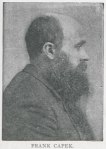
I spent hours at the beautiful Chicago Public Library on Michigan Boulevard, using the actual newspapers and microfilms of the events of May 4, 1886. (At one time later, my Uncle Elmer told me he studied, too, about his grandfather, and claimed he recognized pictures. He lived with Great Grandpa at 5431 South Seeley Avenue [I remember that house across Garfield Boulevard] until the Prussian soldier died.) Great Grandpa Čapek was a talented watchmaker. He died in 1930.
* * *
Frank and Katrina, whom I did not ever know, had eight children, with beautiful ethnic Bohemian names: Emilie [b. 1886], Mike, John, Frank, Joe [b. 1884], Theresa, Katherine, and Mary. I could never understand why my Bohemian relatives chose these names. But when I thought about emperors and empresses, presidents and monarchs, like Franz Josef and Maria Theresa, or King John, maybe the “common” names were more special emulations than Leopold or Vlad the Destroyer. (Not many songs about Leopold, but Emily? Maria? and Joe? or Meet John Doe?–or A Guy Named Joe–or, even better, “What a good Joe he is!,” the compliment.)
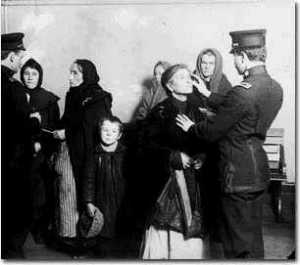
Bohemian immigrants on Ellis Island
There they were, these Bohemian kids (not CZECHS!, not Slovaks, not Slovenes, but Bohacs, or Bohunks–Hunkies or Honkies!). Czechoslovakia was formed in 1918. Bohemia was a kingdom, from “way back when,” like before A.D. 600–those days of Beowulf….
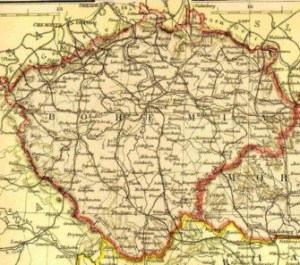
Bohemia in 1882
I learned–and was reminded often–that I was a Bohemian, because “Mom said so.” There I was, growing up in the ethnic South Side of Chicago: Damen and Seeley and Garfield Boulevard (55th Street), and Back of the Yards. Some neighbors were postal workers; others, electricians, tradesmen, homemakers. Family people. Neighborhood people. [Emilie worked in Upton Sinclair’s The Jungle. She was a meat packer for Libby Foods.]
JOE ČAPEK married ANNA JARYKOVIC.
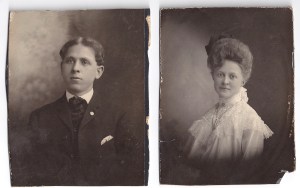
JOE AND ANNA WEDDING PICTURE
Anna–of course, it had to be “AH-NAH”–died in 1924. In 1918 she had contracted the flu–the world influenza pandemic that occurred near the end of World War I. (More died from the disease than died in the war. I learned that in school.) She then contracted and succumbed to TB. Growing up, I remember many trips to the North Side, to Bohemian National Cemetery, and the graves and headstones.

Bohemian National Cemetery Entrance
And Mayor Anton Cermak’s mausoleum
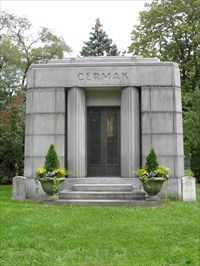
Cermak Tomb
–and the nearby restaurant that had the best roasted duck, with mashed potatoes and gravy. On the way, we sometimes passed the TB Sanitarium….
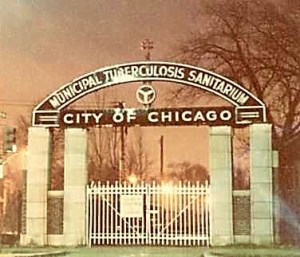
Photo by Jennifer A. Stix 1974
Joe and Anna begot: Herbert (Uncle Herbie, who went with Aunt Flo); Joe (Uncle Joe, who went with Aunt Aggie); Elmer (Uncle Elmer, who went with Aunt Gladys) —I knew them all; and LILLIAN CATHERINE [b. November 16, 1918] (my mom).
LILLIAN C. CAPEK
Mother Katrina, while helping Anna with the children, died of a heart attack: November 1918….
In June 1910, having fallen (madly?) in love, Emilie Čapek (Joe’s sister), while working at Libby Foods, married her handsome supervisor, Edward Albert Šuma [Schuma] [b. 1884]. I have the wedding pictures. My, what a handsome couple they were!
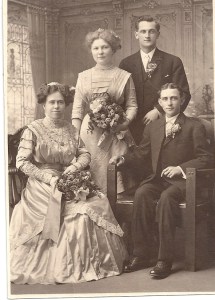
Edward Suma-Schuma and Emilie Capek (seated)
* * *
My Grandpa Schuma was hospitalized, was dying. In Evangelical Lutheran Hospital cafeteria, in 1956, on the South Side of Chicago, I came to know who really begot whom. I heard a beautiful story from my mother, a story of family and love. I heard of the love of a mother for a daughter, and a grandmother’s love. Then illness and death. How could all these children have comprehended it all?
Family togetherness, and the love of a generous aunt and uncle (Emilie and Ed), “begot” Lillian as “parents” and for me were my Grandma and Grandpa Schuma. They took the little girl. “Uncle Joe” kept the boys. I never knew that Joseph Capek was my real grandfather–until 1956. I knew my “grandparents” helped raise me when my father (Francis Cummings) was overseas with the Army. Their house was the first I can recall, at 5644 South Seeley Avenue.
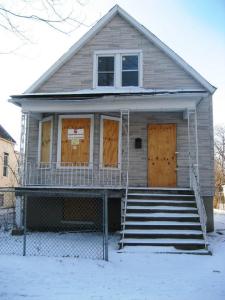
5644 South Seeley Chicago (current)
I grew up there with them: with their daughter, my “Aunt” Emily, and with my sister and with my (2nd) cousin Marilyn (who was begot by “Uncle” Bill Knoch).
So I learned the family “secret.” Yet it was never meant to hide or deceive. Life went on. I learned the facts, the “truth.” My mother said it was so.
Nothing changed after that. Except for my awareness. After Grandma Schuma died, I was present for the reading of her will, in 1958. Then the lawyer stated the “where-from?” that began in 1924: “My niece Lillian,…” when they took in that little girl. Nothing really changed for me.
How does one ever begin to tell a story of ancestry? The more I work with the lives and the connections, however, the more I realize the story was really the beginning of how my sister, my cousin, and I–three little kids–became part of the family story. I never looked at it this way before. Those earliest of pictures I have of me alone show a cute happy baby in my mother’s arms.

Jimmy Loved
Later pictures begin to show three little children, each a year apart, with smiling faces.

January 1944 THREE FRIENDS [Janice, Jimmy, Marilyn]

Grandma’s Porch 5644 S Seeley 1945 [Marilyn, Jimmy, Janice]
Little did these women, sister and cousin, who begat my formation, who made me laugh, who taught me some funny-ness–little did they know they’d become the main characters in an important story:
“Where ya’ from?”
© James F. O’Neil 2016

Kim Novak famous Chicago Bohemian



 So, here’s a shout out HAPPY BIRTHDAY! to two special people born on 21 April.
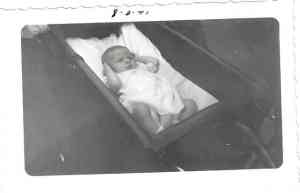 Baby Jimmy in Carriage [8-6-41]
 ELIZABETH II 2016 APRIL 21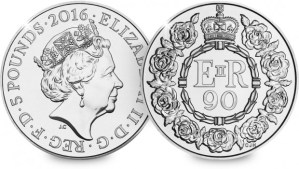
 Lewis Lapham
 Memories of a Time