BY: JAMES F. O’NEIL
My brother Denis recently asked me for a copy of a handout I used in my writing classes: “The 3-8 Paragraph.”
In my memories of a time many years ago, my friend and colleague, Walt, gave me a handout called “The 3-8 Paragraph Method for Writing.” I was not as overly enthusiastic about using it as he was; he explained it was something he had used in teaching for some years. And he had gotten it from someone else during a long-time-ago workshop.
This method shows a simple way for writers to get started working on a topic, especially memories of a time–bringing about “the thrill of mining one’s own experiences,” as Jeff, a former student of mine, described it.
I found it to be a gem in my writing programs, after using it for a while. Since that time ago, I had been using this handout as one of the best pass‑and‑share/show‑and‑tell items I have ever received. I have given workshops describing how to use it, taught it, and shared it with colleagues. (Some might know it now as a method to help develop the so-called “essay map.”)
And so much for that.
However, my remembering now the times I have used the method makes me want to share the most essential element in the process, the keystone: having the concept of “three” or “3” or “threesies.”
This might seem too easy. And it is. And that is all I am going to say about that. Well, not really.
How much does “three” play in a life? What should I know about “3,” other than it comes after 2 and before 4? But wasn’t that a difficult thing to do, counting as a very young child, as you think back on it?
This is not about numerology–but it could be: the study of the use and power of numbers. Though I want it not to be “occult” or “cult-ish.” But think and remember what you might know about this number and its effect upon your life–or what memories you have about something “three.”
Maybe, “Once upon a time, there were three bears….” Why three?
“And now, Earth, Wind & Fire!” (though the classical elements add the 4th, water)
1st, 2nd, and 3rd place… (blue, red, and yellow [white for 4th place])
“Three men on a match”: That is “bad luck.”
Picture this: In the wind, a soldier during World War I lights a match, at night or in the dark, cupping his hand to prevent the wind from putting out the match. Then the cigarette is lighted. He shares the flame with a 2nd soldier. Then a 3rd soldier attempts to use the fading fire. He is the dead man, shot by an enemy sniper who has been alerted by the first light, takes aim on the 2nd, and knows there will be a 3rd. Bad luck.
That is how I learned it.
In the novel As Time Goes By (by Michael Walsh, 1998), Rick Blaine shares a light with a friend. Reading that, I at once thought of the three-men-on-a-match anecdote. It happens that way with me.
Between 1490 and 1510, Hieronymus Bosch painted Garden of Earthly Delights, the modern title given to a triptych.

The Bosch Garden
What is a “triptych painting”? It is a work of art divided into three sections, or three carved panels that are hinged together and can be folded shut or displayed open. A trifold, three-sectioned something. Like a trifold wallet, or greeting card.
And then, remember “Two’s company, three’s a crowd”? Not as dramatic as the match story, but it could be, for some, a serious “threesome” relationship–or a stage of growing up. Just think of how many times you were the “odd man out,” the “third wheel.” Growing up, did you have fun as a “trio”? Or was it ever a “love triangle” (in French, ménage à trois).
Triangle: “… and the hypotenuse of a right triangle is….” Let’s think about that baseball field and see, not three bases but two triangles abutting one another across the mound in the middle. And see the 127 feet from first to third. Hypotenuse. Geometry. Tenth (10th) grade for some. Oh, that throw from third to second to first? That’s known as a “triple play.” That’s a baseball rarity.
Triple, as in “triple-crown winner.” Or the “trifecta.”
What gives me pleasure? “A loaf of bread, a jug of wine, thou.” Yup, another “threesie,”
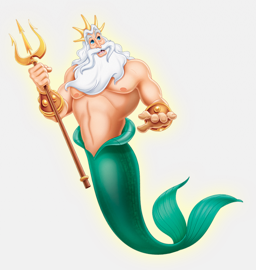
In The Little Mermaid look carefully at the “trident” that King Triton (“tri-”) carries.

King Triton (Credit: Wikipedia)
Or remember the Times Table of Three: that “three times three equals __.”
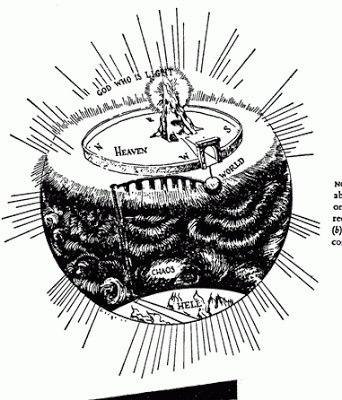
Finally (though this is by no means the last word on threesies), the poet John Milton wrote Paradise Lost, the massive poem about the massive battle about good angels, bad angels, and man. And God. The places were Milton’s poetic descriptions of mythic threesies: heaven, earth, hell.
Milton’s Universe
Though his poem was written “way back when” (1674?), even today writers ask (and answer in science fiction, fantasy, or pop literature), “What is the tripartite cosmology common to many foundation myths?” Outer darkness, earth, and some sort of heaven.
You will not look at three (3) the same way again…
© James F. O’Neil 2014

The Three Stooges (as found in Wikipedia)






 Memories of a Time