Archive

WRITING PHILOSOPHY

“A critic is one who expresses a reasoned opinion on any matter especially involving a judgment of its value, truth, righteousness, beauty, or technique;  one who engages often professionally in the analysis, evaluation, or appreciation of works of art or artistic performances.”  [standard dictionary definition]

But what gives them the right to say those things?

They have the job!  We do not…

We give them the power over us–or at least over what we read, see, and hear.  Nevertheless, they are also expressing their own opinions–as we have opinions.

Whom to believe?  For the most part, it’s a matter of taste and style.  A good critic likes what we like and hates what we hate, writes the way we would like to and reviews the things we like to read about.  A bad critic doesn’t.

THERE ARE FEW ESTABLISHED RULES IN THE FIELD OF CRITICISM–AND FEWER CRITICS’ TRAINING INSTITUTES.

Yet we can look at training in the field of alleged expertise and the ability to communicate effectively when judging the critics we read or listen to.

And what about their reputation among peers?  the effort they expend?  their “readability”?

We have to decide whether we want to read the work of others.  We must be critical of the critics, though, if we have our own standards.  And standards we MUST have.

BE READY TO BE YOUR OWN CRITIC.

“Every effective…critic sees some facet of…art and develops our awareness with respect to it; but the total vision, or something approximating it, comes only to those who learn how to blend the insights yielded by many critical approaches.”  –David Daiches

GOOD PEDAGOGY: “Tell ‘em what you told ‘em”:  [See https://memoriesofatime.com/category/artistic-ventures/ ] HISTORICAL (H): concerned with historical “facts”; FORMALISM (F): concerned with the text (alone); SOCIO-CULTURAL (S): concerned with the text as social commentary; PSYCHOLOGICAL (P): [FREUD]: studies author/artist, work/characters, reader/viewer; MYTHOPOEIC (M): [JUNG]:  tries to present a work as the verbal aspect of ritual. 

CRITICAL READING SKILLS: Seeing/reading what’s there for sure; understanding what we put there; and what it means to us in the greater scheme of things, the “big” picture.”

Finally, review “Comprehension and Critical Reading”: https://memoriesofatime.com/2015/06/30/comprehension-and-critical-reading/

and

“Critical Reading and Skills”: https://memoriesofatime.com/2015/07/11/critical-reading-and-skills/

Finally,

“The aim of all commentary on art now should be to make works of art–and, by analogy, our own experience–more, rather than less, real to us.  The function of criticism should be to show how it is what it is, even that it is what it is, rather than to show what it means.”  — Susan Sontag

Question_mark_(black_on_white)  


“I have four principles of writing good English.  They are Clarity, Simplicity, Brevity, and Humanity.”  –William Zinsser

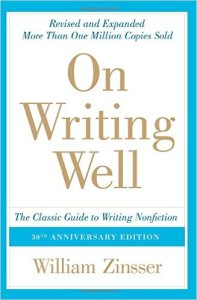
ON WRITING WELL PIC

William Knowlton Zinsser: October 7, 1922 – May 12, 2015: American writer, editor, literary critic, and teacher.

On Writing Well, 1976: “…along with Strunk and White’s Elements of Style…a copy of this latest book by William Zinsser should be shelved in every library that houses ‘how-to’ books on non-fiction.  [He] is an expert, a practitioner, with ‘one lesson that writers must learn’: how to control their material.  And he does it well.  Simple.  Direct.  Uncluttered.  His purpose ‘is not to teach good nonfiction, or good journalism, but to teach good English that can be put to those uses.’  Recommended as a good textbook too.”  [from a CHOICE review, June ’76 by James F. O’Neil]

Zinsser was a graduate of Princeton University.

His 18 books include On Writing Well, which is in the seventh edition, revised and updated (2006), the “30th anniversary edition” which includes “Writing About Yourself: The Memoir” and “Writing Family History and Memoir.”   

Throughout the 1970s, Zinsser taught writing at Yale University.

On Writing Well is full of what might be called tips.  But that’s not the point of the book.  It’s a book of craft principles that add up to what it means to be a writer.”

“I always write to affirm–or, if I start negatively, deploring some situation or trend that strikes me as injurious, my goal is to arrive at a constructive point.”

“One of the saddest sentences I know is ‘I wish I had asked my mother about that.’”

Executive editor, Book-of-the-Month Club: 1979-1987.

“Writers are the custodians of memory.”

“Humanity.  Be yourself.  Never try in your writing to be someone you’re not.  Your product, finally, is you.  Don’t lose that person by putting on airs, trying to sound superior.”

“Re-writing is the essence of writing well: it’s where the game is won or lost.”

“…the storytelling business…is the oldest of narrative forms, going back to the caveman and the crib, endlessly riveting…all you have to do is tell a story, using the simple tools of the English language, and never losing your own humanity.”

“Repeat after me:
Short is better than long.
Simple is good.
Long Latin nouns are the enemy.
Anglo-Saxon active verbs are your best friend.
One thought per sentence.”

 * * *

william zinsser r. i. p. 5-12-2015

William Zinsser


ARGUABLY:

Learning is an active creative process.

Learning involves the discovery (or development) of relationships among phenomena the learner observes or perceives.

Learning how to learn involves learning how to look for relationships, how to inquire into relationships.

The greater the number of experiences, the greater the opportunity for the learner to learn.

The greater the ability to see relationships, the greater the learning from each additional experience.

The quantity and quality of learning can be increased if two people can share their experiences and their perceptions of them.


ALSO:

Writing is a process of thought.

Memories fade with the passage of time.

The mind can focus on only a limited number of phenomena at one time.

Recording one’s observations can serve as reminders, as memory stimulators.

Recording one’s observations can enable one to search any number of
phenomena for relationships.

Recording one’s generalizations about observed phenomena can enable one to search out the relationships among one’s generalizations.

Writing is one of man’s most important learning tools.

Question_mark_(black_on_white)


from Scott Russell Sanders

[In my writing] “I let my feelings and opinions grow.”

“I summoned up memories. I drew shamelessly on my own life. I swore off jargon and muddle and murk. I wrote in the active voice, and as nearly as I could in my own voice, the one I used in speaking about matters close to my heart.”

“I began asking my students to write in the first-person singular.”

“I began inviting my students to draw on their own experience, whenever appropriate, as a way of tying their studies to their lives.”

“Most students seem to welcome the chance of writing more personally, more concretely, more passionately.”

“There is no shortcut to good writing, no list of ten easy steps…”

“I believe that writing is the most difficult art that most of us ever try to learn, which is why relatively few of us ever learn it very well.”

Chronicle of High Education, October 10, 1997…

Question_mark_(black_on_white)