Why do we do it this way and not that?

Some say we like to reminisce about the past and often repeat the “traditional” things we have “always” done at Thanksgiving and other holidays for a sense of continuum that our lives have been.

We are reminded of the persons and personalities we were many years ago.

We shun any new “traditions” because they separate us from our past and make us feel even older than we are because they attach to no memories.

However, some people don’t want to attach to the persons they were earlier because those memories are not often happy ones, and/or they prefer the people they are now over who they used to be.  

HAPPY THANKSGIVING!

Happy memories, or not?

 (Music plays: “Tradition,” from Fiddler on the Roof.)

Question_mark_(black_on_white) 


(Read about “The Cult of Efficiency.”)

Thesis/premise: “People are more important than things.”

EFFECTIVE works with PEOPLE.

EFFICIENT works with THINGS

Some highly effective persons: Charles M. Schulz; Douglas McGregor; Tom Peters; Tom Hanks; Robert F. Mager; Peter Drucker; Ivan Pavlov; Carl Rogers; Erich Fromm; Mohandas Gandhi; Dag Hammarskjold; Viktor Frankl.

More? Alvin Toffler; Pierre Teilhard de Chardin; Stanley Kubrick; Abraham Maslow; Erik Erickson; Gail Sheehy; Frank Capra; Kenneth Blanchard; Stephen R. Covey; Myers and Briggs/Myers-Briggs; Paul Hersey; Edw. T. Hall; Sun Tzu.

Even more? Amatai Etzioni; George Patton; Fareed Zakaria; Sidney Simon; Kurt Lewin; Orson Welles; William Ouchi; Albert Camus; Ayn Rand; Max Weber; Carl Jung.

And so forth…

Question_mark_(black_on_white) 


In the study of literature, using the PSYCHOLOGICAL approach, one type of critic places emphasis upon subjective perception and emotional response to an aesthetic experience.

The “objects” of study are

the writer/author/artist

the work (characters/personae)

the reader/viewer and reactions/responses

in addition to the study of the creative process.

Literature helps us reveal ourselves to ourselves; yet literature often is expressing the author’s unconscious in symbolic terms without awareness. Images, connotations, desires, repressions become significant in a work.

HOW IT ALL WORKS (in a “perfect” situation):

The literary work is presented as a text. We use knowledge of the language to perceive the text as things we know in life/reality. Consciously we supply an intellectual meaning to the text by the process of abstraction.

We supply theme/meaning by thinking about the work as a separate entity: We reality test it. We experience the work by INTROJECTION, taking it into ourselves, feeling the nucleus of fantasy and the formal management of that fantasy as though it were our own. By ANALOGIZING, we bring to the work our own highly individualized fantasies.

Fantasies are not “good” or “bad”: only those that please or displease. So “good” now means that which pleases, and pleases for a long time.

However, MEANING is not there simply: it is something we construct for the text within the limits of the text. It is transforming unconscious relevancy to conscious relevancy.

So: “literary meaning” conveys an idea that all the details of the work are “about,” a “point” to which all the individual words, or events, or images in a literary work are RELEVANT.

 Question_mark_(black_on_white)


BY: JAMES F. O’NEIL

“The musical film is a film genre in which songs sung by the characters are interwoven into the narrative, sometimes accompanied by dancing. The songs usually advance the plot or develop the film’s characters, though in some cases they serve merely as breaks in the story line, often as elaborate production numbers. Typically, film musicals use lavish background scenery and locations. In such films, performers often treat their song and dance numbers as if there is a live audience watching.” [Wikipedia]

I was raised with the movies, black and white and then color. I still spend much time with movies, reading about film and films, though as I have gotten older, I hardly ever go to an actual movie theater, relying on other resources for my viewing pleasure.

An avid moviegoer since I can remember, I vividly recall attending my first CinemaScope 55 film Carousel.

cinemascope 55

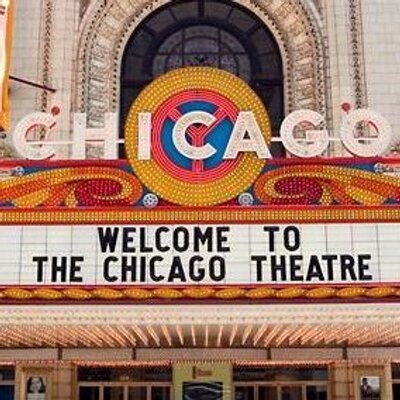
Sometime in 1956, I had a Sunday-afternoon-experience with my mother, which included an L ride in Chicago, and the movie Carousel at the Chicago Theater:

chicago theater welcome

That was the “real” beginning. Since then, I have been mildly addicted and affected by the grand opening spectacle of this color film: 20TH CENTURY FOX, blazing out to me, with full orchestration.
20th century fox

(To this day, I get thrills when a film opens with this icon. Memories.)  Mesmerized, to say the least: In CinemaScope, the story, the music, and the production numbers were alive for me on that huge big screen. I was awestruck, not being familiar with this beautiful theater and with such a spectacle.
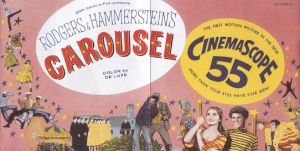
carousel_poster

I laughed and cried and moved with the music; I was saddened by the story. But a profound moment came for me at the end, when I, a mere fifteen years old, was told “You’ll never walk alone.” To this day–and most recently–I watch the movie, still fresh, sad, enlightening, with its tear-making choral finale. A classic, that has certainly withstood the test of time.

After seeing the movie, I could hum many of the songs; I knew then I had to have the music for my music library. My mother bought for me the small boxed-set in 45 rpm, for use in my portable carry-along phonograph. Later I purchased a 33 1/3 LP edition [and now have the CD and DVD].
Carousel_film_1956

I love movies. To that memory-of-a-time in 1956, I attribute my love and appreciation of so many kinds of film. Ultimately, I have come to possess my list of favorites–which changes as time passes and new films and movies are produced. However, one thing for sure, Carousel will always remain at the top of that list.

© James F. O’Neil 2015

 chicago theater by jeffB at flickriver

 Chicago Theater (by JeffB at flickr)