
BY: JAMES F. O’NEIL
Corned Beef? “In the United States and Canada, consumption of corned beef is often associated with Saint Patrick’s Day. Corned beef is not considered an Irish national dish; the connection with Saint Patrick’s Day specifically originates as part of Irish-American culture, and is often part of their celebrations in North America.
“Corned beef was used as a substitute for bacon by Irish-American immigrants in the late 19th century. Corned beef and cabbage is the Irish-American variant of the Irish dish of bacon and cabbage. A similar dish is the New England boiled dinner, consisting of corned beef, cabbage, and root vegetables such as carrots, turnips, and potatoes, which is popular in New England and parts of Atlantic Canada.” [Wikipedia]
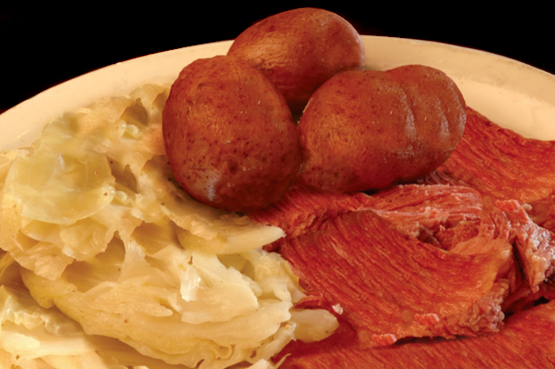 Yummy Corned Beef and Cabbage Dinner
Since I could ever remember, we had corned beef and cabbage for St. Patrick’s Day. The Irish Catholic Feast Day of St. Patrick was almost a Holy Day of Obligation: Attend church under pain of mortal sin. Well, it wasn’t really such a day; but it was a day off from school, it meant a Chicago parade, and it meant the Italians in my neighborhood had to wait two more days to get even with us by brandishing St. Joseph’s Day–and by having local processions and festivities.
[Saint Joseph’s Day, March 19, the Feast of St. Joseph is in Western Christianity the principal feast day of Saint Joseph, husband of the Blessed Virgin Mary. But the Feast of St. Joseph the Worker on 1 May was created in order to coincide with the celebration of International Labor Day (May Day) in many countries.]
 Saint Joseph in Glass
Saint Alphonsus Church
Wexford, PA
He was the stepfather to Jesus; St. Patrick only drove out snakes from Ireland….
However, more people in America ate turkey at Thanksgiving time than they ate ham. And more people in American ate corned beef at St. Patrick’s Day-time than they ate Italian sausage and peppers (though I cannot “prove” this allegation by me)!
Well, corned beef, cabbage, potatoes, and carrots had been the steady diet of my O’Neil family since I became part of the O’Neil/O’Neill Clan. So my wife and I have continued to carry on our clannish traditions with our own family on that Special Day of 17 March.
 Luck of the Irish Shamrock
Note: In October 1884, a convention held by the Federation of Organized Trades and Labor Unions unanimously set May 1, 1886, as the date by which the eight-hour workday would become standard. As the chosen date approached, U.S. labor unions prepared for a general strike in support of the eight-hour day. On Saturday, May 1, thousands of workers went on strike and rallies were held throughout the United States, with the cry, “Eight-hour day with no cut in pay.” In Chicago, the movement’s center, an estimated 30,000-to-40,000 workers had gone on strike. What then occurred is the Chicago Haymarket Affair. “No single event has influenced the history of labor in Illinois, the United States, and even the world, more than the Haymarket Affair,” with its rally and riot and trial and executions. “What began as a rally on May 4, 1886, the consequences are still being felt today. Very few American history textbooks present the event accurately or point out its significance,” according to labor studies professor William J. Adelman. [Wikipedia]
So, the Haymarket Affair is generally considered significant as the origin of international May Day observances for workers, Catholics and Communists alike.
Thus ends the history lesson relating Saint Patrick, Saint Joseph, The Haymarket Riot, May Day celebrations, the eight-hour work day, and corned beef and cabbage. Now about those Reuben sandwiches….
 Corned Beef on Rye by Kaufman’s Deli
Skokie, IL
© James F. O’Neil 2015



 Memories of a Time