By:  James F. O’Neil

English, once accepted as an international language, is no more secure than French has proved to be as the one and only accepted language of diplomacy or as Latin has proved to be as the international language of science.”  Edward Sapir

My New Latin Grammar by Charles E. Bennett is the 1957 edition.  The first edition, “presenting the essential facts of Latin grammar in a direct and simple manner,” dates to 1894. 

 LATIN BOOK 10-31-2013MY LATIN GRAMMAR BOOK

Timeless.  Priceless.  For this little green book which I managed to keep, despite my years and years of disposing of my books–selling them, donating them, garbage-ing them–still provides me with answers I might seek.  But more: It is a concrete reminder of my years of studying Latin. 

I’m infected with Latinity.

I look upon my education–and my being Latinized–a great gift, monetarily paid for by others, worked for by me and by my teachers.  My testimony is to all hard teachers, easy teachers; good teachers, bad teachers.  I learned from them all: amo, amas, amat [I love, you love, she loves]…porta, portae, portae, portam [the gate, of the gate, to or for a gate, the gate]….

In a humanities class I used to teach, I built an entire unit around three Latin words or phrases: ALLELUIA:

alleluia commons.wikimedia.org

GREGORIAN CHANT ALLELUIA Credit: commons.wikimedia.org

GLORIA:

VIVALDI GLORIA

GLORIA!

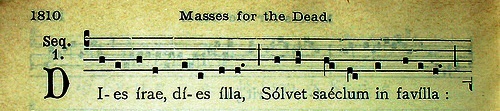
DIES IRAE:

DIES IRAEGREGORIAN DIES IRAE

The themes, motifs, and tropes are around us, as soundtracks, as performed by contemporary vocalists, or even as parts of television commercials.  But not everyone can always recognize a Latin word as a prayer when found on a New Age soundtrack or CD by Aria, Amici, Constance Demby–or Kevin Wood:

sacred kevin wood ScenicListening.com

Credit: ScenicListening.com

Nevertheless, those words are there. 

I once explained that after a moving experience, whether musical or visual or literary, we often have a unique “what’s-it-to-me?” feeling or response.  It’s akin to being “slimed,” like in Ghostbusters.  After we close the book, or turn off the movie (or leave the movie theater); are quiet after hearing “Un bel di vedremo” from Madama Butterfly; or after sitting down after seeing, for the first time, Notre Dame Cathedral, or having walked within Hagia Sophia, or stood overlooking the Grand Canyon, we remark (in awe): “WOW!” or something humanly pathetic.  For we are at a loss–or are lost in the moment: “WOW!”  (Maybe even “That’s awe-some!”)  Or, “Glory gee!”  Or once or twice we might have exclaimed, “Halleluiah!”

This is all beautiful to me, enriching and rewarding, these words, the many musical expressions using Latinity.  I must simply see or hear: be aware.

So there I sat, five minutes into Sleeping with the Enemy, wondering what Julia Roberts and her film-husband were up to.  “Hungry?” she asks.

He goes over to the wet bar.  There, next to bottles of alcohol, rests a CD: Hector Berlioz: Symphonie fantastique.  The music plays as he nuzzles her neck….  DUM, DAH, DUM, DAH….

Dies_Irae_Treble wikipedia

Treble Dies Irae Photo: Wikipedia

WHAT’S THIS? 

Yes, “Making Love to…to….”

Listen.  Watch.  What is the point with this background music, the soundtrack?
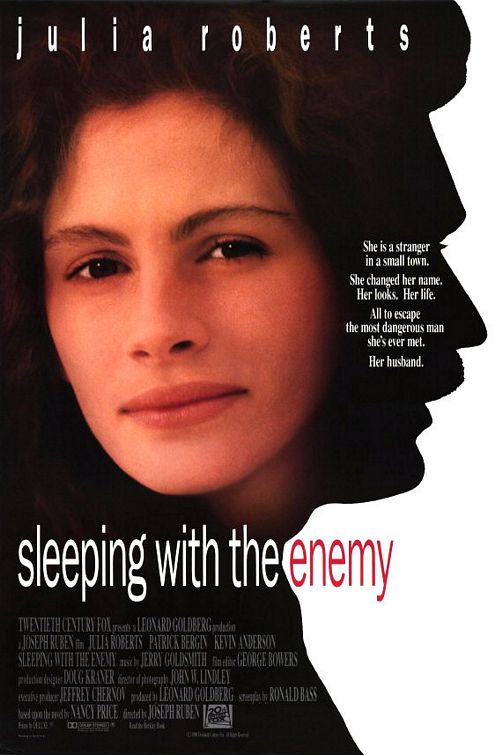
 sleeping_with_the_enemy

From Berlioz’s own program notes, Fifth movement: “Songe d’une nuit de sabbat” (Dreams of a Witches’ Sabbath): The funeral knell tolls…

Can we guess what might come (foreshadowing?)?

And that is our Latin Lesson #3: Not joy [Alleluia!], not awe [Gloria!], but sad, death, requiem–within the first five minutes of this film.  However, there is more; the movie has just begun, with the sounding of a bit of Latinity.

* * *

I have done this blog pro bono (not Sonny nor Cher).  I make no pronouncements ex cathedra (it’s from Florida, not from Rome), and this is not a quid pro quo (an expression often used in sexual harassment cases) exercise.  But you have read a bit here, in situ (where you sit, maybe sedentary, a sedent) on a sedilia (chair); however, I know about you: quid quid recipitur ad modum recipientis recipitur–meaning that if you are feeling lousy now, this doesn’t work so well.  It’s how you’re feeling at the time. 

This is the end.

Deo gratias!

 ©  James F. O’Neil  2013

**Latin Dictionary = http://www.lexilogos.com/english/latin_dictionary.htm

**Philosophical axioms in Latin = http://www.catholicapologetics.info/catholicteaching/philosophy/axiomata.htm

By: James F. O’Neil

“Hi!  I’m Jim.  I am a collecting addict.”   “Hi, Jim.”

My memories of collecting “stuff” include digging through garbage in the neighborhood alleys of Chicago to find used razor blades.  I had quite a collection of Gillette Blue Blades.  Of course, I had to wash off dried shaving cream and dead whiskers, usually doing this in my bathroom sink.  The hazards of washing used razor blades are obvious: cuts and blood.  I stored the blades in metal Band-Aid containers.  (My mother knew little of my secret stashes–though she later found out.) 

  razor blades

I was 7 or 8 years old, as I recall now.

I collected used medicine bottles of all sizes, shapes, and colors.  I had my own little pharmacy with my little brother, Tom.  What a bottle collection we had!  We played with pills, mixed colored water, and made prescriptions for hours and hours on end. 

medicine bottles

Picture credit: sks-bottle.com


(I used my A. C. Gilbert chemistry set for more sophisticated medications–even buying test tubes from the real local pharmacist.)


1940s_Gilbert_chemistry_set_04

Photo: wikipedia


I was 9 or 10 years old then.

Then I had some electric trains, made model airplanes–plastic and even a few balsawood.

10th mountain

10th Mtn Div.

During high school I added to my Army and Air Force sleeve insignia (SSI) collection.  Earlier my grandfather had helped me with the original collection which I used for merit-badge-winning Boy Scout project.

stack of textbooks

Photo: ucf.edu


In college, I collected textbooks…

When my sons were growing, one collected stamps (with me) and one collected coins (with me).  Who was really collecting?  Perhaps re-living my own childhood collecting days, still “addicted” after all those years?  (Baseball cards one son collected; I helped feed his addiction at Christmas time.)

And now, after so many years?  I am collecting again. 

Collecting, to me, is healthy.  I guarantee, it keeps me sane, makes me “whole.”  One hour’s visit to a psychiatrist used to cost me $160.  Now I have something physical to show for my “mental health” expenses. 

So I am back at it, since 2004.  Slowly I began to walk the path of addiction. 

Down that road I went.  What I have found is rewarding: reading and doing research while collecting  WWII model airplanes. 

Some LVR s Models

Diecast Model Airplanes


I enjoy reading: about pilots, planes, places; stories, anecdotes, interviews, memories, recollections. 

Thus, here is what I have learned: The more I learn about one little bit of this or that, the more I realize how impossible it is to really “know it all”–like trying to collect it all.

When it comes down to it, as all know, it’s “whatever turns your crank,” isn’t it?  What I collect, how I collect, why I collect makes me, me.  It is fun and enjoyable.  That works for me–and guides me.

 However, forget the old razor blades!

 “Collecting is the sort of thing that creeps up on you.”  –Paul Mellon

©  James F. O’Neil  2013

By:  James F. O’Neil

“Life grants nothing to us mortals without hard work.”  –Horace

October.  Summer is a memory.  Schools are back in session for a new year, a new term.  “What I Did Last Summer” is long finished.  But wait!

What did teachers do “all” summer?

In my entire college education, I had only one course in economics.  I did not understand much of it; the plain grey-covered textbook weighed at least 15 pounds.  My transcript shows that I received a C in Econ 152 Intro to Economics.

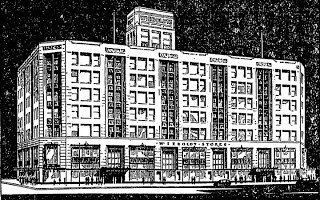
My work-life began with a Social Security card, and a job in the produce department of Wieboldt’s in Chicago, on 63rd Street and Green.

 Wieboldt's 63rd and Green departmentstoremuseum.blogspot.com

Photo: departmentstoremuseum.blogspot.com

This job brought me my first real paycheck and my first taxed Social Security earnings ($21) in 1957.  At sixteen, I was on my way to retirement (and the not-yet-known-Medicare), but certainly did not know it nor understand what was ahead for me in the work force.

In 1957, I was a junior in high school.  I had no earnings to speak of until 1963, the year I began teaching, the year I was married.

The Intro to Economics course taught me nothing about budgets, doing income taxes, withholding, rent, income, health insurance.  The GNP and Adam Smith did not help me with my first checking account.  (We did money orders for the first two years together.)  

We newlyweds had rented a nice one-bedroom apartment, 2nd floor, in a three-story building with long balconies, and dumpsters in the parking lot in the rear.  Wonder bread was 25¢ a loaf.

 wonder-bread-sign-garry-gay images.fineartamerica.com

PHOTO CREDIT: garry-gay images.fineartamerica.com

We could fill the tank of the ’62 Corvair for $3.00; and my Camel cigarettes were 25¢ a pack.

However, we soon realized near the end of the first year together that my teacher salary of $4300 a year was not going to be adequate for our lifestyles of fast cars and nightlife at the drive-in. 

During the summers after a school year, most young teachers, having reported final grades, and having cleaned their classroom and done other bureaucratic duties in order to receive the final paycheck, had to find work for the summer. 

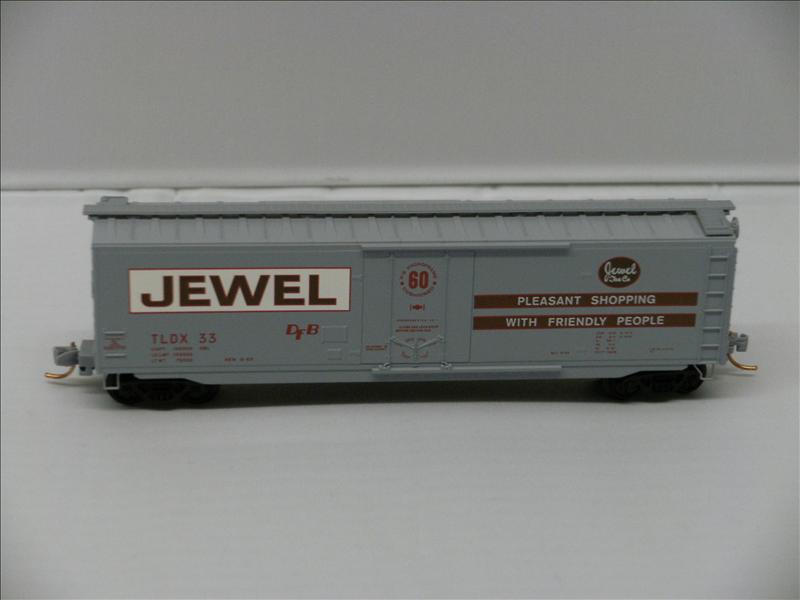
In the summer of 1964, I unloaded boxcars for Jewel Tea Company. 

jewel tea box car americanrailroadcentre.com

Photo of Model Boxcar: americanrailroadcentre.com

Unloading boxcars was, without a doubt, the hardest work I have ever done in my life. 

I was a lean, mean machine who could unload fifty-pound packages of bags of sugar, emptying a “sugar car” in an hour.  Green beans and SPAM took longer.  Ketchup cars were often scenes of massacre as the cars were “humped,” sending cartons of ketchup smashing against walls and ceilings.  After the broken glass, crushed cartons, and sprayed blood-red ketchup were disposed of, the remnants were able to be stacked in proper form on the pallets, awaiting the two-pronged forks of the lifts.

Summer could not end soon enough, with sandwiches made with ground baloney and mixed relish for lunch.

After the next school year?  No more bloody boxcars. 

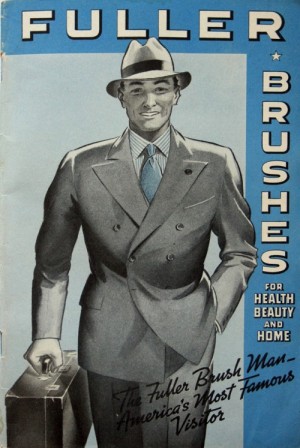
“Fuller Brush!  Good afternoon!  I have a few specials to show you today.”

fuller brush man www.emissourian.com

Photo: Fuller Brush Man http://www.emissourian.com

The work was fun and the products were good (like the DCW–Dust, Clean, Wax–cleaner).  And the brooms never wore out.  My territory was mostly in the Palatine area near Chicago.  Selling, carrying that Fuller Brush case, then sorting orders and packaging and then making deliveries, was the routine.  The best part?  Meeting people–and no baloney sandwiches.

My territory got too big; my manager wanted me to do more.  I quit. 

After the snows melted and the spring rains came, I knew summer would come after another school year finished.

I drove a dump truck.

dump-truckDump Truck

I worked for a landscaper.  I was a real “sod-buster,” taking the truck to the sod farm, getting sod or loads of dirt, and delivering–safely, through the streets and on the roads of northwest Cook County–to the job sites. 

My sod-busting and sod-laying and plant-planting work brought me home every night looking like a Welshman from the mines. 

At the end of the summer of 1966, that chapter of my life, which really began long before at Wieboldt’s, concluded.  We left Chicago and headed up to the Land of 10,000 Lakes.  It was to be our first big Adventure in Moving.  But more summers would lie ahead.

I was only 25….

oh-the-places-youll-go novelreaction.com

Image: novelreaction.com

© James F. O’Neil  2013


By: James F. O’Neil

October 12, 1963: Wedding Day.  I was married.

sue and jim

OCTOBER THEN

With my new bride came her dowry: the gifts to her new husband to help get the household started.

One 1962 Corvair, white, four-door with red leather interior:


Corvair

IT’S A CORVAIR

One high fidelity sound system:

hi-fi

HI-FI-CABINET

The hi-fi was a large piece of furniture that cleverly concealed four speakers, an AM-FM radio, and a phonograph turntable.  All this hid beneath a lift-up top and behind decorative grill/lattice-work.  Two sliding doors even concealed a record storage cabinet that could hold thirty or so LP records (“hi-fi” records with dynamic sound, or the latest LPs, a.k.a. “stereophonic”). 

One wedding picture from 1963 shows us leaving the church in a black ’57 Olds 98 four-door hardtop, with white leather interior. 

wedding wave

WEDDING GOOD-BYE

What a sweet car!  I added pink interior lights for wooing. 

57olds98

COURTSHIP MACHINE 1957 IN 1963

The courtship Rocket-Powered Olds brought me love–and a French provincial hi-fi.  What a dowry! 

I got the Corvair. 

My family got a daughter-in-law, and the Olds. 

49th Anniversary Photo in Florida

OCTOBER NOW

© James F. O’Neil  2013