BY: JAMES F. O’NEIL

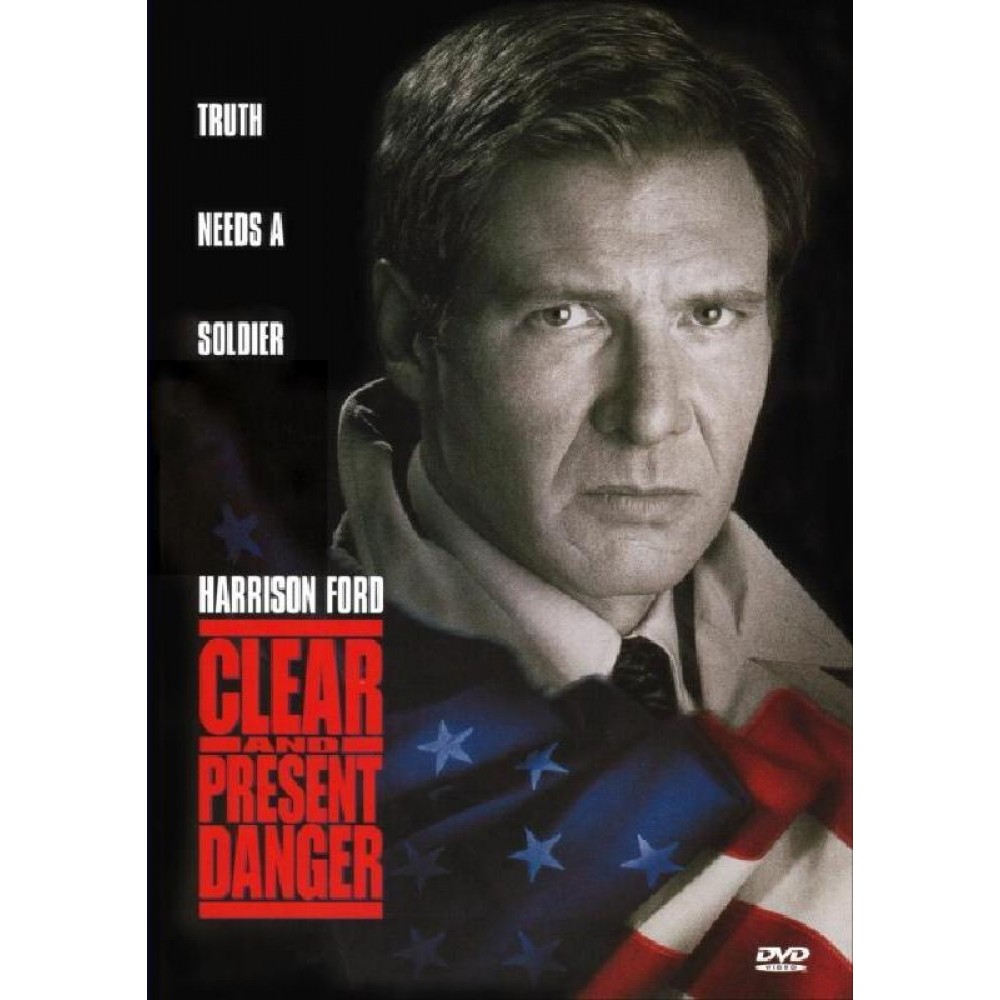
In the film Clear and Present Danger, hero (Dr.) Jack Ryan is accused of being a “boy scout” because he learns of a misguided military operation–and intends to commit “transparency.”
Is the truth to be told? Is telling the truth–facts–a bad thing, to be associated with being a “boy scout”? Seems so, by the standards of the antagonist’s comment to Jack Ryan. It’s complicated. “It’s grey” (not always just black and white).
Whistle-blowers are conflicted, are complicated. Are they “boy scouts” by not speaking up, by not speaking out, by not telling it as it is: the truth?
“[Jack]…You are such a Boy Scout!”
I was a real Boy Scout. Troop 661. St. Mary of Mount Carmel, Chicago. Here I am pictured in my most official uniform, smiling, giving-receiving the Scout handshake. There I am, published in the Southtown Economist, a local Chicago newspaper. My fellow Scouts and I are with the regional Scout director. We must have done something special to get our picture taken and distributed. I cannot remember what it was.
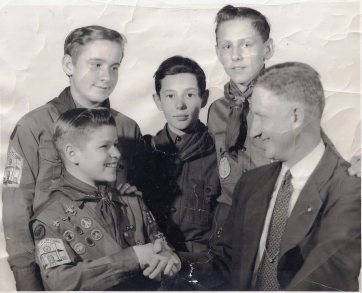 What I remember about Scouting could fill pages, memories from years of service, from Cub Scout to Boy Scout, ending in 1955. It was a sad time for me when I “resigned,” but we also were moving away from the neighborhood. Once there, my high school studies became a priority. No time for Scouting.

LIFE SCOUT BADGE
So there I sit, smiling and handshaking. One can see the sash I have over my right shoulder, with a few merit badges, with my pins from my previous ranks: Tenderfoot, Second-Class, First Class. At the time, I was a Star Scout.
Then I progressed to complete the requirements for a Life Scout. (I never became an Eagle Scout.) An honor, Life Scout was, to wear the heart over my heart, and become a card-carrying member of an elite group.
Scouts, as many know, complete time-in-rank requirements (as military Service members do) and requirements for merit badges before advancing. I earned mine mostly the hard way: work and study. Some stand out more than others, are memorable memories of a time past.
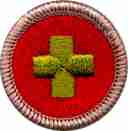
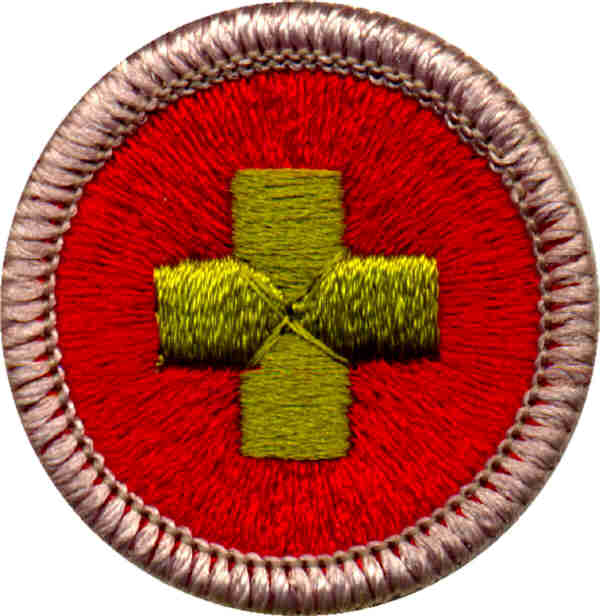
FIRST AID MERIT BADGE
FIRST AID: Though no badge is pictured on my sash, I did complete all required tasks. I later received the badge symbolized by a green cross on a red background.
I wondered about that color until I learned about copyright rules and using the Red Cross logo. I always had to explain that badge. I was pretty good at first aid, one of my better subjects. I knew A-B-C (Airway, Breathing and Circulation, the protocol for cardiopulmonary resuscitation–CPR. “The color, don’t forget the color: When the face is red, raise the head; when it’s pale, raise the tail; when it’s blue, it’s up to you.”) And other good tidbits of life-saving activities.
I remembered much from first aid that helped me in my job while in college as a hospital orderly, even the chest compressions I gave on a patient (who died), and at another time for a neighbor lady who had a heart attack in her yard (who died). Not a really good record, but as a Scout I helped our troop win some first aid competitions.
Later, many years later, I was training for a local volunteer EMS service in our small town. In First Aid Competition, I did well with GSW [gunshot wound] and delivering a baby. Neither of these was I taught in Scouts. My demonstration of the Heimlich maneuver was so good that the “victim” blew out his false teeth… I would have saved his life, but probably bruised his diaphragm.

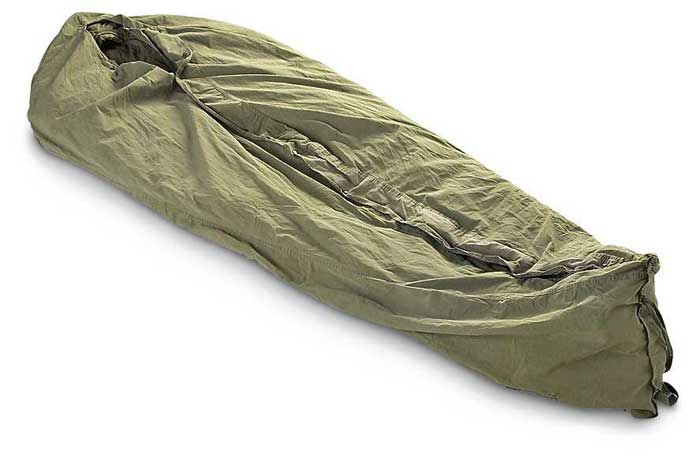
ARMY SLEEPING COCOON
A most important badge for Scouts is CAMPING. Mine is seen there in the picture, along with HIKING–to get to the campgrounds, usually. Most of my experiences in camp, summer or weekend or camporees, were disasters. Most of the time I was constipated…
I had a WWII-Korea-era, US Army–style sleeping bag passed down from my older cousin. It zipped up my body into a cocoon, leaving only my face exposed to the mosquitoes.
I had a good voice for singing around the campfire, could roast marshmallows burned the right way, could even put up a tent or two; but my land navigation was “crap.”

ARMY MESS KIT
My Army surplus metal eating-cooking pan and plateware oxidized, rusted, and were awful to clean with cold camp water. These were real “mess” kits.
SWIMMING: I hated summer camp swimming: cold, cold water. Always cold–and over my head. My merit badge for this activity was earned later, really earned. It took a long time for me to get in over my head, literally. But I did it–and was even able to dive from the barrel raft once I overcame my fear of deep water. Scouting enabled me to do this.

PUBLIC SPEAKING BADGE
PUBLIC SPEAKING: “Prepare a talk on a topic…” And so forth, to collect and organize information…leading a meeting…rules of order…
I received this badge, never dreaming that I would stand in a classroom in front of students, teaching for nearly fifty years.
On my left arm is the patch for Senior Patrol Leader: I became drill instructor, teaching marching, calling meetings to order, and tried to teach knot tying. (I was awful with the Bowline on a Bight, and some others. But I did master the square knot.) I planned outings with our Scout Master (who drove a beautiful four-door Hudson–and told us he was a G-man. Then we learned he worked for the Chicago Sanitation Department: a “Garbage man.”) And, I did “other duties as assigned.”

SOUTHTOWN THEATER LOBBY
One of my greatest experiences was our troop’s exhibition in the lobby of the beautiful Southtown Theater.
Our troop was invited to set up a model campsite, make pretend fire, answer questions, and make displays of our own hobby work. I shall never forget pretending I was sleeping in the tents we arranged–and eating baby hot dogs.
So that is some of what “such a Boy Scout” means to me. I tried to “Do a good turn daily.” Is that such a bad thing? I know I have tried to “Be prepared.” I swore the oath to “do my best, to do my duty to God and my country, and to obey the Scout Law; to help other people at all times (not a bad idea); to keep myself physically strong (ooops!), mentally awake, and morally straight.” Quite a bit for twelve to eighteen year old boys.
I was such a Boy Scout!
I was “trustworthy, loyal, helpful, friendly, courteous, kind, obedient, cheerful, thrifty, brave, clean, and reverent. Then. But I remember. All this from watching a movie. Way to go, Jack Ryan! (Way to go, Author Tom Clancy!)
* * *
“Boy Scouting, one of the traditional membership divisions of the BSA, is available to boys who completed the fifth grade and are at least 10, or who are 11, but not yet 18 years old. The program achieves the BSA’s objectives of developing character, citizenship, and personal fitness.”
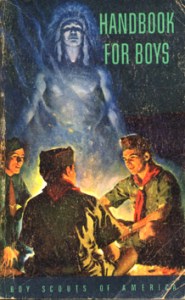
BOY SCOUT HANDBOOK c.1952
© JAMES F. O’NEIL 2015








 Memories of a Time