Archive

THINKING AND THOUGHT

“We are such stuff / As dreams are made on, and our little life / Is rounded [completed] with a sleep.”  –Shakespeare.  The Tempest 4.1.156-58

“Those who dream by day are cognizant of many things which escape those who dream only by night.”  –E. A. Poe

“Row, row, row your boat, gently down the stream . . . life is but a dream.”  –Children’s rhyme

“The dream is the small hidden door in the deepest and most intimate sanctum of the soul, which opens into that primeval cosmic night that was soul long before there was a conscious ego and will be soul far beyond what a conscious ego could ever reach.”  –C. G. Jung

[Music: The Everly Brothers, 1958] :  “Drea-ea-ea-ea-eam, dream, dream, dream … Drea-ea-ea-ea-eam, dream, dream, dream … Whenever I want you, all I have to do is / Drea-ea-ea-ea-eam, dream, dream, dream … Anytime night or day / Only trouble is, gee whiz / I’m dreamin’ my life away … Drea-ea-ea-ea-eam, dream, dream, dream…”

“A dream is a personal experience of that deep dark ground that is the support of our conscious lives, and a myth is the society’s dream.  The myth is the public dream and the dream is the private myth.”  –Joseph Campbell, The Power of Myth.

[Music: Man of La Mancha, November 1965] :  “The Impossible Dream” : “To dream the impossible dream / … To bear with unbearable sorrow / … To right the unrightable wrong / To love pure and chaste from afar / To try when your arms are too weary / To reach the unreachable star / This is my quest, to follow that star, / No matter how hopeless, no matter how far / … And the world will be better for this…”  Songwriters: Joe Darion / Mitchell Leigh.  “The Impossible Dream” lyrics © Helena Music Company

“Wishing and hoping come directly out of the function of dreaming and making myths.”  — Rollo May, The Cry for Myth.

[Music: “I Dreamed a Dream” is a song from the musical Les Misérables.  It is a solo that is sung by the character Fantine during the first act.  …  The song is a lament, sung by the anguished Fantine, who has just been fired from her job at the factory and thrown onto the streets.  See Wikipedia for more history and analysis] :  “I Dreamed a Dream”/Anne Hathaway :  “There was a time when men were kind … There was a time when love was blind … And the world was a song … And the song was exciting.  There was a time…  Then it all went wrong.  I dreamed a dream in times gone by / When hope was high and life worth living / I dreamed, that love would never die / I dreamed that God would be forgiving…  I had a dream my life would be / So different from this hell I’m living / So different now from what it seemed / Now life has killed the dream / I dreamed.”  Songwriters: Alain Albert Boublil / Claude Michel Schonberg / Herbert Kretzmer / Jean Marc Natel.  “I Dreamed a Dream” lyrics © Warner/Chappell Music, Inc.

“Dreams are a private application to one’s life of public myths in which we all are participants.”  –Rollo May, The Cry for Myth.

“What happens to a dream deferred?  / Does it dry up / Like a raisin in the sun?  … / Or does it explode?”  –Langston Hughes

LET THE DREAMS BEGIN! 

“Hold fast to dreams / For if dreams die / Life is a broken / winged bird / that cannot fly. . .  Life is a barren field / Frozen with snow.”  –Langston Hughes, “Dreams.”

 

interrobang

“And the Oscar goes to La La Land….  No!  No!  Wait!  That can’t be right.  It isn’t right.  The Oscar goes to Moonlight!”  “Huh?”

It’s complicated, this movie reviewing stuff.  But maybe reviewing is simply a matter of telling persons who are busy what is better to see than to see something else, simply what NOT to see: “Don’t waste your time.”  “It’s a waste of money.”  “Don’t bother.  See X instead.”

However, do I want a review, or a formal analysis of a movie?  “Thumbs Up” or 5-Stars, or cultural response, production history, or values discussion?

What do you NEED to make you WANT to see a particular movie: old, new, classic, recent, color, black and white, documentary, drama, comedy, Netflix, Redbox, STARZ, Cobb Theatres; story, technology, actor or actress, theme, technique–and more, much more?  Does the critic count for you?  Explanation and evaluation?    

“Critics would be useful people to have around if they would simply do their work, carefully and thoughtfully assessing works [of art], calling attention to those worth noticing, and explaining clearly, sensibly, and justly why others need not take up our time.”  –John Gardner, On Moral Fiction (1978)

SO: Watch these movies for “greatness”–or NOT!”

UP IN THE AIR

CASABLANCA

P.S. I LOVE YOU

A GOOD YEAR

LOVE ACTUALLY

JERRY MCGUIRE

ALIEN

BLADE RUNNER

THE HOURS

THE ENGLISH PATIENT

GIRL WITH A PEARL EARRING

* * *

“Art is meant to be experienced, and in the last analysis the function of criticism is to assist that experience.”  –David Daiches (1956; 1981)

interrobang

“MAGIC MOMENTS” : Magic moments, when two hearts are carin’ // Magic moments, mem’ries we’ve been sharing … Time can’t erase the memory of // These magic moments filled with love … Magic moments filled with love  [Songwriters: Burt Bacharach / Hal David.  “Magic Moments” lyrics © Sony/ATV Music Publishing LLC]

“There’s a magic and mystery in positive events.”  –Sonja Lyubomirsky, PhD, psychologist

The term magic has a variety of meanings, hence there is no widely agreed upon definition of what it is or how it can be used.  However, some treat magic as a personal phenomenon intended to meet individual needs, as opposed to a social phenomenon serving a collective purpose.  The explanatory power of magic should not be underestimated, however.  Both in the past and in the modern world, magical belief systems can provide explanations for otherwise difficult or impossible to understand phenomena while providing a spiritual and metaphysical grounding for the individual.  [See “Magic” in Wikipedia.]

“It’s a mystery!”  –Tom Stoppard, Shakespeare in Love

“…moments of epiphany, or revelation, of radiance…with meaning essentially wordless, for words are always qualifications and limitations.”  –Joseph Campbell, The Power of Myth

“Persons who come for therapy do so because they lack power; they complain that they cannot achieve.  …  Patients want ‘magical knowledge,’ and no matter how correctly the therapist explains that insight is not magic, it still feels that way to the person when an insight ‘dawns.’”  –Rollo May, “Faust in the Twentieth Century” in The Cry for Myth (1991).

“There is no myth which is not the unveiling of a ‘mystery,’ the revelation of a primordial event which inaugurated either a constituent structure of reality or a kind of human behavior.  [But] when no longer assumed to be a revelation of the ‘mysteries,’ the myth becomes ‘decadent,’ obscured; it turns into a tale or a legend.”  –Mircea Eliade, “Preface” in Myths, Dreams, and Mysteries (1957)

“MEMORY”:  Midnight // Not a sound from the pavement // Has the moon lost her memory // She is smiling alone // In the lamplight…  Memory // All alone in the moonlight // …I remember the time I knew what happiness was // Let the memory live again // … Tonight will be a memory too // And a new day will begin // …  –Andrew Lloyd Webber, T. S. Eliot, Trevor Nunn, Zdenek Hruby • © Universal Music Publishing Group, Imagem Music Inc.

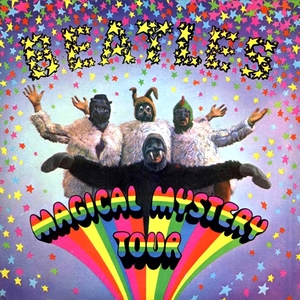
interrobang  MagicalMysteryTourDoubleEPcover.jpgMagical Mystery Tour


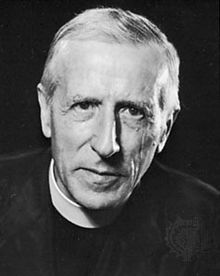
Pierre Teilhard de Chardin, SJ: 1 May 1881–10 April 1955, was a French idealist philosopher and Jesuit priest who trained as a paleontologist and geologist, and Teilhard de Chardintook part in the discovery of the Peking Man.  He conceived the vitalist idea of the Omega Point (a maximum level of complexity and consciousness towards which he believed the universe was evolving).

Although many of Teilhard’s writings were at one time censored by his Catholic Church, in our time he has been posthumously praised by popes.  However, some evolutionary biologists are still negative.  Nevertheless, Chardin has had a profound influence on the New Age movement, being described as “perhaps the man most responsible for the spiritualization of evolution in a global and cosmic context”–even being described as a “visionary” philosopher and a contemporary “truth-sayer” or “prophet.”  Teilhard de Chardin has two comprehensive works, The Phenomenon of Man, and The Divine Milieu.

(Teilhard is mentioned by name and the Omega Point briefly explained in Arthur C. Clarke’s and Stephen Baxter’s The Light of Other Days.  The title of the short-story collection Everything That Rises Must Converge by Flannery O’Connor is a reference to Teilhard’s work.  The American novelist Don DeLillo’s 2010 novel Point Omega borrows its title and some of its ideas from Teilhard de Chardin.  Robert Wright, in his book Nonzero: The Logic of Human Destiny, compares his own naturalistic thesis that biological and cultural evolution are directional and, possibly, purposeful, with Teilhard’s ideas.)  [Wikipedia]

“The perception of the divine omnipresence is essentially a seeing, a taste, that is to say a sort of intuition bearing upon certain superior qualities in things.  It cannot, therefore, be attained directly by any process of reasoning, nor by any human artifice.  It is a gift, like life itself, of which it is undoubtedly the supreme experimental perfection.”  (The Divine Milieu, p. 131.)  

“When a distinguished but elderly statesman states that something is possible, he is almost certainly right.  When he states that something is impossible, he is very probably wrong.”  –Arthur C, Clarke

“Mystics seem intent in regarding the death of earth as the birth of the new cosmic man.  In this respect, Teilhard de Chardin’s vision is remarkably like A. C. Clarke’s Childhood’s End”: ‘Let us suppose from this universal centre, this Omega Point, there constantly emanate radiations hitherto only perceptible to those persons we call “mystics.”  Let us further imagine that, as the sensibility or response to mysticism of the human race increases with planetisation, the awareness of Omega becomes so widespread as to warm thechildhood's end jackeet earth psychically while physically it is growing cold.  Is it not conceivable that Mankind, at the end of its totalisation, its folding-in upon itself, may reach a critical level of maturity where, leaving the earth and stars to lapse slowly back into the dwindling mass of primordial energy, it will detach itself from this planet and join the one true, irreversible essence of things, the Omega Point?  A phenomenon perhaps outwardly akin to death; but in reality a simple metamorphosis and arrival at the supreme synthesis.’”  –Chardin, The Future of Man, p. 127, in Harper’s, December 1971: 77-78)

interrobang