
REFLECTIONS ON “WHAT IS TRUTH?”
 TOM CRUISE
From notes gathered into my journals: Will I ever “get to the bottom of it?” [bottom of what?]
Should I know the truth, the whole truth, and nothing but the truth?
* * *
TRUTH = the quality of being true or correct according to SOME ground or test for establishing the reality of a statement (proposition, idea, thought, belief, opinion).
“Truth” assumes that what it applies to DOES depict fact or reality.
But some statements are to be tested: proposals (accept or reject); resolutions (yes, or violated); promises (kept or not); suggestions (heeded, or not); commands (obeyed, or not).
***TRUTH IS THE CONFORMITY OF THE INTELLECT WITH THE THING (logical truth, “truth of knowing”).
SHOULDS: Contain VALUE JUDGMENTS, without moral import at all. “You should turn here.” YET, the action COULD have moral import…and consequences: “You should turn here, or you’ll….”
PRACTICAL LIVING demands certain guidelines or limits within which all humans should behave.
BASIC MORAL PRINCIPLES can indeed be set up to govern most human actions–yet exceptions can be provided for, with careful and strong justification.
So, we live with NORMATIVES (“It’s good/right.”) and PRESCRIPTIVES (“You should not do it.”).
**Yet, even if a proposition is true, there is no guarantee that people will act in accordance with it–yet the proposition still remains true whether they do or not….
THUS:
Just because they do it doesn’t mean it’s true.
Just because they believe it doesn’t make true.
* * *
PRINCIPLE OF TRUTH-TELLING, OR HONESTY:
The principle that states a human being should always OUGHT to strive to tell the truth or be honest, except when it would interfere with or seriously violate the principles of GOODNESS, VALUE OF LIFE, and JUSTICE. [This principle is necessary for meaningful communication and human relationships…]
 ARE SOME LIES VITAL?
VALUE OF LIFE [SANCTITY OF LIFE] = 1st moral principle = life of humans is to be preserved, protected, valued
GOODNESS/RIGHTNESS = moral/ethical = good/right
Promote good over bad
Cause no harm/badness
Prevent badness/harm
JUSTICE/FAIRNESS = not enough to do good and avoid bad, but some effort must be made to distribute the good and bad resulting from actions = moral rightness, equity, fairness:
Exchange = payment/remuneration
Distributive = merit, reward (for work performed)
Social = fair and just for all
Retributive = eye for an eye/punishment
* * *
From On Truth by Harry G. Frankfurt (Knopf, 2006):
Truth is so important to us . . . we should especially care about it. Yet common sense tells us that we know what it means to tell the truth, …and what it means to give false accounts: to lie.
Higher levels of civilization must depend even more heavily on a conscientious respect for the importance of honesty and clarity in reporting the FACTS, and on a stubborn concern for accuracy in determining what the facts are.
[No one in his right mind would rely on a builder, or submit to a physician, who does not care about truth. There is a clear difference between getting things right and getting them wrong, and thus a clear difference between the true and the false.]
…societies cannot afford to tolerate anyone or anything that fosters a slovenly indifference to the distinction between true and false. AND indulge the . . . narcissistic pretense that being true to the facts is less important than being “true to oneself.”
We need to avoid being debilitated either by error or by ignorance. We need to know–and, of course, we must understand how to make productive use of–a great many truths.
Our success or failure in whatever we undertake, and therefore in life altogether, depends on whether we are guided by truth or whether we proceed in ignorance or on the basis of falsehood.
WE REALLY CANNOT LIVE WITHOUT THE TRUTH… 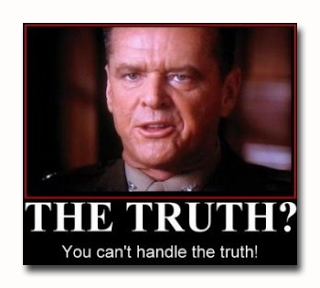
…hiding our eyes from reality will not cause any reduction of its dangers and threats.
If we have no respect for the distinction between true and false, we may as well kiss our much-vaunted “rationality” good-bye.
For every fact, there is a true statement that relates it; and every true statement relates a fact.
…caring about truth plays a considerably different role in our lives, and in our culture, than does caring about the accumulation of individual truths.
It is because we appreciate that truth is important to us that we care about accumulating truths.
It is only through our recognition of a world of stubbornly independent reality, fact, and truth that we come both to recognize ourselves as beings distinct from others and to articulate the specific nature of our own identities.
How, then, can we fail to take the importance of factuality and of reality seriously? How can we fail to care about truth? We cannot….





 Memories of a Time