“HOMEOSTASIS is the ability or tendency of an organism or cell to maintain internal equilibrium by adjusting its physical processes.”  [Chlordiazepoxide, trade name LIBRIUM, is a sedative and hypnotic medication of the benzodiazepine class; it is used to treat anxiety, insomnia, and withdrawal symptoms from alcohol and/or drug abuse–discovered accidentally in 1955.  Wikipedia]

 “RISK is the possibility of suffering harm or loss; danger.  A factor, thing, element, or course involving uncertain danger; a hazard.”

RISK HOMEOSTASIS was a hypothesis posited by Gerald J. S. Wilde, a professor of psychology at Queen’s University, Ontario, Canada, dealing with the notion that every person has an acceptable amount of risk that she or he finds tolerable.  If the perceived level of risk in one part of a person’s life changes, that person will compensate by either reducing or increasing the amount and severity of risks taken–all in order to maintain an EQUILIBRIUM of perceived risk. 

Let’s say, for example, a rocket ship with astronauts aboard is about to lift off into space.  The night before liftoff, temperatures dropped and the seals around the fuel tanks may have hardened a bit from their softened sealing state.  These are the large O-rings connecting and sealing.  Launch engineers can observe ice on the rocket, around the O-rings.  Is it all sealed properly?  Should they abort?  Manufacturing engineers are consulted.  They’re not sure.  The mission is a GO FOR LAUNCH!  (Cannot disappoint the country, the crew, the politicians, the families, the companies.  Hubris: pride.  USA!  USA!) 

Up, up it goes.  A beautiful candlestick into the blue sky on a full-sunny morning in Florida.  POOF!  No more.  Risky business, this space travel stuff. 

It’s Risky Business, this technology of ours.  Was the long-ago, not-often-thought-of Challenger explosion an “accident”?  a “catastrophe”?  a “disaster”?  On the other hand, was it a kind of “Russian roulette,” as some suggested? 

The Challenger explosion–and also the Columbia accident (which certain engineers knew was doomed when they saw a panel hit the wing at liftoff)–teaches us that we live in a world which we have made, a world of technology which has the potential for catastrophe: “It will happen again.”

Do we want the safest of all possible worlds?  Really?  Life is filled with trade offs, for safety and comfort: The “ancient” national speed limit of 55 mph saved lives…. 

“Under certain circumstances, changes that appear to make a system or an organization safer, in fact, don’t,” writes Gerald Wilde in his book Target Risk.  Why is that?  Human beings have a tendency to compensate for lower risks in one area by taking greater risks in another.  “Ah, now I have new brakes and tires.  I feel safer, can drive better, and can go faster–stopping better.” 

Pedestrians are still killed at marked crosswalks.  They feel more safe because of some white paint–but are less vigilant about traffic.  Did they Mind the Gap?  Look both ways?  They assume “safe zones” or assume they are invincible, not even bothering to look out at all. 

Do we have a sense of indestructibility because we drive a large SUV, or large-cab truck?  Is there a false sense of power–or safety?  (I remember my brother who drove a semi- telling me he worried only about trains, tanks, and road ice…) 

What are the benefits of risky behavior, speeding to gain time?  What are the benefits of lighter-constructed vehicles?  More plastics, less weight, better fuel economy, faster speed.  Better air bags, passenger-compartment safety.  Observe the Crash-Test Dummies for results, at the pile of rubble at a 35-mph crash, at 65-mph, at 75-mph.  Risky Business. 

“Chances are…you won’t get caught.  So go for it.”

“It’s risky, but you’ll regret it if you don’t try it.”

“C’mon, take a bite.  It’s only an apple.”

“Might as well.  You only live once.”

“It’s not a scary movie.  Don’t be a wuss.”

“Take a chance.  What’s to lose?” 

© JAMES F. O’NEIL  2018    

 interrobang


BY: JAMES F. O’NEIL

EMILY DICKINSON: “I’M NOBODY, WHO ARE YOU?  ARE YOU NOBODY TOO?”

Nobody Diary 1992

 …

“The shadow is a moral problem that challenges the whole ego-personality, for no one can become fully conscious of the shadow without considerable moral effort.  To become conscious of it involves recognizing the dark aspects of the personality as present and real.  This act is the essential condition for any kind of self-knowledge, and it therefore, as a rule, meets with considerable resistance.”  –C. G. Jung, in Your Mythic Journey, Sam Keen and Anne Valley-Fox, p. 15 (1973, 1989)


Here I am:INFJ personality-infjI reveal all, having taken the Myers-Briggs Type Indicator test at various times in my life, under counselor supervision, online, and just recently with my wife (using the printed tests in Please Understand Me: Character and Temperaments Types by Keirsey and Bates and Understand Me II by Keirsey, both still in print).  The recent scoring was my strongest ever, my “most solid.”  I find the indicator questions fascinating and intellectually challenging, even though a few might seem simple or simplistic:  “Are you more firm than gentle, more gentle than firm.”  “Do you put more emphasis on the definite [or] the open ended.”  I’ve always liked, when I was younger (and drinking): “At parties do you stay late, with increasing energy [or] leave early, with decreased energy.”  How about, as a writer, do I “prefer the more literal [or] the more figurative.”

Am I basically passionate, hard-headed, soft-hearted, easy to approach, cool-headed, punctual, easy going, devoted?  What type am I?  Researchers claim this test can give a description or portrait of a person’s psychological personality type.  It tells me about myself, my differences, something about my behavior or even my attitudes towards others.  I portray myself, know myself, and how I deal with and react to family and friends, teachers and students.  For me, it has paid off; I have gained from this knowledge, though sometimes, unfortunately, after the fact.  “I should have not said that.”  “I should know better.”  In other words, I never planned my career based on the questionnaire.

For a time, I wanted to attend medical school:Jefferson medical college diplomaI had even planned to take the MCAT.  Counselors had me undergo a series of tests, including the MMPI, the Myers-Briggs, and a few others that helped determine I had the desire, but not the “right stuff” to be encouraged to pursue a career in medicine.

At one time I wanted to be a Navy corpsman, then became a teacher, desired to become a doctor, stayed a teacher–and enjoyed, for the most part (91.344%, A-/B++), a long career in education.  The Myers-Briggs could describe me at each stage of my career, and did even help me understand my behavior at just the right time.  Please Understand Me!  As noted, I’m a “true” INFJ type.

The intent of the Myers-Briggs Type Indicator® (MBTI®) personality inventory is to make the theory of psychological types described by C. G. Jung in the 1920s understandable and useful in people’s lives.  The essence of the theory is that much seemingly random variation in the behavior is actually quite orderly and consistent, being due to basic differences in the ways individuals prefer to use their perception and judgment.

“Perception involves all the ways of becoming aware of things, people, happenings, or ideas.  Judgment involves all the ways of coming to conclusions about what has been perceived.  If people differ systematically in what they perceive and in how they reach conclusions, then it is only reasonable for them to differ correspondingly in their interests, reactions, values, motivations, and skills.”

In developing the Myers-Briggs Type Indicator [instrument], “the aim of Isabel Briggs Myers, and her mother, Katharine Briggs, was to make the insights of type theory accessible to individuals and groups.  The MBTI tool was developed in the 1940s by Isabel Briggs Myers; the original research was done in the 1940s and ’50s.”  This research is ongoing, providing users with updated and new information about psychological type and its applications.

“Millions of people worldwide have taken the Indicator each year since its first publication in 1962.  They addressed the two related goals in the developments and application of the MBTI instrument:

–The identification of basic preferences of each of the four dichotomies specified or implicit in Jung’s theory.

–The identification and description of the 16 distinctive personality types that result from the interactions among the preferences.”

FAVORITE WORLD: Do you prefer to focus on the outer world or on your own inner world? This is called Extraversion (E) or Introversion (I).

INFORMATION: Do you prefer to focus on the basic information you take in or do you prefer to interpret and add meaning?  This is called Sensing (S) or Intuition (N).

DECISIONS: When making decisions, do you prefer to first look at logic and consistency or first look at the people and special circumstances?  This is called  Thinking (T) or Feeling (F). 

STRUCTURE: In dealing with the outside world, do you prefer to get things decided or do you prefer to stay open to new information and options?  This is called Judging (J) or Perceiving (P). 

Your Personality Type: When you decide on your preference in each category, you have your own personality type, which can be expressed as a code with four letters.

(All types are equal: The goal of knowing about personality type is to understand and appreciate differences between people.  As all types are equal, there is no best type, despite what some INFJs may think!).

[This material is from https://www.myersbriggs.org/my-mbti-personality-type/mbti-basics/.  Some is used from the MBTI® Manual: A Guide to the Development and Use of the Myers-Briggs Type Indicator.]  Complete tests are available online, as are shorter tests taking 10 minutes or so of your time, coming with explanations and interpretations–for free!  (I found a 12-minute-or-less test while preparing for this blog.  It was quick and simple.)  [Some are $49.95.]  Just “Google it.”  It is a trip–one worth taking.

Note, however, that the test or Type Indicator has not existed without controversy, nor without detractors.  Its reliability and validity have been questioned oftentimes, despite its popularity and use.  The response?  “The best reason to choose the MBTI instrument to discover your personality type is that hundreds of studies over the past 40 years have proven the instrument to be both valid and reliable.  In other words, it measures what it says it does (validity) and produces the same results when given more than once (reliability).  When you want an accurate profile of your personality type, ask if the instrument you plan to use has been validated.”  [www.myersbriggs.org]

So, are you ready to unlock your inner self?  If you have not ever done this, do it. 

JUST DO IT!

It will “give you a framework for understanding yourself and appreciating differences in others.” 

For further, interesting reading: “Myers-Briggs: Does It Pay to Know Your Type?”  By Lillian Cunningham (Dec. 14, 2012): https://www.washingtonpost.com/national/on-leadership/myers-briggs-does-it-pay-to-know-your-type/2012/12/14/eaed51ae-3fcc-11e2-bca3-aadc9b7e29c5_story.html?utm_term=.1a7b2a0c12c8

© JAMES F. O’NEIL  2018

YODA AN INFJ


BY: JAMES F. O’NEIL

How is one to assess and evaluate a type face in terms of its esthetic design?  Why do the pace-makers in the art of printing rave over a specific face of type?  What do they see in it?  Why is it so superlatively pleasant to their eyes?  Good design is always practical design.  And what they see in a good type design is, partly, its excellent practical fitness to perform its work.  It has a ‘heft’ and balance in all of its parts just right for its size, as any good tool has.”  –Alexander Lawson,

Anatomy of a Typeface, p.345 (1990) anatomy of a typeface

When I began as a school administrator in Minnesota in 1973 (many memoriesofatime), many school districts had already put aspects of Title IX into the school district curriculum, aside from sports.  Shop classes and Home Ec classes were “integrated.”  At the same time, to be “fair,” some schools had even added required typing for all 10th grade students so that the traditional course was not any longer “girls only.” 

On any given school day, one could hear the clacking sound of typewriter keys from the typing room, set aside with 25-35 desks and manual typewriters, and, perhaps, five or so Smith-Corona electric machines for advanced proficient students.  One might observe a business teacher, male or female, pacing in the aisles, checking the work of the students, or even observe a few male students who were longhair throwbacks of the 60s, now required to wear hairnets lest their locks become tangled in the inner workings of the keys of the machines.  It did happen.

So most Minnesota high school graduates of that era learned non-sexist equality gender-free typing.  On the other hand, high school students in Florida, at the same time, had one required course in the curriculum, not typing, not World History, not English 10, but rather “AVC”: “AMERICANISM vs COMMUNISM.”

Following the Bay of Pigs Invasion in April 1961, the 1961 Florida Legislature passed a law [233.064 (1961), Florida Statutes] mandating all junior and senior public high school students in Florida take the six-week course, Americanism vs. Communism.  The course remained an educational requirement until the law was repealed in 1983 and replaced with a mandatory economics course:

avc bulletin 2

“THE FLORIDA LAW SECTION 230.23 (4) (1), Florida Statutes: Americanism vs. communism; required high school course  1. The legislature of the state hereby finds it to be a fact that a. The political ideology commonly known and referred to as communism is in conflict with and contrary to the principles of constitutional government of the United States … b.  The successful exploitation and manipulation of youth and student groups throughout the world today are a major challenge, which the free world forces must meet, defeat, and c.  The best method of meeting this challenge is to have the youth of the state and nation thoroughly and completely informed as to the evils, dangers, and fallacies of communism …  2.  The public high schools shall each teach a complete course of not less than thirty hours, to all students enrolled in said public high schools entitled “Americanism versus communism.”  3. The course shall provide adequate instruction in the history, doctrines, objectives, and techniques of communism and shall be for the primary purpose of instilling in the minds of the students a greater appreciation of democratic processes, freedom under law, and the will to preserve that freedom.  4. The course shall be … in comparative governments and shall emphasize the free-enterprise-competitive economy of the United States … which produces higher wages, higher standards of living, greater personal freedom  and liberty than any other system of economics on earth.  5. The course shall lay particular emphasis upon the … false doctrines of communism.  6. The state textbook committee and the state board of education shall … prescribe suitable textbook and instructional material … using as one of its guides the official reports of the house committee on un-American activities and the senate internal security sub-committee of the United States congress.
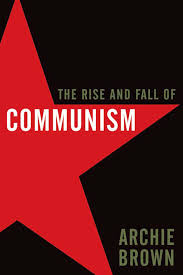
communism bookONE EXAMPLE OF ADOPTED TEXT

7.  No teacher or textual material assigned to this course shall present communism as preferable to the system of constitutional government and the free-enterprise-competitive economy indigenous to the United States. 8. The course of study hereinabove provided for shall be taught in all of the public high schools of the state no later than the school year commencing in September 1962.”

 What a shock for me when I moved to Florida to teach: I began in the summer of 1980 registering students for classes.  I discovered only ONE required course: “AVC.”  (However, to be fair, I point out that the schools were going through a transition to have the law changed.)

Imagine me, on the other hand, in 10th grade, 1956-1957, parsing and declining Latin and Greek, and studying other sophomore grade subjects, like geometry.  Yet no typing classes.  In fact, I never had a typing course and had/have had to hunt-n-peck my way through QWERTY after receiving a Christmas present Underwood in 1956, useful through high school, college, and most of graduate school.  (I still have many of the papers to prove it.)
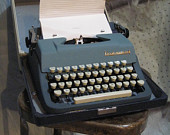
underwood typewriter

JUST LIKE MY PORTABLE UNDERWOOD

That machine, truly a collector’s item that still worked, is long gone now, purchased by a “picker” collector who knew a good deal when she saw the sixty-year-old beauty, with Courier typeface–one typeface that many of us were used to, Courier.  What type?

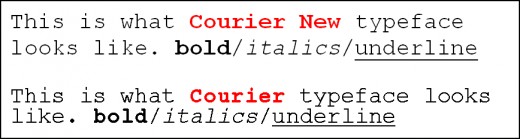
“Courier is a monospaced slab serif typeface designed to resemble the output from a strike-on typewriter.  The typeface was designed in 1955, later redrawn for the IBM Selectric Composer series of electric typewriters” (Wikipedia).

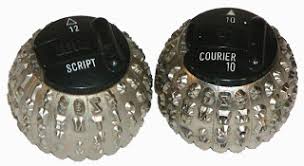
Those lucky few advanced typing students in the 1970s in Minnesota were later allowed to demonstrate their excellence on the Selectrics.  In addition, secretaries throughout the nation were purchasing “golf-ball” heads with various fonts never before readily available on “normal” typing machines for their newly acquired office machines.
IBM GOLFBALL.jpg

IBM SELECTRIC “GOLF BALL” TYPE FACES

Although IBM commissioned the design of the original Courier typeface, the company deliberately chose not to secure legal exclusivity to the typeface, nor seek any copyright, trademark, or design patent protection.  So Courier typeface cannot be trademarked or copyrighted and is completely royalty free.  It soon became a standard font used throughout the typewriter industry. 
courier and courier new.jpg

 A variant, however, 12-point Courier New, the U.S. State Department’s standard typeface until January 2004, was replaced with a 14-point, more “modern” and “legible” font, Times New Roman: “Of all the typefaces developed during the past seventy-five years [Times (New) Roman], is the one most frequently singled out as typifying the twentieth century” (Lawson 270). Times_New_Roman_versus_Georgia

Different fonts, italics, and speed helped make the transition to the keyboard of the PC, with QWERTY, and many, many choices of fonts, sizes, and black letter.  Now, What’s your type?  can be GEORGIA, Arial, Garamond, or PALATINO–and many more to mention here, upper case-lower case, that suits your fancy, or whatever serif-non-serif required by APA, MLA, CMS, or an office handbook, available on word processing programs, from A-Z, like Algerian to___–and in colors!

Technology is so much with us, “To boldly go where no man has gone before!”  “The computer is the most advanced typographic product yet to appear; it would seem to be the culmination of almost five and a half centuries of progress in the transfer of the scribal hands to the printed page.  Engineers have thus provided the means for printers to continue enriching the heritage they have provided humankind.  Now the responsibility falls on the printers to control the new technology and make it serve the great legacy of their time-honored craft” (Lawson 403).

© JAMES F. O’NEIL  2018


APA original_editor_example_double_spaced


All I Really Need to Know I Learned in Kindergarten” (1986)

In thirty-two (32) years since the book’s best-seller publication, have we forgotten, gotten lost (within family life, at work, in government, throughout the world)?

Robert_Fulghum.jpg

ROBERT FULGHUM

Robert Fulghum grew up in Waco, Texas, received a Bachelor of Arts at Baylor University in 1958, a Bachelor of Divinity in 1961, and was ordained as a Unitarian Universalist minister, serving Bellingham Unitarian Fellowship in Bellingham, Washington, from 1960-1964.  He is currently Minister Emeritus at the Edmonds Unitarian Universalist Church in Edmonds, Washington. The Kindergarten book stayed on The New York Times bestseller lists for nearly two years.  The collection of essays, subtitled “Uncommon Thoughts on Common Things,” has been updated and revised.  There are currently more than 17 million copies of his books in print, published in 27 languages in 103 countries!  [See more in Wikipedia.]

Remember this: Play fair . . . Don’t take things that aren’t yours . . . When you go out into the world, watch out for traffic, hold hands, and stick together . . . Share everything . . . Don’t hit people . . . Clean up your own mess . . . Say you’re sorry when you hurt somebody . . . Take a nap every afternoon.

“Crayolas are one of the few things the human race has in common.”

“Rock, paper, scissors: scissors cut paper; paper covers rock; rock smashes scissors.”

“To be human is to know and to care and ask, ‘What’s it for?’”

“We take what we know, which isn’t even the whole story, and we add it to what we wish and need, . . .  We even make ourselves up, fusing what we are with what we wish into what we must become.”

from the book Uh-Oh (1991):

“In high school, one learns that love is not forever.”

“A question with several possible answers comes to mind: If one man lives as though he would never die and another man lives as though he might die tomorrow, would either wear a wrist watch?”

“Will we ever have enough time?  What would happen if we only had enough time?  When will the time finally come?  Who knows where the time goes?  How far is it from time to time?  What time is the right time?  Will we know when our time has finally come?”

“Surprise is at the core of existence.  It’s true.  You never ever really know what’s coming next.” 

from the book Maybe (Maybe Not) [1993]

“Whatever we may think or believe, what we have done is our story.”

“Life is.  I am.  Anything might happen.”

“. . . since everything and anything are always possible, the miraculous is always nearby and wonders shall never, ever cease.”

“At age ___, I begin to realize there are some things I will never have or be able to do.”

“The varying truth perceived by many witnesses is a fact of life.”

“Professionals don’t know everything.”

“. . .  [My navel].  It’s the mark of mortality.

“Never, ever, regret or apologize for believing that when one man or one woman decides to risk addressing the world with truth, the world may stop what it is doing and her.” 

“THE MYTH OF THE IMPOSSIBLE DREAM IS MORE POWERFUL THAN ALL THE FACTS OF HISTORY.”

 interrobang

all i needed to know