Archive

Monthly Archives: June 2016

Diane called my attention to this list in the latest issue of Parade Magazine which gets delivered in our Sunday Buffalo News. It’s an eccentric list. I’ve read about 60 percent of the books. Some books, like When Breath Becomes Air and The Lion and the Mouse, I’d never heard of. You can find a…

via THE 75 BEST BOOKS OF THE PAST 75 YEARS By Ann Patchett in PARADE MAGAZINE — GeorgeKelley.org

Required Texts:     Eats, Shoots & Leaves: The Zero Tolerance Approach to Punctuation by Lynne Truss (2003).  The Well-Tempered Sentence: A Punctuation Handbook for the Innocent, the Eager, and the Doomed by Karen Elizabeth Gordon (1983).  [original edition]  The Elements of Style by Strunk and White (1999) 

. . .

PERIOD/FULL STOP/END STOP.  Every one of them is guilty.

COLON: Florida has four seasons: tolerable, hot, really hot, and snowbird. 

SEMICOLON; She loves peach; I like coconut better.

QUESTION MARK?  So what’s the use?

EXCLAMATION POINT!  Don’t shout! 

COMMA, The patient had severe, but not global, knee pain.

. . .

Some special considerations:

Use a COMMA before and, or, nor, but, for, so, yet, and still when these words are used to connect independent clauses of a compound sentence:  THAT WAS THEN, AND THIS IS NOW.

Use a SEMICOLON to connect independent clauses of a compound sentence IF and, or, nor, but, for, so, yet, and still are missing: THAT WAS THEN; THIS IS NOW.

BUT: Use a SEMICOLON before and, or, nor, but, for, so, yet, and still in a compound sentence IF either clause is long OR (and this is important) either clause contains some other internal punctuation, like a comma or commas, colon, dash, or parentheses: THAT WAS THEN; YET THIS IS NOW, AS FAR AS I AM ABLE TO TELL.

Do not use quotation marks if words are directed by a person to herself or himself or are merely unexpressed thoughts BUT capitalize the first word: She thought, What will I have to pay?  He said to himself, Not this time!

Simple Rules for Vertical Lists:  Here are some simple rules for vertical lists:

  • Use a colon before a vertical list if the introductory element is grammatically complete, otherwise no colon.
  • Use periods after all items in a vertical list if the items are complete sentences, otherwise no punctuation, except a period after the last item in the list.
  • Use capital/uppercase letters to begin each item in the list.

My needs are simple:

  • To have food
  • To obtain adequate shelter
  • To wear appropriate clothing.

Each hiker has to have

  1. Comfortable clothing
  2. Adequate training and skill
  3. Knowledge of the area.

. . .

To remember: Many rules, many uses, all for clarity, emphasis, style.  Know the basics. A semicolon is more like a semi-period, a “partial” stop.  It ends, yet connects.  It also separates, like a super-special comma.  A colon is a stop.  It is like an equal (=) sign.  It is sometimes like a period on top of another period.  Both are special for writers, for communicators.  Use them well–and carefully, like the use of a dash. (That comes in another lesson.)

interrobangINTERROBANG!

Each of us brings our personal history to the table of writing, revision, editing, and criticism.”  –Roy Peter Clark, HELP! for Writers [Little, Brown, 2011]

. . .

Writing movie reviews and book reviews in a journal or as a blog is an excellent opportunity to write briefly, succinctly, pointedly.  Time, Newsweek, The New Yorker, and the New York Times can serve as good sources and models for their exposition and narration.

Writing reviews is, first, self-expression.  The author is able to use simple critical writing skills and the basics of criticism: to discover PURPOSE; to judge the WORTH; and to criticize the TECHNIQUE.      

Some movie critics remind writers first to enjoy and to realize the entertainment, then to express that enjoyment–or disappointment.

The review is a free form; for in a review virtually everything is relevant: subject matter, technique, social and intellectual background, biographical facts, relationships to other similar works, historical importance, and everything else.  Evaluation is only one of the aims; for there may be other elements of the work under discussion, special difficulties . . . to explain, and special features . . . to note.  –Edgar Roberts, Writing Themes about Literature (1964)

In addition, the reviewer can consider tone, ideas, characters, story, imagery, symbolism, style, music, and other aspects and techniques–and, of course, include a list of favorites, from time to time.

As time passes, the favorites list will change; new films and movies will be produced.  However, one thing for sure, “We’ll always have Paris.” –or we can always “Round up the usual suspects.”  A journal-er or blogger will never be at a loss to find a good movie to watch, and talk about, and think about:  a review.

Some All-Time Favorites: Casablanca  Love Actually  A Room with a View  Singin’ in the Rain  Girl with a Pearl Earring  Moonstruck  West Side Story  Forbidden Planet   Doctor Zhivago  Some Like It Hot  To Kill a Mockingbird  Fargo  One Flew Over the Cuckoo’s Nest  Metropolis

Question_mark_(black_on_white)


“We are what we believe.”  –Mary Hambidge [1885-1973]

A lifelong pursuit of creativity, along with a love of dynamic symmetry and natural beauty, led Mary Hambidge to develop an artist’s community in the foothills of the Blue Ridge Mountains.

Rabun Gap, Georgia: Located in northeastern Georgia where the Blue Ridge and Nantahala Mountain ranges meet.  Hambidge is 100 miles from Atlanta, and 80 miles from Asheville, North Carolina.

Hambidge is the oldest artists’ residency program in the Southeast, and one of the oldest in the nation, founded in 1934, to provide artists and other creative thinkers with the setting, solitude, and time necessary to create,

HAMBIDGE CENTER

Meeting House from search Courtesy of Hambidge House

Mary Crovatt became involved with Jay Hambidge (1867–1924), an artist and writer who achieved fame with his books on design and “dynamic symmetry.”  Though they never married, she took his last name.  After his death, she had envisioned a place in the Georgia mountains where crafts and agriculture could be practiced according to the principles developed by Jay.  She expanded dynamic symmetry and imagined a self-sufficient lifestyle emerging from the practice of balance and proportion.  In his memory, she created the Hambidge Center, believing that creativity can best be nurtured through working closely with nature.

In the early days of Hambidge, she employed local women to create exceptional weavings, but with the industrialization of the 1950s and the availability of steady mill jobs, the weavers slowly disbanded.  Hambidge broadened the scope of the center and invited creative artists and friends to come for extended stays there.  

One landscape architect often brought his son along with him; Eliot Wigginton returned to the Hambidge Center while a teacher in the area in 1966. Discussions with other Hambidge guests inspired him to develop the Foxfire program, in which students explored their local and regional heritage for the magazine that they created under his guidance.   
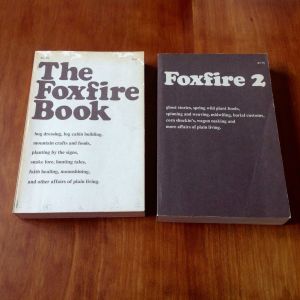
Foxfire books  from eBay“The teacher’s approach put to action John Dewey’s progressive premise that classroom learning should be a form of democratic life in which students actively demonstrate their knowledge and skills by immediately using them to improve society.”  [in Carl Glickman, KAPPAN, Feb. 2016: p. 55]

Foxfire remains alive where it was created.  For others, “it is realistic and imperative to expect that students today can apply what they are learning in English, math, science, history, and the arts to making their communities healthier, more caring, economically viable, and aesthetically better places to live.  That would be the ultimate success for Foxfire and for our country.”  [Glickman, p. 59]

Mary Crovatt Hambidge, from native of coastal Georgia to New York model and actress, to student and creative artist and weaver, to builder and visionary to missionary for the arts, remains in spirit as a driving force at Hambidge today.

. . .

The Hambidge Center has gathered many of her writings and papers and put them together in a book Apprentice in Creation: The Way Is Beauty.

“Work is one form of worship.” 

“I’d rather be one little cog in the wheel of truth than the entire wheel in a machine of lies.”

“What the world needs today is love, not religion.  …psychological love.  Religion comes from love, not love from religion.  The world was created by love, not religion.  Religion is man made.”

“Never have the forces of the world met together with such power.  Shall it be for destruction or creation?  I believe in the divinity of man and the immortality of his soul, therefore I believe that creation will triumph.”

“All life is working towards a state of exaltation.  One does not stay in this state, but by means of it, one is led into that world of beauty where one remains.  Moments of ecstasy come when the divine inner beauty of things, of life, is overpowering.”

“One knows that everything that contributes to this life that goes on, this making of perfection, is important.  Everything we suffer, every shortcoming, every weakness we must struggle against is the result of someone who has gone before who has not conquered it.  If we abandon the fight, it is not only we who suffer but those who come after.”

“I know now that to lose one’s faith in humanity is to lose one’s faith in God.  Humanity is God.  Life only is God, and humanity is the highest expression of Life.”

© The Jay Hambidge Art Foundation Question_mark_(black_on_white)