Archive

AUTHORS

from Art and Reality by Joyce Cary (1958; 1961)

What happens in reading?

The reader is receptive only in a special sense. What a reader has in front of him is simply a collection of marks on paper, inert and meaningless in themselves. They are incapable on their own account of giving him anything. Reading is a creative art…. The meaning received is created by the imagination from the symbols, and that imagination must first be educated . . . in the use and meaning of a symbolic system….

Without education, it is not possible for a man even to appreciate any art. For education does not give only knowledge but taste; it qualifies the feelings as well as the judgment. It creates the sensibility, which is a compound of feeling and judgment.

We judge the value of the work finally by its revelation of a moral real. The power and quality of the artist’s craft is in the force and authority of his revelation. His subconscious is creating or reconstructing from the symbols before him the whole emotional content of the work; his reflective judgment is all the time recording flaws of expression, failures of emphasis, loose joints and weak transitions . . . some part . . . ready to notice an error of fact, even when the error does not destroy the continuity of the emotional experience.

The mind, in short, by education, has acquired a complex formal character which has all the spontaneity of primitive emotional make-up. The feelings are charged with ideas and the ideas with feeling, and reflection can proceed without conscious thought.

Question_mark_(black_on_white)

from Art and Reality by Joyce Cary (1958; 1961)

ART is the MEANS

by which we can express ourselves in forms of meaning and communicate these meanings to others.  It is the only means by which we can convey both FACTS and FEELINGS about the fact.

Truth in art can be checked with an objective reality, by correspondence with the real. All the scenes, all the events, and all the characters must contribute to the total effect, the total meaning of the work. The reader must not be confused by side issues.

Men live so entirely by feeling that reason has extremely small power over even our most intelligent geniuses.

The most important part of man’s existence, that part where he most truly lives and is aware of living, lies entirely within the domain of personal feeling.

Reason has very little power in conflict with any strong emotion, any powerful symbol [like a flag, the mere name of a country . . . or words like “freedom”].


Question_mark_(black_on_white)


BY: JAMES F. O’NEIL

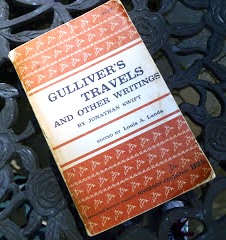
gulliver's travels and other writings by harper honey com Pic of Old Text by HarperHoney.com

James F. O’Neil

2111 Ash Street

Des Plaines

11/29/62

So this is written on the first page of my “textbook” for my 18th Century Literature course in my undergraduate English major program (1962-1964, BA ’64).

I have too many books. Reaching this conclusion (again, as I have noted before), I have been giving away my books to the library. But many, like this volume, have too much writing in them, too many annotated passages in them for the library to accept them. Too much marginalia, too many underlinings and highlightings (mostly in pencil and red ballpoint ink, the latter soaking through the pages; pencil works best).

Thus I have been sorting (again, again) and culling: those books no longer usable (silverfished or book-wormed) or useful have found their lives with me cut short: into the recycle bins. That’s that.

recycle bin arborday foundationCredit: Arbor Day Foundation

The Swift book had a long life with me. By the first page alone, its life and use has time-dates: 11/29/62; 1-15-66 (graduate school, MA ’66); 3-21-68; 9-3-68; 11-18-70; 11-10-71 (dates I taught from the text for undergraduate courses in Minnesota); then a hiatus while I did school administration. The book was again opened 12-11-80 when I was teaching 12th grade English classes in Florida: many memories there, for sure, as my students reacted to the modest proposal, for cooking fattened Irish babies! Next, 11-94, 11-95, 12-2-97, the years I taught British Literature I at a Florida community college. The end.

That was the last time I had need for the text, for I moved on to teach other subjects until retirement in 2003.

The book has sat, has been boxed-unboxed-re-shelved, gathering dust on its pages, as do other unused books that reside in bookcases.  “Some books are to be tasted; others swallowed; and some to be chewed and digested.” [Francis Bacon]

Even though downsizing, I had to keep one page, to remind me of what I learned, of what I remember. I look upon this page (now glued intomy current journal) and see written in pencil, in addition to all the dates of my book’s life, the essence of what I needed to take with me from Gulliver’s Travels:

1. Explain the main point of each voyage, the theme of each book.
2. Explain through the work how “man fails to use his reason.”
3. Discuss the Utopian society in each book. Explain “dystopia.”

Under this handwriting (in cursive, of course with me), I find some other notes of mine: science fiction; Vonnegut. H. G. Wells. Bradbury. Bellamy. Verne. Butler.
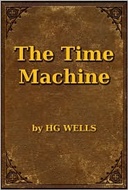
the-time-machineNice Cover for The Time Machine

How important Jonathan Swift was. How important the other authors were. Are?

The text is gone. Its residue remains with me: flying machines, time travel (like one of my favorites, The Time Traveler’s Wife?), horses and apes (like Planet of the Apes?), ice-nine, giant octopuses; Erewhon (the novel/place AND the cereal), Dandelion Wine, and Fahrenheit 451 (and now, Fahrenheit 9/11?).

Enough. Enough memories and connections for now. Enough “teaching” and reminders of what was learned or retained from school.

I understand.

So the text was carefully placed into the recycle bin, a text that brought back (brings back?) so many memories of a time. . . .

And so it goes.

But, I have Gulliver’s Travels in my Kindle…

© James F. O’Neil   2015

 

By: James F.O’Neil

I have become an Epstein-ite.  Joseph Epstein was former editor of The American Scholar and teacher of writing at Northwestern University.  Born and educated in Chicago, as I was, he came into my life through some of his familiar essays. 

Joseph Epstein

Joseph Epstein

These writings have helped shape me and my reading “habits” (definitely an “addiction” word).  Bored with some of the “masters,” I have learned to decide for myself what I want to do with the printed word.  I will not stop reading, that is for sure–“better read than dead.”

Espousing what Epstein means in writing that books “have become much more like family,” I have in my bookcases pictures of family on the shelves; intermixed with books, I have special photo albums and journals of travels and picture books–even special “family mementos.”  A mix, of poetry, philosophy, psychology, history; film books, Books of the Western Canon, a Bible here and there, pop “culture,” and art books; some law, an education treatise or two, architecture and humanities; and even a few books each about chocolate, Absolut vodka, and fairy tales.  This is my family–and, in my life, “family is everything.”

In his essay “Bookless in Gaza” (a takeoff on Eyeless in Gaza, a bestselling novel by Aldous Huxley, published in 1936), Joseph Epstein writes of his early reading experiences, which were not “friendly.”  John Milton wrote about the Biblical Samson, captured and later blinded by the Philistines–“eyeless”–then forced into labor in Gaza.          

Epstein relates how his “forced labor” reading [emphasis mine], like doing book reports–actually faking them–gradually became a labor of love, actually an “addiction.”  (No doubt, Epstein was able to outgrow and break away from the “ignorant and uncultured” philistine teachers of his childhood.)    

He confesses that he holds “a philistine assumption”: that everyone dies someday (not an intellectual matter at all).  With this belief, he writes (as he has written elsewhere) that he wants to be “as well read as possible”–“better read than dead.”           

“And now a philistine confession to go with a philistine assumption: I read in the hope of discovering the truth, or at least some truths.  I look for truth in what some might deem strange places: novels and poems, histories and memoirs, biographies and autobiographies, letters and diaries.”          

“. . .  I seek clues that might explain life’s oddities, that might light up the dark corners of existence a little, that might correct foolish ideas that I have come to hold too dearly, that might, finally, make my own stay here on earth more interesting, if not necessarily more pleasant.”

I, too, desire great things in life–especially to live long and prosper.  Reading, in my estimate, as an Epsteinite, will continue to reinforce this desire.

© James F. O’Neil  2013