BY: JAMES F. O’NEIL
“I’ll Be Home for Christmas” is a Christmas song recorded in 1943 by Bing Crosby, who scored a top ten hit with the song. Originally written to honor soldiers overseas who longed to be home at Christmastime, “I’ll Be Home for Christmas” has since gone on to become a Christmas standard. It has a beautiful message of being at home with family during the most wonderful time of the year. The song has been recorded by Perry Como (1946), Frank Sinatra (1957), Josh Groban (2001), Kelly Clarkson (2011), Pentatonix (2016), and by many other artists.
* * *
“Home Is Where the Heart Is.”
“A House Is Not a Home.”
“Home, Home on the Range”
“A Man’s Home Is His Castle.”
“Home Is Where Your Story Begins.”
“There’s No Place Like Home.”
You Can’t Go Home Again
“Where is your home?” More than once, I have had to list “former addresses.” Most of the time for a job application: “for the past ten years.” Or once when I applied to the Governor a few years ago for a position on a local board: “all previous addresses.” “Where do you live?” Most of us have had to do this applying for credit, for some license, or for a gun purchase. Certainly, those of us who have gone past second grade are so familiar with “Name-Address-Phone Number.” And we learn quickly, so we’re not lost, or for identification purposes: “Do you know your address?” Sometimes a post office box–P.O. Box 357–or rural route, R.R. #6, is the only way correspondence can be addressed to a person. Even some addresses are the name of the place where a person lives:
 Biltmore Mansion at Christmas Asheville, North Carolina
Recently, my wife and I had an interesting breakfast conversation that began with our considering “downsizing” again, disposing of more of our “stuff.” We laughed that our present home was 860 sq. ft. downsized from our 1800 sq. ft. home we left six years ago. Our talking led to a short list of some homes we’ve had in our married life: size and characteristics. For the next few days, we thought up some questions about our residences. By later in the week, we had compiled a list of something about each. We realized each possessed a unique quality. A house has its physical dimensions, furniture, character and style, and “story” to be told, if but one. We had more than enough for talking about.
So where to begin? How to begin? We found ourselves conversing about kids, and jobs and illnesses, and once or twice humming “Our house is a very, very fine house with two cats in the yard…” (Even though we once had four cats that never went out. So many memories of times.) One question we settled on first, though, was “How did we get there?” Nothing to do with a U-Haul or moving van. Was it climate-related? Job-related? Did it have to do with our health? The size of the family? (Our one-bedroom wedding apartment, then into a new apartment a year later, “with a room for the new baby” in our garden apartment in Palatine, Illinois.)
Or was it a move to some place just because we “liked” something bigger, better, newer? (Our move from a 7th-floor condominium apartment, with its garbage chute and elevators and condo restrictions, but which overlooked the beautiful Caloosahatchee River in Fort Myers, Florida, to a house with a yard and trees and lawn to cut.

The Moorings Point North Fort Myers, Florida
We tired of high-rise condo living after three years.) We concluded our exercise with an “Oh,-the-places-you’ll-go” moment

with an inventory of questions, including a “best overall,” a “worst,” a “best financial decision” to “lousy deal.” We had answers, and a major event for each separate place, to include “Why did we leave?” Then came more inquiring, for example, what changes made a place more comfortable or perfectly matched to our lifestyle (the one house we had built)?
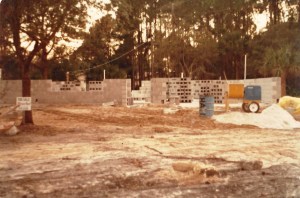
McMahon Avenue Home Construction Port Charlotte, Florida
In our fifty-plus years together, we have undertaken two MAJOR migratory events, moving from Chicago to Minnesota (in 1966, for 14 years), and moving from The Land of 10,000 Lakes to the Sunshine State of Florida (in 1980). In any event, all our house-home-stories begin with our apartment hunting in summer 1963, before our October wedding. And so it goes from there.
A favorite and important story-within-a-story we relate often is about my driving with a teacher-colleague to his job interview in Minnesota. He needed a reliable vehicle: our 1964 VW was chosen for the February weekend trip, the back of the car loaded with bags of sand and salt and shovels. We were prepared for weather events or highway problems. (There were neither.)
While Lennie was being interviewed on that cold Saturday morning, I was passing time in the Dean’s waiting room, paging through magazines. A young man entered, then inquired what I was doing. He heard, then told me to spend some time with him. He was a departmental chairperson. I ended up in conversation, just chatting; he presented a program description–and offered me a job.
My friend and I did pros-and-cons for the 300-mile trip home. I took the job; we moved in July 1966. He declined his offer; he could not afford the move with his family. And that was the beginning of that story.
Some persons never move, never leave. Ever. (Some of my former students still live in their original bedrooms in their first and only house.) Others have made annual moves, for whatever reasons. (“Join the Navy. See the world!” came out of World War II–and stayed as a popular slogan, and reality.)
 However, Americans, says the Census Bureau, are staying in the same house longer between moves: from 5 years, on average, in the 1950s and 1960s, to about 8.6 years in 2013. The U.S. Census Bureau reports that the average American moves 12 times during his or her lifetime. Since our wedding-apartment in 1963, we have had eighteen (18) addresses and moves. Surely, we deliberated many times over with questions like those asked during our recent activity. For each dwelling, we know why we chose it instead of another.
History of the home (structure moved into town from a farm, original Homestead building site). How we lived in it.

SANBORN FARM HOME SANBORN, MINNESOTA
How we loved it. How we made a family. How the family grew, then decreased (graduations and marriages). How we responded to forces around the home (weather, landscape). How the house-home became part of us.
This analytical time for houses, homes, and addresses has been fulfilling–even despite some hurtful memoriesofatime past or pain that might have arisen. Overall, though, looking back at our downsizing exercise, we find we are now in a good place and time to look back at ourselves and our lives together–and how “nomadic” we thought we were. However, “if we had it to do all over again . . .”
* * *
“We can’t separate who we are from where we are. People are rooted in time and place, so our psychic space is generously seasoned with memories of physical territories. … The geography of our past is part of memory. … Every human emotion is seeded in the sights, smells, sounds, and tastes of specific environments.” — Sam Keen, Your Mythic Journey: Finding Meaning in Your Life through Writing and Storytelling (1973, 1989).
* * *
“Country roads, take me home…” (John Denver); and then “I’ll be home for Christmas.”
© James F. O’Neil 2016
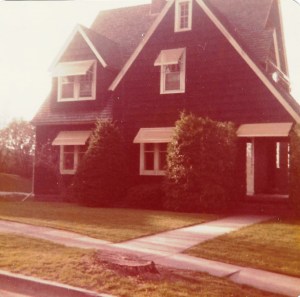
THE MELBY HOUSE OUR FAVORITE-IST OF THEM ALL MABEL, MINNESOTA





 And? “Coconut for me, please.” The delicious-tasting ice cream bar on a stick, covered completely with a thin coat of white-something loaded with coconuts pieces. Heaven as I ate it. Heavenly. If my favorite was not available, I had to settle for something like chocolate cake or perhaps succumb to savoring an orange creamsickle:
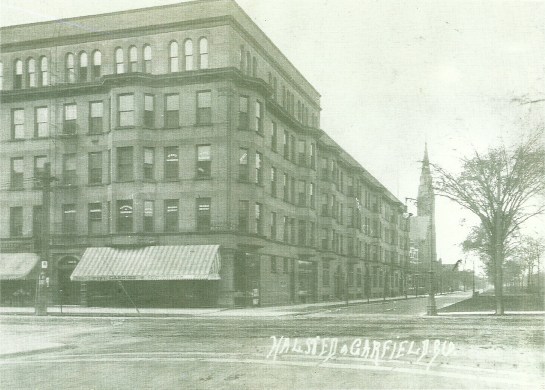 BYRNE BUILDING WITH PAPPAS CORNER
 COCONUT MILK
 Memories of a Time