Archive

THINKING AND THOUGHT

“What we call the beginning is often the end / And to make an end is to make a beginning.  / The end is where we start from.”  –T. S. Eliot

“The past is never dead.  In fact it’s not even past.”  –William Faulkner

“…these statements express the realization that we can never access the body of the past, the physical experience that people now dead once felt in the very fiber of their bodies.  But we can also nevernot want to access that past, to think, imagine, and write our way back to an imagination of what those bodies must have felt [Walt Whitman’s referring to the Civil War dead].  Often our own past feels this way, too–we recall feeling pain or horror or terror, but it is difficult to ‘get it in the books,’  to write it so that others can experience in their bodies what we felt in ours (or so that we can once again feel what we know we once felt).  Writers often experience most keenly this notion that ‘the past is never dead’ and that we are always starting at the end.’”  [IWP © The University of Iowa 2012-2016]

MEMORIESOFATIME  are often written about past events which caused the writer to feel intensely and deeply and physically, then described in such a way emphasizing what the body felt–words being used to bring a dead past alive.

“Memories are the key not to the past, but to the future.”  –Corrie Ten Boom

“Fear not for the future, weep not for the past.”  –Percy Bysshe Shelley

“There is not past, no future; everything flows in an eternal present.”  ….  “Hold to the now, the here, through which all future plunges to the past.” –James Joyce

“We can’t let the past be forgotten.”  –George Takei

“The destruction of the past is perhaps the greatest of all crimes.”  –Simone Weil

© James F. O’Neil 2016 

“Technical communication is the transfer of information about a technical situation, product, service, or concept, by written, oral, or visual means, to audiences of varying levels of technical knowledge, so that each member of the audience clearly understands the message.”  –Ron Blicq, Administratively Write!  [1985]

. . .

Communicating in business and industry is not all about telephones, emails, secretarial assistants and transcription, and signing contracts. 

From some old class notes, perhaps still with some relevancy:

  • 28% of time on the job is spent in written communication
  • The writing process involves exploring a topic (20%); planning (10%); actual writing (30%); re-writing (35%); proofreading and editing (5%)
  • Business writers do not always have choices of topics–and write under pressure in 43% of the situations.

. . .

Presenting Technical Information

[Some]  Notes from Professor Reginald Kapp, Institute of Scientific and Technical Communicators (ISTC)

“Clear and precise technical communication is getting directly to the point, being specific and not generalizing, using qualifications and metaphors in writing, using a technical vocabulary.

“Thinking about the person addressed is ‘the first lesson in the art of conveying information effectively from mind to mind.’

“Functional English is the English that any writer uses who expresses meaning clearly and without ambiguity; who spares readers unnecessary effort; who selects every item and places every sentence and every word so that it will meet the function assigned to it.  Functional English presents facts and ideas simply and logically.

“Functional English is chiefly the language of science…nearly always concerned with the outer world; it rarely conveys information obtained by introspection.

“Plain statement alone serves the purpose of Functional English.  Words must not be made to carry either more or less meaning than they do in common usage.

“Language was not evolved by the human race in order to discuss what goes on in our minds.  It was designed as an instrument of the co-operative practical work of every day.

Yet, new information must bring with it associations with things the reader, listener, or viewer already knows, in the ‘storehouse of memories’: ‘things heard, seen, felt; tastes and smells; spoken and written words; trivial and momentous ones; things experienced in reality and things experienced in thought only.’  Thus, illustrative examples should be those familiar to the receiver, not those familiar only to the sender.

“Understanding requires the correlation of the new information with what is already known.  During correlation, work is done on the items that have been assembled for display in consciousness.

“The pleasure one gets from imaginative art is the pleasure of exercising one’s imagination, one’s insight, one’s understanding of human nature.  Imaginative writing calls for insight.  Scientists must not leave anything to the imagination.  They must set it all down in black and white, as Newton did.  Scientists must explain, where the poet implies.”  [1948]

Question_mark_(black_on_white) 


“Socrates was the first person to distinguish between the ability to criticize literature and the ability to compose it.”  –Abercrombie

Is old criticism still “good” criticism?

“The realm of criticism is occupied by the activities of three distinct powers: the power to CREATE; the power to ENJOY; the power to CRITICIZE.

“The powers to criticize can be acquired, with process and system to be studied, and deliberately put into practice.

“There are no principles which will tell you how to create literature, nor how to enjoy it.”

“Criticism consists in asking and answering rational questions about literature.”

Basically two kinds of criticism, or critical inquiry, can be determined: studying the function of literature, the nature of literature, the theory of literature (aesthetics).  The second, criticism proper, may be called practical criticism (studying unique qualities in actual concrete examples of literature).

***

“The history of criticism has been very largely the history of attempts to formulate rules for criticism.  But rules derived from some particular instances in one kind of literature…have been found wanting.

“Only the principles which express the nature, and define the function, of literature in general can determine what is essential in any kind of literature; and only by appealing to what is essential can criticism provide itself with trustworthy rules.”

***

So where does one begin?  At the beginning: “The first and most celebrated of all systematic theories of literature?  Aristotle’s Poetics.”  [That’s old.]

“Aristotle raises almost all the problems out of which emerge the principles required by criticism for its security.”  (But he doesn’t always solve the problems satisfactorily, yet he compels us to consider them exactly.  How could he ever imagine a Catcher in the Rye or À la recherche du temps perdu–or even Joyce’s Ulysses?)

Question_mark_(black_on_white)


“We are what we believe.”  –Mary Hambidge [1885-1973]

A lifelong pursuit of creativity, along with a love of dynamic symmetry and natural beauty, led Mary Hambidge to develop an artist’s community in the foothills of the Blue Ridge Mountains.

Rabun Gap, Georgia: Located in northeastern Georgia where the Blue Ridge and Nantahala Mountain ranges meet.  Hambidge is 100 miles from Atlanta, and 80 miles from Asheville, North Carolina.

Hambidge is the oldest artists’ residency program in the Southeast, and one of the oldest in the nation, founded in 1934, to provide artists and other creative thinkers with the setting, solitude, and time necessary to create,

HAMBIDGE CENTER

Meeting House from search Courtesy of Hambidge House

Mary Crovatt became involved with Jay Hambidge (1867–1924), an artist and writer who achieved fame with his books on design and “dynamic symmetry.”  Though they never married, she took his last name.  After his death, she had envisioned a place in the Georgia mountains where crafts and agriculture could be practiced according to the principles developed by Jay.  She expanded dynamic symmetry and imagined a self-sufficient lifestyle emerging from the practice of balance and proportion.  In his memory, she created the Hambidge Center, believing that creativity can best be nurtured through working closely with nature.

In the early days of Hambidge, she employed local women to create exceptional weavings, but with the industrialization of the 1950s and the availability of steady mill jobs, the weavers slowly disbanded.  Hambidge broadened the scope of the center and invited creative artists and friends to come for extended stays there.  

One landscape architect often brought his son along with him; Eliot Wigginton returned to the Hambidge Center while a teacher in the area in 1966. Discussions with other Hambidge guests inspired him to develop the Foxfire program, in which students explored their local and regional heritage for the magazine that they created under his guidance.   
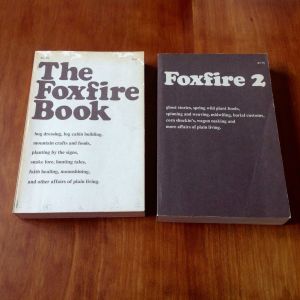
Foxfire books  from eBay“The teacher’s approach put to action John Dewey’s progressive premise that classroom learning should be a form of democratic life in which students actively demonstrate their knowledge and skills by immediately using them to improve society.”  [in Carl Glickman, KAPPAN, Feb. 2016: p. 55]

Foxfire remains alive where it was created.  For others, “it is realistic and imperative to expect that students today can apply what they are learning in English, math, science, history, and the arts to making their communities healthier, more caring, economically viable, and aesthetically better places to live.  That would be the ultimate success for Foxfire and for our country.”  [Glickman, p. 59]

Mary Crovatt Hambidge, from native of coastal Georgia to New York model and actress, to student and creative artist and weaver, to builder and visionary to missionary for the arts, remains in spirit as a driving force at Hambidge today.

. . .

The Hambidge Center has gathered many of her writings and papers and put them together in a book Apprentice in Creation: The Way Is Beauty.

“Work is one form of worship.” 

“I’d rather be one little cog in the wheel of truth than the entire wheel in a machine of lies.”

“What the world needs today is love, not religion.  …psychological love.  Religion comes from love, not love from religion.  The world was created by love, not religion.  Religion is man made.”

“Never have the forces of the world met together with such power.  Shall it be for destruction or creation?  I believe in the divinity of man and the immortality of his soul, therefore I believe that creation will triumph.”

“All life is working towards a state of exaltation.  One does not stay in this state, but by means of it, one is led into that world of beauty where one remains.  Moments of ecstasy come when the divine inner beauty of things, of life, is overpowering.”

“One knows that everything that contributes to this life that goes on, this making of perfection, is important.  Everything we suffer, every shortcoming, every weakness we must struggle against is the result of someone who has gone before who has not conquered it.  If we abandon the fight, it is not only we who suffer but those who come after.”

“I know now that to lose one’s faith in humanity is to lose one’s faith in God.  Humanity is God.  Life only is God, and humanity is the highest expression of Life.”

© The Jay Hambidge Art Foundation Question_mark_(black_on_white)