Archive

WRITING/BLOGGING

BY: JAMES F. O’NEIL

“A fingerprint in its narrow sense is an impression left by the friction ridges of a human finger.  Fingerprints are easily deposited on suitable surfaces (such as glass or metal or polished stone) by the natural secretions of sweat from the eccrine glands that are present in epidermal ridges.  In a wider use of the term, fingerprints are the traces of an impression from the friction ridges of any part of a human hand. 

“Deliberate impressions of fingerprints may be formed by ink or other substances transferred from the peaks of friction ridges on the skin to a relatively smooth surface such as a fingerprint card.  Fingerprint records normally contain impressions from the pad on the last joint of fingers and thumbs, although fingerprint cards also typically record portions of lower joint areas of the fingers.

“Human fingerprints are detailed, nearly unique, difficult to alter, and durable over the life of an individual, making them suitable as long-term markers of human identity.  They may be employed by police or other authorities to identify individuals who wish to conceal their identity, or to identify people who are incapacitated or deceased, as in the aftermath of a natural disaster.”  [See Wikipedia for more material’]

Where is Thumbkin?  Where is Thumbkin?
(Hide hands behind back)
Here I am! Here I am!
(Show L thumb, then R thumb)
How are you today, sir?
(Wiggle L thumb)
Very well, I thank you.
(Wiggle R thumb)
Run away, run away.
(Hide LH behind back, then RH)

[This is a song often sung in Head Start classes I taught, bringing memoriesofatime.]

jim's thumbThis is my Thumbkin [my thumb].

 fingerprint identification chartThis is a fingerprint identification chart.

History of MY LEFT THUMBKIN: SMASHED in a church door when I was a youngster in Chicago (with little memories of that pain).  SMASHED in a friend’s car door while I was in college:  “Good night.  Thanks for the ride home.”  SLAM!  Car begins to pull away.  “WAIT!” as I scream in pain, pounding on the passenger’s side window, Thumbkin still in the door.  In the Emergency Room, I looked at the thumb twice the size as normal, bruised and blue and internally bleeding.  But flattened.  And the throbbing.  Throbbing.  Throbbing.  “Scalpel.”  Holes drilled into the nail.  Pain and blood. 

Later: August 1964: Rochester, Minnesota, Airport parking lot.  Slipped, fell, and slid along asphalt, Thumbkin extended.  ER: cleansing of bits and pieces of Minnesota, stitches, and awful drilling into the bruised and battered nail, throbbing.  And throbbing.  And throbbing.  Young ER resident took an alcohol lamp, bent a paperclip, grabbed it with a forceps.  Taking the red-hot paperclip, he pssit pssit pssit pssit pssit five holes into the nail, blood squirting and oozing.  NO PAIN!  “Just a trick I learned in med school.”

My fingerprints are on file.  Or not…

I was first fingerprinted in the spring of 1963, for a government position: The U. S. Post Office [USPS].  Once more, in 1980, then in 2003–all for positions with public agencies.  After retirement, I applied as a free-lancer, and once more needed to have my prints updated.  “Mr. O’Neil, could you come with me, please.”  I followed down the long hall in the administrative offices, in 2010, and was led into a small room.  On a small table was a device I had never before seen.  “You’ll have to insert your left thumb into that hole with the red light.”  “Is there a problem?”  “You don’t seem to have fingerprints.  We need to do a deeper, thorough examination of your ridges, that’s all.”  After some time, I was given the proper directions and allowed to leave.  “But whatever happened to my prints?”  I had asked before leaving.  “Acid…” 

My professional career began in 1963.  I had a few hobbies–coin collecting, for one– but none like doing stained glass work, from 1990-2014, until my back “gave out”–and I could no longer lift and bend like before.  I had to stop.  An essential part of working with glass and solder is the use of acid flux.
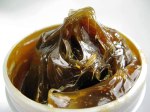
flux

Paste Flux

A flux (derived from Latin fluxus meaning “flow”) is a chemical cleaning agent, flowing agent, or purifying agent, for metal joining.  Flux allows solder to flow easily on the working piece rather than forming beads as it would otherwise.  Flux is usually, normally, applied with a brush, to the joints to be soldered. 
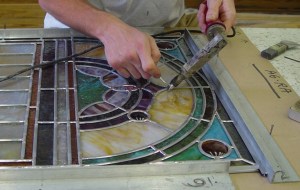
soldering and leading

Stained Glass Piece Soldered Restoration

But in the turning and moving of a glass piece being worked on, if the artist does not wear gloves, flux begins to work on the skin and, of course, the finger tips.  Flux is an acid, and a poison.POISON SYMBOL.pngMy fingertips would peel; I thought nothing of it.  No pain.  Just washed well.  I did my best to take care, and did wear gloves as often as possible, but…

And that’s the real story of my thumb and fingerprints… 

In the minds of some, however, there exists another story, one of fascination, intrigue, and cover and covert operations:  passportThat my forty-year teaching career concealed my true identity and sheltered my true profession:  CIA Operative.  How this story may have been initiated and by whom puzzles me.

I see no resemblance to any “secret agent.”

JIM 1966 SMC haircut 2

JIM

jason bourne as Matt Damon

JASON

These pictures were taken many years ago, and I never remember telling stories to my boys who might have had over-active imaginations, with their Batman and Robin, and other hero-Super-hero themes in their lives.  Why would I have told the kids about the CIA?  Did someone else tell them?  Well, that story–and the fingerprint issue–just needs to be put to rest once and for all.  And that is that.

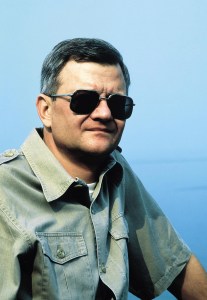
BTW: Here’s a picture of one of my favorite authors who, along with Robert Ludlum, did write good political intrigue fiction.
P612300 RED

TOM CLANCY

Here’s a recent picture of me that fell out of a folder…jim tom clancy.jpg 

© James F. O’Neil  2017 


My Personal Notations from “A Mere Journalist” by Aristides [Joseph Epstein] in The American Scholar (Winter 1985/86).

“Off and on for more than twenty years, I have been keeping a journal.  One expects a famous writer to keep a journal,” wrote Aristides, the pen name for Joseph P Epstein, editor of The American Scholar, 1975-1997. 

“The first function of a young writer’s journal: a place to grouse, a place to dramatize one’s condition in prose, and a place to bemoan the fact that, once again, this time in the instance of oneself, the world in its ignorance is failing to recognize another genius.”

“In my [current] journal…I have done my best to cease complaining and have taken as my motto the lines from the beer commercial that runs ‘I guess it doesn’t get much better than this.’”

“…to feature introspection and self-analysis…even in a journal has its limits.”

“Who needs this?…I suppose I alone do.  Something in me impels me to record much I have thought, or experienced, or read, or heard.”

“I find keeping a journal quickens life; it provides the double pleasure of first living life and then savoring it through the formation of sentences about it.”

Graphomania: a writer’s disease “taking the form of simply being unable to put down the pen (the authorly equivalent to logorrhea).  ‘Advanced’ stage takes the form of needing to write down everything because anything that hasn’t been written down isn’t quite real.”

“The graphomaniac’s slogan is ‘no ink, no life.’”

“I must confess that I do not write in my journal every day.  But when I do write something in my journal, I feel rather more complete…  Not that journal writing elevates me–it doesn’t, usually…”

“I do feel upon having made an entry in my journal as if I have done my duty, completed, in effect, an act of intellectual hygiene.”

“I do not often look into my journals; yet whenever I do, I am impressed by how much experience has slipped through the net of my memory.”

“I suspect that anyone who keeps a journal has to be something of a Copernican–he [or she] really must believe that the world revolves around himself [or herself].”

“Everything I have written is these journals is true–or at least as true as I could make it at the time I wrote it.  Lying, as such, is not, I believe, a question in my journal.”

“I try, when writing in my journal, to keep in mind the twin truths that I am someone of the greatest importance to myself and that I am also ultimately insignificant.  (This is not always so easily accomplished.)”

“Sometimes I am astonished at the items that find their way into this journal of mine.”

“I [once] wrote that John Wayne had become part of the furniture of [my] one’s life.  The first half of one’s life, it strikes me, one fills up one’s rooms with such furniture; the second half, one watches this furniture, piece by piece, being removed.”

“My journal has served as a running inventory of my days, and I am pleased to have kept it.”

“Though we must live life forward, ‘Life can only be understood backward,’ wrote Kierkegaard.  Yet a journal does provide backward understanding…a great aid in replaying segments of past experience, in running over important and even trivial events, in recollecting moods and moments otherwise lost to memory.”

“A journal is a simple device for blowing off steam, privately settling scores, clarifying thoughts, giving way to vanities, rectifying hypocrisies, and generally leaving an impression and record of your days.”

“When you are through with it, [and] when the time has come to leave this…earth, you can even pass the damn thing along to your yet unborn great-grandchildren.”

interrobang


“If you don’t understand, ask before it’s too late.”  –Anon.

Once upon a time, as the story goes, there were three bears, a Lorax, and seven dwarfs.  They all planned to sit down on the forest lawn one late spring morning for a leisurely brunch, complete with honey, biscuits, green eggs and ham (this was a typical New Orleans Brennan’s-style meal), and some good apple pies baked by the old hag who also built gingerbread houses.  Well, because of the whims of Thor and the other gods, the brunch party was called on account of rain.  But they all lived happily ever after, for they knew behind every rain cloud there was a silver lining.

THE END.

SO IT GOES.

HEIGH, HO!

Narration is to entertain, by storytelling, with a beginning, a middle, and an end.  Mostly.  There is FACTUAL narration and FICTIONAL narration.  (Some get them mixed up.)

FACTUAL presents a sequence of events (and people involved) as they are, CONCERNED WITH TIME AND ACTION.  The events have significance or meaning to the teller of the tale, even though he or she may not have been directly involved in the event (what I might know from a historical happening). 

(Sometimes, though, narration or storytelling is used to make a point, or even to make an argument, as in a parable, a fable, or in a sermon [or at a political rally]).  In telling, tellers capture and use DETAILS and organize and present with FEELINGS and EMOTIONS, yet ordering with reason-ableness.  (A reader or listener wants to hear or read details that emotionally involve–“Yeah!  That happened to me!”; details that are understandable; details that present a sense of time and past-ness to make it all ring true–memoriesofatime)

TELL A GOOD STORY.  BE HONEST AND TRUE.  PUT IT ALL IN GOOD ORDER: incidents, anecdotes, memories, nostalgics, milestones, autobiography, biography, family history. 

Jean Piaget told some teachers once upon a time that most people usually do not reflect upon their lives–and maybe cannot–until they are 18 or 19.  (He said some writers need to be taught how to reflect.)

Finally, once upon a time, the author Flannery O’Connor remarked that anybody who has survived childhood (the 18 or 19 mentioned by Piaget?) has enough information about life to last (to write about?) the rest of his or her days.

THE END.

interrobang

BY: JAMES F. O’NEIL

“We’ve been playing games since humanity had civilization.  There is something primal about our desire and our ability to play games.  It’s so deep-seated that it can bypass latter-day cultural norms and biases.”  — Jane McGonigal

“You have to learn the rules of the game.  And then you have to play better than anyone else.”    — Albert Einstein

***

I hate games!

I don’t care whether they are intellectually or physically challenging: I simply hate them.

I have been a Player in this Game of Life.  It’s a game, with winners and losers.  And that “crap” about “it’s not about winning but how you play the game”?  It’s crap!  Otherwise, why keep score?  Statistics?  Population numbers?  Win-Loss columns?  Is that what Life is all about?  Scoring?

So life is The Big Game, this life of ours.  From beginning to end.  Parameters.

When did it all begin?  (Big Bang Game Theory?)  LET THE GAME BEGIN!

Who set the rules?  “RULE NUMBER ONE: Don’t eat the fruit from that tree over there!”  And all amid them stood the Tree of life, / High eminent, blooming Ambrosial Fruit / of Vegetable Gold; and next to Life / Our Death the Tree of Knowledge grew fast by, / Knowledge of Good bought dear by knowing ill.  [Paradise Lost, IV:218-22.]  Was there a rule book for the participants?  Too late!  “Unfair!”

Ten Commandments?  The Constitution?  Case Law?  “Color inside the lines.”

Does everyone get a chance to play?  (“Many are called, but few are chosen”?)  The strong/strongest survive–those picked for the team.  But “some play by different rules” (“march to a different drummer?).  The mystery of it all boggles my mind.

4.1.2

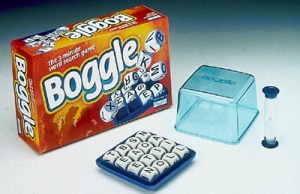
Boggle–I hate that game, especially the three-minute sand timer: “the sands of time run out.”  Maybe the Whole of Life is Boggle?  or maybe Monopoly?  What game are we playing that is NOT physically or intellectually challenging?

From birth, I play Either/Or: Either breathe or not, crawl or not, walk or not.  If I can move, I move on to the next plateau, the next level.  (Flying is out of the question: I have to compete with gravity–and that is really some opponent, that Gravity Character!).

Physically, I learn the rules as I grow: “Don’t touch!  You’ll burn yourself!”  “Careful!  You’ll fall!”  Those rules of physics, natural science, natural selection, X-Y rules, and other theories, like Germ Theory.  I have to compete with bugs; I have to fight, win-lose, survive: illness, wellness, strength, weakness; weather, climate, natural destruction and/or disaster. 

Most of this is out of my control, usually lucky or not.  (Is 98% of my life really out of my hands, not under my control?  Fate?  Chance?  Providence?  Good or Bad Luck?  Predestination?) 

Oh, the Lucky Theory: Where was I born?  On an island?  In Canada?  On a tectonic plate line?  (A “fault” line?  whose fault?)  In a village in the Sudan?  Oh, that Lucky Theory.  So some have been dealt one hand better than another.  Another Game of Life: Poker, Hearts, Go Fish (“Teach a man to fish…”).  The metaphors, the symbols, the myths all reflect–or are–Game Theory in Life:  kings, queens, jacks, spades, clubs, deuces, aces.  And those Tarot Cards?  Have you seen the movie The Red Violin?

the-red-violinI hate games.  Chess?  A beauty this is, with royalty, pawns, knights, and even a bishop or two.  I was even in the high school chess club.  I played on a miniature board with a classmate while we rode the “L” to school.  I made a chess board for my boys.  But I’ve had it with chess.  And Battleship, Solitaire, Minesweeper, Husker Du, or HOOSKER DOO– whatever.  I have outgrown Cops-n-Robbers, lost my Confederate soldier cap, never did the Cowboys-n-Indians thing, but Soldiers?  Now THAT… 

I was a regular in John Wayne’s squad–er, Sgt. Stryker’s squad: “You gotta learn right and you gotta learn fast.  And any man that doesn’t want to cooperate, I’ll make him wish he had never been born.”

john-wayne-sands-of-iwo-jimaJOHN WAYNE aka SGT Stryker

I had the pluck.  I had the skinned knees to show my battle damage as I played war games on the neighborhood sidewalks of Chicago.  Not in the parks: Couldn’t be too far from home.  Not too far from supper.  Not out too late.  Homework.   

Saint Paul wrote to the Corinthians (13.11), in that now-famous verse, that when he became a man, he wasn’t playing with the kids anymore.  I can’t believe that:  “…when I became a man, I put away childish things.”  No, he didn’t stop playing.  (I just bet he was a good soccer player!)  He is saying that at the time he was serious about love.  And life.  But not that we couldn’t have fun.  Nor shouldn’t have fun.

Subsequently, I accept Life.  The Game of Life.  I’ll play.  I’m in.  Deal me in.  I hope I get a good hand.  I’ll keep my fingers crossed.  I shall play my best.  Besides, it’s not about winning and losing but about how I play the game anyhow, right?  (Said that.  Heard that so many times.  That mantra.)  I’ll keep my eyes on the prize, maybe getting into the semi-finals, for I know that “strait is the gate, and narrow is the way, which leadeth unto life, and few there be that find it.” 

Along the way, I might even pick up a medal or two–or a ribbon–or have a moment of fame.  I’ll run the good race, fight the good fight, go for a three-pointer, believe I can win.  “I think I can.  I think I can.  I think I can.  I know I can.”

thinker-by-rodinRodin’s THE THINKER

“HE SCORES!”

I’ll have to wait, however, in the “the kiss-and-cry area” for my results, maybe not a Perfect 10, but for sure a

-30-

©  James F. O’Neil  2017

NUGAS LUDOSQUE ANTE GRAVIA.

[FUN AND GAMES BEFORE SERIOUS THINGS]

I cannot forget the motto of my college class.

Cardinal Glennon College (Saint Louis, Missouri), 1963: