“The great books are those that tradition, and various institutions and authorities, have regarded as constituting or best expressing the foundations of Western culture…derivatively the term also refers to a curriculum or method of education based around a list of such books.

Mortimer Adler lists three criteria for including a book on the list:

the book has contemporary significance; that is, it has relevance to the problems and issues of our times;

the book is inexhaustible; it can be read again and again with benefit;

the book is relevant to a large number of the great ideas and great issues that have occupied the minds of thinking individuals for the last 25 centuries.” [Wikipedia]

TODAY:  In Defense of a Liberal Education (2015) by Fareed Zakaria is a “great book.”

YESTERDAY:  The Idea of A University (1854) by John Henry Newman is a “great book.”

Here are some other “Great Books”:

Classical/Old Fashioned, but not-outdated sources for reading/reading skills:

Art and Reality— Joyce Cary (1957)

The Dynamics of Literary Response--Norman N. Holland (1968)

Great Books–David Denby (1996)

How to Read a Book–Mortimer J. Adler and Charles Van Doren (1940; 1972)

Literature as Exploration–Louise M. Rosenblatt (1937; 1968)

On Moral Fiction–John Gardner (1978)

Perspectives in Contemporary Criticism–Sheldon Norman Grebstein (1968)

Principles of Literary Criticism–Lacelles Abercrombie (1932; 1960)

Understanding Fiction–Cleanth Brooks and Robert Penn Warren (1943; 1959)

Question_mark_(black_on_white)


BY: JAMES F. O’NEIL

“Wow! That really tastes good,” I said to Jimmy Pappas so many years ago, so many long years ago. I had just had my first taste of a Green River malted milk shake. What a treat and delight that was.

Who would have ever thought of marrying one of the greatest flavors made by man–malted milk–to Green River soda? A marriage made–in heaven?

No, a marriage performed often at the Pappas Ice Cream Shop, at the corner of 55th (Garfield Boulevard) and Halstead. In the Byrne Building.

BURNS BUILDING  Pat Telios Reagan

 Byrne Building.  Credit Pat Telios Reagan 

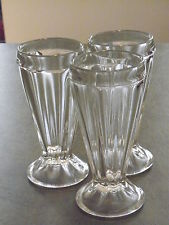
And I was the Best Man, along with my friend Bill Manion. There we sat, in the booth, savoring the minty-looking thick green malted milk shake in the tall ice-cream-parlor glass, with melting drippings running down the sides of the metal mixing container. Ahhh, a Green River malt (-ed milk shake).

green river malt

Yum! So far from “the next best thing to sliced bread!”

It was heaven for us ice cream lovers (I still am) who would choose wisely between “a malt” or a hot fudge sundae. Choose wisely. Tastefully.

milk shake glasses ebay

Milk Shake glasses [eBay]

Marriage: two entities who come together and pledge (“plithe their troth”–whatever that used to mean) to … standing before a minister (administer) of the state.

Jimmy Pappas was our minister. Bill and I sat, ready to partake in the marriage, not of two vines (as some wines and brandies are known as), but of a blend of the finest ingredients: icy cold vanilla ice cream, Horlick’s malted milk powder, and Green River soda fountain syrup flavoring (and color). “Blend and serve chilled in a …”

milk shake mixer tin

(As many know, or remember, “a malted milk shake” has that special powder, that “strengthening medicine” [malt extract] told Kanga to Roo in The House at Pooh Corner, and was also Tigger’s favorite food in the book.)
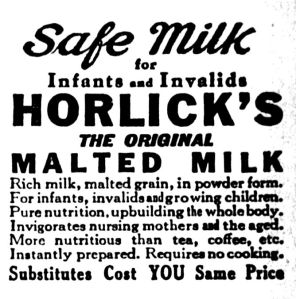
 horlick's ad pinterest

Horlick’s ad from Pinterest

Pharmacist James Horlick developed ideas for an improved, wheat and malt-based nutritional supplement for infants. With his brother William, in 1873 they formed J & W Horlicks, manufacturing an infant food in Chicago. In 1887 the company marketed its new product, trademarked the name “malted milk.” (See Wikipedia for more history.)

Like Ensure today, and similar drinks, malted milk found unexpected markets, customers drinking the new beverage for enjoyment. So malted milk became a standard offering at soda fountains, and found greater popularity when mixed with ice cream in a “malt.” “Malt shops” owe their name to the Horlick brothers. Additionally, I used to buy jars of malted milk tablets, chewing them like candy, making a glob of them in my mouth to suck on and melt away. Yummy!

horlicks white tablets

Now, add the Green River syrup:

At the time of Prohibition, Green River soda was introduced to Midwestern drinkers when some breweries turned to making nonalcoholic drinks, while others were churning out ice cream. The Schoenhofen Edelweiss Brewing Company of Chicago turned to Green River in late 1919 as a non-alcoholic product that became popular as a soda fountain syrup, “trailing only Coca-Cola popularity throughout the Midwest.” However, after Prohibition ended in 1933 the Schoenhofen Brewery made Green River a second priority to alcoholic drinks. (The Brewery closed in 1950.) [Wikipedia]

Green River aficionados know that it’s not just another soda; it’s nostalgia in a bottle, being found at St. Patrick’s Day (being produced by WIT Beverage Company) and in some Chicago-area restaurants.

GREEN RIVER AND BURGER WIKIPEDIA

“With a Green River, please.”

We acquire tastes, our taste buds–and brain–telling us what we like: carbonated water, cane sugar, lime flavor, some lemon flavor, and all the special colors that are used to make it “look good.” Some do not like drinking something green or tasting lime-y.

But Jimmy Pappas put my mind at ease, and my taste buds accepting something green that was not mint-y. At first, the color tricked the brain. Then the taste buds received the message that found its way into my memory.

I grew up, then grew away from our favorite ice cream shop–and found Green River malts harder and harder to find.

In time, I learned that the Byrne Building was torn down in the late 70’s. Now the corner is occupied by a gas station. That was the end of the shop, but I have my memories of a time when Green River flowed freely and made its way into those great ice cream malts.

© James F. O’Neil 2015

Green River bottle WIKIPEDIA


From

 On Moral Fiction (1978)

Notes put together from the book; each passage could be a starting point for discussion.

***

Criticism, like art, is partly a game [but the game has a point].

My basic message . . . drawn from Homer, Plato, Aristotle, Dante, and the rest, and a standard in Western civilization down through the eighteenth century . . . : TRUE ART IS MORAL: it seeks to improve life, not debase it.

Trivial art has no meaning or value except in the shadow of more serious art.

Art is essentially serious and beneficial, a game played against chaos and death, against entropy.

Art re-discovers, generation by generation, what is necessary to humanness.

The critic’s proper business is explanation and evaluation, . . .

To understand a critic, one needs a clear head and a sensitive heart, but not great powers of the imagination.

Criticism and art, like theology and religion, are basically companions but not always friends. At times, they may be enemies.

True art is a conduit between body and soul, between feeling unabstracted and abstraction unfelt.

Dullness is the chief enemy of art.

True art is too complex to reflect the party line.

True art is by its nature moral. We recognize true art by its careful, thoroughly honest search for and analysis of values.

**Morality is nothing more than doing what is unselfish, helpful, kind, and noble-hearted, and doing it with at least a reasonable expectation that . . . we won’t be sorry for what we’ve done. Moral action is action which affirms life.

True morality [is] life-affirming, just, and compassionate behavior.

Great art celebrates life’s potential, offering a vision unmistakably and unsentimentally rooted in love.

In art, morality and love are inextricably bound: we affirm what is good . . . because we care.

Critics would be useful people to have around if they would simply do their work, carefully and thoughtfully assessing works of art, calling attention to those worth noticing, and explaining clearly, sensibly, and justly why others need not take up our time.

A good book is one that, for its time, is wise, sane, and magical, one that clarifies life and tends to improve it.

The chief quality that distinguishes great art . . . is its sanity, the good sense and efficient energy with which it goes after what is really there and feels significant.

The true artist’s purpose, and the purpose of the true critic after him, is to show what is healthy, in other words sane, in human seeing, thinking, and feeling, and to point out what is not.

The theoretical border between art and madness seems to be, then, that the artist can wake up and the psychotic cannot. When Hamlet plays mad, he takes a step toward real madness. Sanity is remembering the purpose of the game.

**The business of civilization is to pay attention, remembering what is central, remembering that we live or die by the artist’s vision, sane or cracked.

Question_mark_(black_on_white) 

A “theme” or “composition” is a writing with a purpose, not necessarily to make a point or state a moral.  It could be a story (narrative).

An “essay” is a kind of “theme” or “composition,” with form and content–and a purpose.

(Blogs are “compositions,” of course.)

A writing course has a goal: to allow those enrolled to have the opportunity to do better writing than before.  It’s that simple.

Or, if not “better,” then to learn more than they knew before.  And, if they know it “all,” then to produce a product worthy of them, exhibiting knowledge and skills–and art.

Crafting an essay or theme or composition (or blog) is not easy for most.  Composing and writing this piece requires awareness of what has been learned and an ability to use drafting, revising, and proofing (editing) skills (to say nothing of using a keyboard on a computer, perhaps, even, to transcribe from a hand-written rough draft).

The basics of writing knowledge we learn by and through sixth grade–if all goes well.  After that, it’s a matter of chance and choice: having a good foundation, choosing to learn, having the opportunity to “get” learning, staying healthy, being subject to many other variables.

Note that all compositions reflect care, concern, and competencies:

Caring about self and goals

Concern for a subject

Competencies in language skills.

Bloggers must ask:

What do I care? What’s the point of doing this? 

Why should I do something “stupid”–ever?  Like write about a dumb topic I really am not concerned about?

Why should I care about my language or punctuation or spelling?  Do I really have to learn all the rules of such a difficult language?  Do I want to exhibit my confidence and competency–or ignorance?  (And who really cares about who and whom?)

The point to all of this:

Care

Concern

Competency.

It is as simple as that.

Question_mark_(black_on_white)