Archive

MEMOIRS

“To work together, words need help.  They need connecting words, and they need punctuation.  All methods of punctuation point the way for the reader, gathering, linking, separating, and emphasizing what truly matters.  These marks are more than squiggles on a page.  They are the ligaments of meaning and purpose.”  –Roy Peter Clark, The Glamour of Grammar, 2010.

At one English conference I attended, long into my teaching career, I listened to a speaker lecture about grammar, and teaching punctuation.  I heard him say clearly that the semicolon was such a sophisticated piece of punctuation that it should not be used until students were in 12th grade!  Sophistication, and more.

semicolons

It differs from everything else–the comma, colon, period–yet incorporates each with a semblance of “uniqueness”: slow…explain…stop.  All at the same time.  But it’s a slow-stopper, not a full-stopper.  A breather.  (“Take a breath,” it says.)  It is just so useful, so delightful, so important, and so special.  Not to be easily misused.  Roy Peter Clark describes it as an object that connects and separates at the same time, like a swinging gate, even: “a barrier that forces separation but invites you to pass through to the other side” (Glamour of Grammar).  It is so special.

But it wasn’t always so special then as it is to me now.  Memories of a time: My latest high school composition returned to me.  The paper had red-pen bleedings…D31…here and there, with some comments written in the margins, from my teacher Father William Flaherty.  william-flaherty-ma-stl
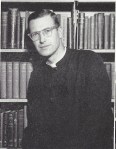
These bloody droppings, references to items in our writing handbook [which I still keep under pain of excommunication!], these codes, symbols, cryptic messages…D31…we would have to consult, we would try to learn well enough before the next theme or essay was due.  It did not always work that way so easily.  Repeatedly I would make those same mistakes/errors…D31…until…the semester ended. 

writing-handbook HANDBOOK USED 1956-1960

New semester: same rules about that pesky semicolon.  But more “sophisticated” examples for us to follow.  For the next year.  And the next.  Then the end of 12th grade.  Done with all the gobbledygook about punctuation and grammar rules.  “All done.  I’m putting that handbook away!”  Then: College.  More writing books, like The Elements of Style.  Never did I expect D31 to follow me, to become such a part of my writing life.  I was impressed with D31, impressed upon by D31:

“Use a semicolon rather than a comma before and, or, nor, but, and for in a compound sentence if–A Either clause is long–say, three or four lines.  B Either clause contains a comma, colon, dash, or parentheses.”    

That’s how I learned it; that’s how I used it; that’s how I taught it.  So here I am, so many years later, out of the classroom, yet still concerned with punctuation and with the special semicolon.

How special?  When I first read not long ago the words “Project Semicolon” in a blog posting, I thought it was another grammar site, part of the Common Core, intending to teach today’s students in elementary and high school grades the sophistication and beauty of using the semicolon.  I became excited that there existed devotion still to punctuation, and especially to my favorite special mark.  What a surprise when I clicked on the link:  http://www.projectsemicolon.org/

PROJECT SEMICOLON is a global non-profit movement dedicated to presenting hope and love for those who are struggling with mental illness, suicide, addiction, and self-injury.  PROJECT SEMICOLON exists to encourage, love, and inspire.  How fitting a sign the “organization” has chosen to symbolize the purpose of the group: “A semicolon is used when an author could’ve ended a sentence but chose not to.  You are the author and the sentence is your life.  Your story is not over.”  The mark is most often seen or displayed as a tattoo, placed behind an ear or on an arm or wrist.  It often represents the wearer’s past (the before), the present (the now), and what will or can be or should be (the future): a “slow-stopper,” not a “full-stopper,” indicating that there is more to come, more to the story. 

So why would someone ever have a tattoo of a punctuation mark, for everyone to see?  Is this like “wearing a heart upon a sleeve”?  I believe so.  To be very open about one’s emotions, not ashamed of the past, being honest; being loyal and truthful in the present, with no secrets; and perhaps never to forget the adventure of life to come, the future.  Openness and honesty is risky business.  It takes courage to admit, to “come out,” as it were.  And the tattoo is symbolic of this.  I like it, endorse it, support it, and support the organization.
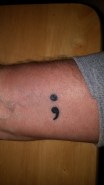
semicolon-arm-tattoo

There it is: I am a marked man.  An impressed man.  My tat indicates a story to be told; or it promises, better, that something lies beneath the embedded ink and the skin–perhaps some “in-depth” meaning.  And that explanation is saved, remains, for another day.

©  James F. O’Neil  2017



Save

BY: JAMES F. O’NEIL

“I’ll Be Home for Christmas” is a Christmas song recorded in 1943 by Bing Crosby, who scored a top ten hit with the song.  Originally written to honor soldiers overseas who longed to be home at Christmastime, “I’ll Be Home for Christmas” has since gone on to become a Christmas standard.  It has a beautiful message of being at home with family during the most wonderful time of the year.  The song has been recorded by Perry Como (1946), Frank Sinatra (1957), Josh Groban (2001), Kelly Clarkson (2011), Pentatonix (2016), and by many other artists.

* * *

“Home Is Where the Heart Is.”

“A House Is Not a Home.”

“Home, Home on the Range”

“A Man’s Home Is His Castle.”

“Home Is Where Your Story Begins.”

“There’s No Place Like Home.”

You Can’t Go Home Again

“Where is your home?”  More than once, I have had to list “former addresses.”  Most of the time for a job application: “for the past ten years.”  Or once when I applied to the Governor a few years ago for a position on a local board: “all previous addresses.”  “Where do you live?”  Most of us have had to do this applying for credit, for some license, or for a gun purchase.  Certainly, those of us who have gone past second grade are so familiar with “Name-Address-Phone Number.”  And we learn quickly, so we’re not lost, or for identification purposes: “Do you know your address?”  Sometimes a post office box–P.O. Box 357–or rural route, R.R. #6, is the only way correspondence can be addressed to a person.  Even some addresses are the name of the place where a person lives:

christmas-biltmore-candlelightBiltmore Mansion at Christmas  Asheville, North Carolina


Recently, my wife and I had an interesting breakfast conversation that began with our considering “downsizing” again, disposing of more of our “stuff.”  We laughed that our present home was 860 sq. ft. downsized from our 1800 sq. ft. home we left six years ago.  Our talking led to a short list of some homes we’ve had in our married life: size and characteristics.  For the next few days, we thought up some questions about our residences.  By later in the week, we had compiled a list of something about each.  We realized each possessed a unique quality.  A house has its physical dimensions, furniture, character and style, and “story” to be told, if but one.  We had more than enough for talking about.

So where to begin?  How to begin?  We found ourselves conversing about kids, and jobs and illnesses, and once or twice humming “Our house is a very, very fine house with two cats in the yard…”  (Even though we once had four cats that never went out.  So many memories of times.)  One question we settled on first, though, was “How did we get there?”  Nothing to do with a U-Haul or moving van.  Was it climate-related?  Job-related?  Did it have to do with our health? The size of the family?  (Our one-bedroom wedding apartment, then into a new apartment a year later, “with a room for the new baby” in our garden apartment in Palatine, Illinois.)

Or was it a move to some place just because we “liked” something bigger, better, newer?  (Our move from a 7th-floor condominium apartment, with its garbage chute and elevators and condo restrictions, but which overlooked the beautiful Caloosahatchee River in Fort Myers, Florida, to a house with a yard and trees and lawn to cut.

moorings-point-fort-myers-1987

The Moorings Point  North Fort Myers, Florida

We tired of high-rise condo living after three years.)  We concluded our exercise with an “Oh,-the-places-you’ll-go” moment

oh-the-places-youll-go novelreaction.com

with an inventory of questions, including a “best overall,” a “worst,” a “best financial decision” to “lousy deal.”  We had answers, and a major event for each separate place, to include “Why did we leave?”  Then came more inquiring, for example, what changes made a place more comfortable or perfectly matched to our lifestyle (the one house we had built)?

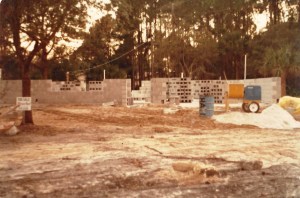
mcmahon-construction-1981

     McMahon Avenue Home Construction  Port Charlotte, Florida

In our fifty-plus years together, we have undertaken two MAJOR migratory events, moving from Chicago to Minnesota (in 1966, for 14 years), and moving from The Land of 10,000 Lakes to the Sunshine State of Florida (in 1980).  In any event, all our house-home-stories begin with our apartment hunting in summer 1963, before our October wedding.  And so it goes from there.

A favorite and important story-within-a-story we relate often is about my driving with a teacher-colleague to his job interview in Minnesota.  He needed a reliable vehicle: our 1964 VW was chosen for the February weekend trip, the back of the car loaded with bags of sand and salt and shovels.  We were prepared for weather events or highway problems.  (There were neither.)

While Lennie was being interviewed on that cold Saturday morning, I was passing time in the Dean’s waiting room, paging through magazines.  A young man entered, then inquired what I was doing.  He heard, then told me to spend some time with him.  He was a departmental chairperson.  I ended up in conversation, just chatting; he presented a program description–and offered me a job.

My friend and I did pros-and-cons for the 300-mile trip home.  I took the job; we moved in July 1966.  He declined his offer; he could not afford the move with his family.  And that was the beginning of that story.

Some persons never move, never leave.  Ever.  (Some of my former students still live in their original bedrooms in their first and only house.)  Others have made annual moves, for whatever reasons.  (“Join the Navy.  See the world!” came out of World War II–and stayed as a popular slogan, and reality.)

join-the-navyHowever, Americans, says the Census Bureau, are staying in the same house longer between moves: from 5 years, on average, in the 1950s and 1960s, to about 8.6 years in 2013.  The U.S. Census Bureau reports that the average American moves 12 times during his or her lifetime.  Since our wedding-apartment in 1963, we have had eighteen (18) addresses and moves.  Surely, we deliberated many times over with questions like those asked during our recent activity.  For each dwelling, we know why we chose it instead of another. 

History of the home (structure moved into town from a farm, original Homestead building site).  How we lived in it. 

sanborn-farm-home-1976

SANBORN FARM HOME   SANBORN, MINNESOTA

How we loved it.  How we made a family.  How the family grew, then decreased (graduations and marriages).  How we responded to forces around the home (weather, landscape).  How the house-home became part of us. 

This analytical time for houses, homes, and addresses has been fulfilling–even despite some hurtful memoriesofatime past or pain that might have arisen.  Overall, though, looking back at our downsizing exercise, we find we are now in a good place and time to look back at ourselves and our lives together–and how “nomadic” we thought we were.  However, “if we had it to do all over again . . .”

* * *

“We can’t separate who we are from where we are.  People are rooted in time and place, so our psychic space is generously seasoned with memories of physical territories.  …  The geography of our past is part of memory.  …  Every human emotion is seeded in the sights, smells, sounds, and tastes of specific environments.”  — Sam Keen, Your Mythic Journey: Finding Meaning in Your Life through Writing and Storytelling (1973, 1989).

 * * *

“Country roads, take me home…” (John Denver); and then “I’ll be home for Christmas.”

©  James F. O’Neil  2016

melby-house-mabel-minn-1975

THE MELBY HOUSE OUR FAVORITE-IST OF THEM ALL  MABEL, MINNESOTA


BY: JAMES F. O’NEIL

“Just lather, that’s all.  You are an executioner and I am only a barber.  Each person has his own place in the scheme of things.  That’s right.  His own place.”  — from the short story  “Just Lather, That’s All” by Hernando Téllez (1908 – 1966)

Possibly the most famous work by Hernando Téllez was his short story Espuma y nada más (“Just Lather, That’s All”), a story widely read amongst American high school Spanish students.  It depicts the inner conflict of a barber who is shaving the captain of a military unit who has tracked, imprisoned, and killed some of the barber’s comrades.  The barber vacillates between thoughts of slitting the captain’s throat with his razor or giving him the expert shave for which he is known.  In the end, the barber decides he does not want to be stained in blood, but only in soap lather or “espuma y nada más.”  As the captain leaves, he reveals that he heard the barber would kill him; his visit was to see if this was true.  [Summary by Wikipedia]

I first heard about this story when I was teaching 10th grade English in Florida.  I knew nothing of it except it was a film available through the A-V Department.  “Anything I could use to keep them entertained,” I said to myself one day while I was shaving.  The 10th graders and I were having some difficulties with literature “appreciation.”  So I ordered the film.  They and I were mesmerized.  What a great film–and I had to find and read the story.  I did–again and again.

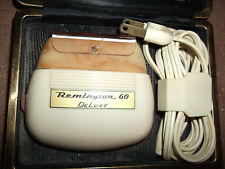
Yet aside from the literary effects of the story or the history of my classroom use of the film, the memories that audio-visual production (real film with projector!) conjured up took me back to my beginning experiences with face hair and shaving, images of laughter and love affairs with razors and shaving; remembrances of questionable pedagogical actions.  Gillette, single edge, blue blades, double edge, Mach 3 Turbo; Merkur, Wilkinson.  Words, words, words.  And Remington, not shotgun, but a 1959 Electric Roll-a Matic electric razor.

As men get older, they don’t shave as often.  If they do, it’s out of habit, not of necessity.  “Don’t hafta go ta work.”  Or when they look shaggy, or out of self-esteem–or, perhaps, guilt.  Or, possibly, old military-like discipline.  I’m one of those who don’t shave much anymore, certainly not every day, as before.  “In the day,” I used to look forward to Saturdays, for a day off–especially from shaving.  Yet how excited and eager we were “once upon a time” to be able to shave like our dads, brothers, or uncles.  Then.

Today, shaving and all it entails is such big-money business, in stores and in advertising.  Reggie Perrin was the consummate Razor Man, from reggie-perrin-bbc-martin-clunesBBC-UK: from the company always trying to out-blade the multi-blade blade.  Reggie was British comedy.  More important, who would ever have thought of a sit-com about a razor blade engineer-salesman, and his company’s Quest for the Perfect Razor Blade.  The elusive “Perfect Razor Blade”–or even The Perfect Shave, like the search for The Holy Grail or the secret of alchemy.  We men (mostly) continue our Quest, as the mythics tell us “from the beginning” (ab initio) until… 

Which brings me up to my story.  (My “beginning” early memories of collecting “stuff” includes digging through garbage in the neighborhood alleys of Chicago to find used razor blades.  Whatever possessed me to do such a thing?  [I had quite a collection of Gillette Blue Blades.  I related some of this story of collection/addiction previously: https://memoriesofatime.com/2013/10/25/confessions-of-an-addict-reflections-on-collecting/].)

During my puberty and adolescence, peach fuzz came, sprouted in the pores on my face where zits did not thrive.  As I aged, I found razor blades not kind to my bumpy face.  My Uncle Bill gave me the Remington electric in 1959 that I used through my senior year of high school, then took to college. 

remington-electric-razor-my-first

JIMMY O’NEIL’S FIRST RAZOR

(Any memory images of college shaving are non-existent, more than a blur.)  My Electric Days have included Norelco products and mini-portables–and Braun Mobile units, battery-powered, for quick touch up works, at home or office.  These have been delightful.  Thomas Edison notwithstanding, I always have come back to the lather and the razor.  I have been on the receiving end of the lather and the blade: in college, a classmate who did haircutting offered to give me a shave.  My first and last with a straight edge, though older barbers still do neck trims with straight razors, and around the ears. 

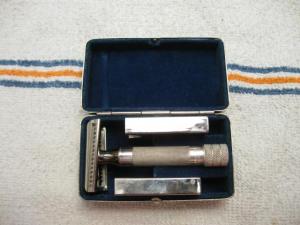
For our first Christmas after our wedding, my new bride learned–perhaps from hints I had made, or from her reading–that The Perfect Shave Tool was a Merkur (German) razor wedded to a Wilkinson Sword Blade blade (made in England).  These, with a genuine badger bristle brush and a bar of Williams Shaving Soap were my gifts under the tree in 1963. 

merkur-razor-by-toecutter1967-photobucket

MERKUR RAZOR (by photobucket)

Brushes later, shaving mugs later, then Burma Shave canned lather, or Barbasol Thick and Rich (with aloe, of course)–to say nothing of a cup of Old Spice in a mug–have been used, tried, sampled (gels never were a success), and discarded.  I am a fickle shaver with lather, even trying shaving using messy (non-foaming) greasy-like cream or Noxzema.  Messy application, messy shaving, messy clean up.  (But, incidentally, a clean shave.  In spite of that, not worth the mess.)

In the past years, I have tried different razors and a combination of blades.  No Reggie Perrin blades (six or seven?), but single, twin, triple, with Atra razors, various Gillette models, the Merkur, and the Mach3 Turbo (current).  Harry’s in New York sent me a trial sample kit.  Harry’s is becoming popular, with good products and mailing.  But I just could not maneuver the blade under my nose…and around my nostril…  So No to their beautiful razor and handle and shaving cream and Blade-of-the-Month Club.  And I also do not need any Gillette Fusion!

So this story ends.  Not quite.  That film for the 10th graders.  Whatever possessed me (another possession) to bring brush and soap and razor to class and ask for a volunteer.  Was I sure of what I was doing?  (Did I care?)  I was certain that many of the peach-fuzzed boys had not yet shaved; many of the girls (I assumed then) had never seen any boy shave, or watched anyone shave, for real or in the movies (and certainly not as done in the Lather film).  Up stands Jerry Cohee, and comes to the front of the room.  “Gather round, kids,” I might have said, putting a towel around him.  I had the water and the soap ready.  In the cup, I “began to stir with the brush…and whipped up the soap” and just lathered.  I took my razor, and off they came, the hairs on his chinny, chin, chin.  Voila!  Done!  “Next?”  No Next.  Time for the bell. 

That was the end.  The last time I showed that film.  The last time I demonstrated expert shaving in the classroom.  The last time I taught 10th grade, and high school classes (moving on into a community college setting).  After all, though, it was one of those memoriesofatime never to be dismissed as trivial or insignificant.  So much surrounds it making it a great story.  And that’s it.

Telling stories about shaving isn’t as glamorous as writing about food in the movies, diets, exercise plans, building muscles in a gym, or travels to Paris, or babies’ first walkings–perhaps.  But I enjoy telling my stories about shaving.  At the same time, I have been thankful, at times, that I did not have to worry about cutting or nicking an ankle or taking a chunk out of my knee or calf, or messing with a razor in a bathtub.  I just need some hot water, a sink, a good razor and blade, and Just Lather, that’s all.


© James F. O’Neil  2016

shaving-bowl-and-colonel-shaving-brush

SHAVING BOWL AND BRUSH


“What we call the beginning is often the end / And to make an end is to make a beginning.  / The end is where we start from.”  –T. S. Eliot

“The past is never dead.  In fact it’s not even past.”  –William Faulkner

“…these statements express the realization that we can never access the body of the past, the physical experience that people now dead once felt in the very fiber of their bodies.  But we can also nevernot want to access that past, to think, imagine, and write our way back to an imagination of what those bodies must have felt [Walt Whitman’s referring to the Civil War dead].  Often our own past feels this way, too–we recall feeling pain or horror or terror, but it is difficult to ‘get it in the books,’  to write it so that others can experience in their bodies what we felt in ours (or so that we can once again feel what we know we once felt).  Writers often experience most keenly this notion that ‘the past is never dead’ and that we are always starting at the end.’”  [IWP © The University of Iowa 2012-2016]

MEMORIESOFATIME  are often written about past events which caused the writer to feel intensely and deeply and physically, then described in such a way emphasizing what the body felt–words being used to bring a dead past alive.

“Memories are the key not to the past, but to the future.”  –Corrie Ten Boom

“Fear not for the future, weep not for the past.”  –Percy Bysshe Shelley

“There is not past, no future; everything flows in an eternal present.”  ….  “Hold to the now, the here, through which all future plunges to the past.” –James Joyce

“We can’t let the past be forgotten.”  –George Takei

“The destruction of the past is perhaps the greatest of all crimes.”  –Simone Weil

© James F. O’Neil 2016