Archive

WRITING/BLOGGING

“Once upon a time…” Sam Keen told and repeated the story of the death of his father.  Keen’s world was shattered, he writes, leading to his finding “a new myth by which to live.”  He realized that he “had a repertoire of stories within my autobiography that gave me satisfying personal answers about the meaning of my life.”

“Everyone has a fascinating story to tell, an autobiographical myth.  And when we tell our stories to one another, we, at one and the same time, find the meaning of our lives and are healed from our isolation and loneliness.”

“We don’t know who we are until we hear ourselves speaking the drama of our lives to someone we trust to listen with an open mind and heart.”

[“In a strict sense myth refers to ‘an intricate set of interlocking stories, rituals, rites, and customs that inform and give the pivotal sense of meaning and direction to a person, family, community, or culture.’”]

“The organizing myth of any culture functions in ways that may be either creative or destructive, healthful or pathological.  By providing a world picture and a set of stories that explain why things are as they are, it creates consensus, sanctifies the social order, and gives the individual an authorized map of the path of life.  A myth creates the plotline that organizes the diverse experiences of a person or community into a single story.”

“Every family, like a miniculture, also has an elaborate system of stories and rituals that differentiate it from other families.  …  And within the family each member’s place is defined by a series of stories.”

“Each person is a repository of stories.  …  We gain the full dignity and power of our persons only when we create a narrative account of our lives, dramatize our existence, and forge a coherent personal myth that combines elements of our cultural myth and family myth with unique stories that come from our experience.”

[Santayana: “Those who do not remember history are condemned to repeat it.”]

“To remain vibrant throughout a lifetime we must always be inventing ourselves, weaving new themes into our life-narratives, remembering our past, re-visioning our future, reauthorizing the myth by which we live.”

TO BE A PERSON IS TO HAVE A STORY TO TELL.  WE BECOME GROUNDED IN THE PRESENT WHEN WE COLOR IN THE OUTLINES OF THE PAST AND THE FUTURE.”  –Sam Keen and Anne Valley-Fox, Your Mythic Journey (1973; 1989)

So, “Tell me a story, pleeeeze…”

interrobang

“To work together, words need help.  They need connecting words, and they need punctuation.  All methods of punctuation point the way for the reader, gathering, linking, separating, and emphasizing what truly matters.  These marks are more than squiggles on a page.  They are the ligaments of meaning and purpose.”  –Roy Peter Clark, The Glamour of Grammar, 2010.

At one English conference I attended, long into my teaching career, I listened to a speaker lecture about grammar, and teaching punctuation.  I heard him say clearly that the semicolon was such a sophisticated piece of punctuation that it should not be used until students were in 12th grade!  Sophistication, and more.

semicolons

It differs from everything else–the comma, colon, period–yet incorporates each with a semblance of “uniqueness”: slow…explain…stop.  All at the same time.  But it’s a slow-stopper, not a full-stopper.  A breather.  (“Take a breath,” it says.)  It is just so useful, so delightful, so important, and so special.  Not to be easily misused.  Roy Peter Clark describes it as an object that connects and separates at the same time, like a swinging gate, even: “a barrier that forces separation but invites you to pass through to the other side” (Glamour of Grammar).  It is so special.

But it wasn’t always so special then as it is to me now.  Memories of a time: My latest high school composition returned to me.  The paper had red-pen bleedings…D31…here and there, with some comments written in the margins, from my teacher Father William Flaherty.  william-flaherty-ma-stl
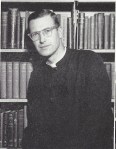
These bloody droppings, references to items in our writing handbook [which I still keep under pain of excommunication!], these codes, symbols, cryptic messages…D31…we would have to consult, we would try to learn well enough before the next theme or essay was due.  It did not always work that way so easily.  Repeatedly I would make those same mistakes/errors…D31…until…the semester ended. 

writing-handbook HANDBOOK USED 1956-1960

New semester: same rules about that pesky semicolon.  But more “sophisticated” examples for us to follow.  For the next year.  And the next.  Then the end of 12th grade.  Done with all the gobbledygook about punctuation and grammar rules.  “All done.  I’m putting that handbook away!”  Then: College.  More writing books, like The Elements of Style.  Never did I expect D31 to follow me, to become such a part of my writing life.  I was impressed with D31, impressed upon by D31:

“Use a semicolon rather than a comma before and, or, nor, but, and for in a compound sentence if–A Either clause is long–say, three or four lines.  B Either clause contains a comma, colon, dash, or parentheses.”    

That’s how I learned it; that’s how I used it; that’s how I taught it.  So here I am, so many years later, out of the classroom, yet still concerned with punctuation and with the special semicolon.

How special?  When I first read not long ago the words “Project Semicolon” in a blog posting, I thought it was another grammar site, part of the Common Core, intending to teach today’s students in elementary and high school grades the sophistication and beauty of using the semicolon.  I became excited that there existed devotion still to punctuation, and especially to my favorite special mark.  What a surprise when I clicked on the link:  http://www.projectsemicolon.org/

PROJECT SEMICOLON is a global non-profit movement dedicated to presenting hope and love for those who are struggling with mental illness, suicide, addiction, and self-injury.  PROJECT SEMICOLON exists to encourage, love, and inspire.  How fitting a sign the “organization” has chosen to symbolize the purpose of the group: “A semicolon is used when an author could’ve ended a sentence but chose not to.  You are the author and the sentence is your life.  Your story is not over.”  The mark is most often seen or displayed as a tattoo, placed behind an ear or on an arm or wrist.  It often represents the wearer’s past (the before), the present (the now), and what will or can be or should be (the future): a “slow-stopper,” not a “full-stopper,” indicating that there is more to come, more to the story. 

So why would someone ever have a tattoo of a punctuation mark, for everyone to see?  Is this like “wearing a heart upon a sleeve”?  I believe so.  To be very open about one’s emotions, not ashamed of the past, being honest; being loyal and truthful in the present, with no secrets; and perhaps never to forget the adventure of life to come, the future.  Openness and honesty is risky business.  It takes courage to admit, to “come out,” as it were.  And the tattoo is symbolic of this.  I like it, endorse it, support it, and support the organization.
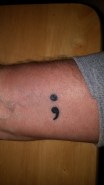
semicolon-arm-tattoo

There it is: I am a marked man.  An impressed man.  My tat indicates a story to be told; or it promises, better, that something lies beneath the embedded ink and the skin–perhaps some “in-depth” meaning.  And that explanation is saved, remains, for another day.

©  James F. O’Neil  2017


Save

“What we call the beginning is often the end / And to make an end is to make a beginning.  / The end is where we start from.”  –T. S. Eliot

“The past is never dead.  In fact it’s not even past.”  –William Faulkner

“…these statements express the realization that we can never access the body of the past, the physical experience that people now dead once felt in the very fiber of their bodies.  But we can also nevernot want to access that past, to think, imagine, and write our way back to an imagination of what those bodies must have felt [Walt Whitman’s referring to the Civil War dead].  Often our own past feels this way, too–we recall feeling pain or horror or terror, but it is difficult to ‘get it in the books,’  to write it so that others can experience in their bodies what we felt in ours (or so that we can once again feel what we know we once felt).  Writers often experience most keenly this notion that ‘the past is never dead’ and that we are always starting at the end.’”  [IWP © The University of Iowa 2012-2016]

MEMORIESOFATIME  are often written about past events which caused the writer to feel intensely and deeply and physically, then described in such a way emphasizing what the body felt–words being used to bring a dead past alive.

“Memories are the key not to the past, but to the future.”  –Corrie Ten Boom

“Fear not for the future, weep not for the past.”  –Percy Bysshe Shelley

“There is not past, no future; everything flows in an eternal present.”  ….  “Hold to the now, the here, through which all future plunges to the past.” –James Joyce

“We can’t let the past be forgotten.”  –George Takei

“The destruction of the past is perhaps the greatest of all crimes.”  –Simone Weil

© James F. O’Neil 2016 

“LIFE IS ONE BIG TRANSITION.”—  Willie Stargell

TRANSITIONAL

 AGAIN   ACCORDINGLY   AFTER ALL   ALSO   AS A RESULT   AND   CONSEQUENTLY   ALTHOUGH THIS MAY BE TRUE   BESIDES   FOR THIS REASON

AT THE SAME TIME   EQUALLY IMPORTANT   HENCE   I ADMIT

FINALLY   OF COURSE   IN SHORT   NATURALLY   SO   THEN

FIRST, SECOND, ETC.   FURTHER   THUS   FURTHERMORE   THEREFORE

IN ADDITION   FINALLY   LAST   TRULY   IN BRIEF   LIKEWISE   IN CONCLUSION

MOREOVER   IN SHORT   NEXT   FOR THIS REASON     IN SUMMARY

NOR   TO THIS END   LAST

OR   WITH THIS PURPOSE   LASTLY

SIMILARLY   THUS    IN ANY EVENT   TO CONCLUDE

AFTER ALL   IN FACT   TO SUM UP   ALTHOUGH   IN PARTICULAR   TO SUMMARIZE

AT THE SAME TIME   INDEED   ON THE WHOLE

BUT   MORE IMPORTANT   CONVERSELY   MOST IMPORTANT

FOR ALL THAT   PARTICULARLY   AFTER A WHILE

HOWEVER   SPECIFICALLY   AFTERWARD

IN CONTRAST    AFTERWARDS   IN SPITE OF THAT    FOR EXAMPLE   AT LAG

NEVERTHELESS   FOR INSTANCE        AT LENGTH

NONETHELESS   IN PARTICULAR       IMMEDIATELY

NOTWITHSTANDING     IN THIS MANNER      IN THE MEANTIME

ON THE CONTRARY     NAMELY   LATELY

ON THE OTHER HAND   THAT IS   LATER   STILL   TO ILLUSTRATE   MEANWHILE

YET   PRESENTLY   SHORTLY   IN OTHER WORDS   SINCE

IN THE SAME WAY   THAT IS   SOON   LIKEWISE   TO PUT IT ANOTHER WAY   TEMPORARILY

SIMILARLY   THEN   THEREAFTER   THEREUPON   UNTIL   WHILE

Question_mark_(black_on_white)